
Breaking News
One of America’s most dangerous volcanoes will soon power homes

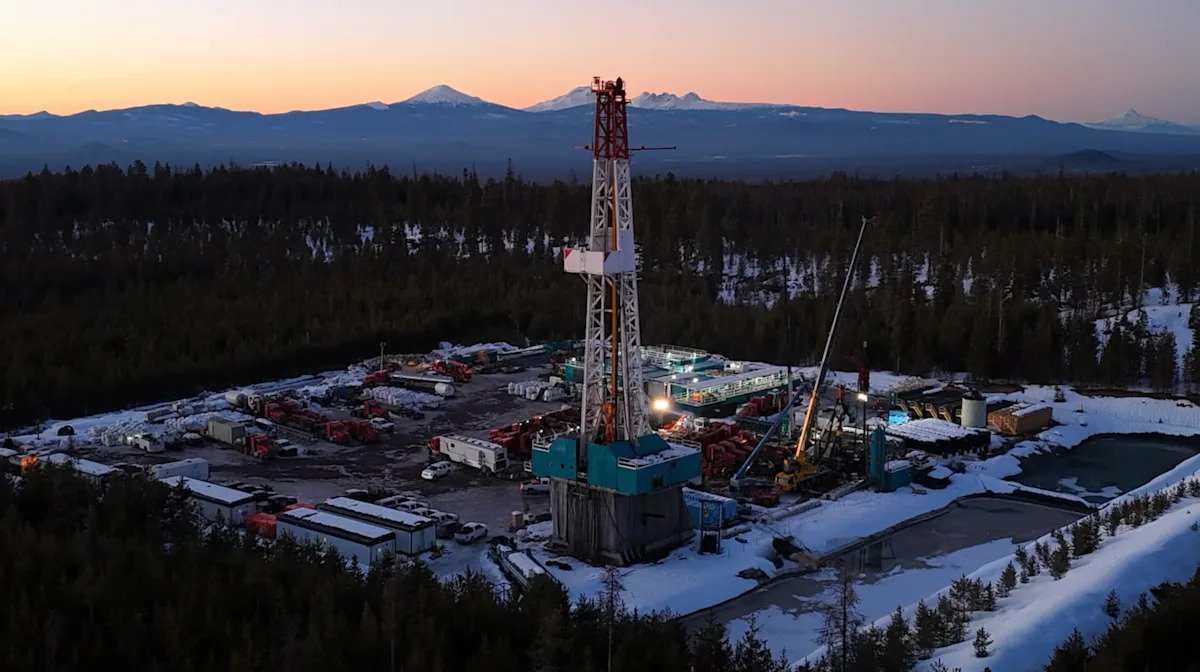
On the slopes of an Oregon volcano, engineers are building the hottest geothermal power plant on Earth.
The plant will tap into the infernal energy of Newberry Volcano, “one of the largest and most hazardous active volcanoes in the United States,” according to the U.S. Geological Survey. It has already reached temperatures of 629 degrees Fahrenheit, making it one of the hottest geothermal sites in the world, and next year it will start selling electricity to nearby homes and businesses.
Subscribe to The Post Most newsletter for the most important and interesting stories from The Washington Post.
But the start-up behind the project, Mazama Energy, wants to crank the temperature even higher – north of 750 degrees – and become the first to make electricity from what industry insiders call “superhot rock.”
Enthusiasts say that could usher in a new era of geothermal power, transforming the always-on clean energy source from a minor player to a major force in the world’s electricity systems.
“Geothermal has been mostly inconsequential,” said Vinod Khosla, a venture capitalist and one of Mazama Energy’s biggest financial backers. “To do consequential geothermal that matters at the scale of tens or hundreds of gigawatts for the country, and many times that globally, you really need to solve these high temperatures.”
Today, geothermal produces less than 1 percent of the world’s electricity. But tapping into superhot rock, along with other technological advances, could boost that share to 8 percent by 2050, according to the International Energy Agency (IEA). Geothermal using superhot temperatures could theoretically generate 150 times more electricity than the world uses, according to the IEA.
“We believe this is the most direct path to driving down the cost of geothermal and making it possible across the globe,” said Terra Rogers, program director for superhot rock geothermal at the Clean Air Task Force, an environmentalist think tank. “The [technological] gaps are within reason. These are engineering iterations, not breakthroughs.”
– – –
A new kind of geothermal
The Newberry Volcano project combines two big trends that could make geothermal energy cheaper and more widely available.
First, Mazama Energy is bringing its own water to the volcano, using a method called “enhanced geothermal energy.”
Historically, people have been able to use geothermal energy only in rare locations that have hot rocks and underground water, creating natural pockets of steam. That limits conventional geothermal to a handful of hot spots in countries such as Japan, Iceland, Kenya and the American West.
But over the past few decades, pioneering projects have started to make energy from hot dry rocks by cracking the stone and pumping in water to make steam, borrowing fracking techniques developed by the oil and gas industry. The geothermal start-up Fervo Energy and the U.S. Department of Energy have built pilot projects in Nevada and Utah, and international researchers have demonstrated the technology in France, Germany, Switzerland and Japan, among others.
Pumping water into rock fractures risks causing earthquakes – much like injecting wastewater from fracking. A Swiss enhanced geothermal experiment was shut down after setting off a 3.4 magnitude quake in 2006. Sensors at the Newberry site recorded five tremors in the past six months, with the biggest reaching magnitude 2.5 on July 24.
Scientists say earthquakes will always be a risk, but it can be managed with good monitoring and engineering. The Energy Department says water pollution risks are low because geothermal plants recirculate the same water in sealed wells, passing through reservoirs much deeper than most groundwater.
The Newberry project also taps into hotter rock than any previous enhanced geothermal project. But even Newberry’s 629 degrees fall short of the superhot threshold of 705 degrees or above. At that temperature, and under a lot of pressure, water becomes “supercritical” and starts acting like something between a liquid and a gas.
Supercritical water holds lots of heat like a liquid, but it flows with the ease of a gas – combining the best of both worlds for generating electricity.
“The [liquid] water is Clark Kent when it goes down,” said Sriram Vasantharajan, Mazama’s CEO. “Then it gets heated, and when it comes up, it’s Superman.”
A superhot geothermal well can produce five to 10 times more energy than a well at typical temperatures, which hover around 400 degrees Fahrenheit. That means geothermal operators don’t have to drill as many multimillion-dollar holes in the ground, bringing down costs.
Eventually, superhot rock geothermal energy could be about as cheap as natural gas or solar – without the pollution of fossil fuels or the variability of renewables, according to economic modeling from the Clean Air Task Force.
Vasantharajan said Mazama will dig new wells to reach temperatures above 750 degrees next year. Alongside an active volcano, the company expects to hit that temperature less than three miles beneath the surface. But elsewhere, geothermal developers might have to dig as deep as 12 miles.
– – –
Superhot challenges
Drilling into 750-degree rock presents some devilish challenges. Conventional geothermal plants can use off-the-shelf gear developed by the oil and gas industry, which can stand up to lower temperatures. But in superhot rock, standard drills die as their electronic components fail.
“To put it very technically, they get fried,” said Vasantharajan.
Mazama engineers cooled their drilling rigs by pumping in a constant stream of liquid carbon dioxide. That allowed them to burrow two miles into the flank of the volcano to find 629-degree rock earlier this year.
Other experimental wells have hit even higher temperatures, but none has survived for long. Drilling experiments in Iceland and Hawaii were called off after they unexpectedly hit magma, which broke their drill bits. Wells in Japan and Italy reached rock hotter than 900 degrees – approaching the region of Earth’s crust where rigid rock starts behaving more like putty – but were abandoned after facing problems with their drilling equipment and cement casings.
So far, Mazama says its well – which runs much cooler than those record-setting experiments – has remained stable. But experts say challenges will pile up as the company drills into hotter rock and operates its wells for years on end, exposing the cement and steel casings to punishing up-and-down cycles of temperature and pressure.
“With something like this, there’s a huge amount of problems that can happen,” said Kolbrún Ragna Ragnarsdóttir, who leads work on geothermal energy at the Global Geothermal Alliance, a nonprofit under the International Renewable Energy Agency, which represents 169 countries.
But the potential rewards loom larger than the fiendish challenges. Mazama plans to generate 15 megawatts of electricity on the western flank of Newberry Volcano next year, eventually ramping up to 200 megawatts – enough to power a big data center or a small city. Vasantharajan said the Newberry site could theoretically generate up to five gigawatts of power, roughly two-thirds of Oregon’s average electric output.
Successful projects “motivate other players to get into the market,” said Annick Adjei, senior research analyst for geothermal at Wood Mackenzie, an energy consultancy. “I think there will be a ripple effect, and we’ll start seeing more companies get the financial support to kick off their own pilots.”
Related Content
Since Khashoggi killing, here’s how U.S.-Saudi relations have changed
Ken Burns says Americans have been fighting each other since the beginning
So long, penny. The Treasury has officially stopped producing one-cent coins.