
President
Iran-backed Houthi rebels clash with Yemeni government

Clashes between Iran-backed Houthi rebels and government forces in Yemen raged overnight and into Thursday, raising fears that the country’s civil war could reignite and open another front in the Middle East.
Here’s a look at the latest developments in the Iran war and the wider Middle East. Full coverage can be found here.
Yemeni soldier killed in clashes with Houthis
At least one government soldier was killed and another critically wounded in clashes with the Houthis in the mountainous province of Taiz, Yemeni military officials told The Associated Press.
The fighting came as part of a spate of recent Houthi attacks on government-held areas across the country. Dozens of government troops have been killed since last week, the Yemeni military said.
The Houthis also said they launched another drone attack on an Aramco oil refinery in Saudi Arabia. Saudi officials did not immediately comment on the reported attack in the city of Jazan. Last weekend, the Houthis fired drones at the refinery, where the Saudi Energy Ministry reported a fire but no casualties.
Last month, the Houthis announced a blockade of Saudi shipping, threatening another key trade route in the region.
US carrier heads toward Middle East after issues reported on long-deployed USS Lincoln
The Pacific-based aircraft carrier USS George Washington has begun heading toward the Middle East as reports have emerged of mental health and supply issues aboard the long-deployed USS Abraham Lincoln.
The Lincoln has been supporting the U.S. war against Iran, and its deployment has included a record-setting uninterrupted time at sea of more than 260 days.
Defense Secretary Pete Hegseth told reporters on Thursday that reports of trouble on the carrier were “completely misrepresented.”
Speaking during a trip to Panama, he said the U.S. military could maintain the blockade of Iranian ports indefinitely, “because we’ll rotate ships in and out, as we have and we’ll continue to.”
The USS George Washington left port in Da Nang, Vietnam, last week, a Navy statement said. The carrier, along with a cruiser and a destroyer, have since been spotted crossing the Singapore Strait.
A Navy official, who spoke on the condition of anonymity to detail sensitive ship details, confirmed that the Washington was in the Strait of Malacca, which links the Pacific and Indian oceans and puts the carrier on a course to head into the Indian Ocean. The Wall Street Journal reported earlier that the Washington would replace the Lincoln as one of the two aircraft carriers now stationed in the Middle East.
The move would leave the waters of the Pacific without a U.S. carrier presence for an unknown period of time.
— Konstantin Toropin in Washington
Peace laureate calls for UN pressure to resolve Yemen conflict
Hans Grundberg, the U.N. special envoy for Yemen, told the U.N. Security Council in a video briefing Thursday that Yemen is at greater risk of returning to large-scale conflict than at any time since a 2022 truce paused the fighting.
Yemen faces “catastrophe” from rising hunger and from health services crumbling amid the fighting, said U.N. humanitarian chief Tom Fletcher. He said 6 million people in Yemen face emergency levels of food insecurity bordering on famine, “the highest number globally.”
Yemeni Nobel peace laureate Tawakkol Karman told reporters outside the chamber that Houthi rebels bear the primary responsibility for the “collapse of the state” in her home country.
But the human rights campaigner also blamed Iran for backing the Houthis, Saudi Arabia for its intervention on behalf of the government ousted by the Houthis, the United Arab Emirates for its involvement in the conflict and the international community for its failure to do enough to protect civilians.
Karman was invited to brief the U.N. Security Council as an independent civil society voice on Yemen, but was blocked from speaking because of “strong opposition,” Danish Deputy Ambassador Sandra Jensen Landi said. Instead, Karman spoke to reporters outside the council chamber.
Iran and Oman working to clean oil spills off their coasts
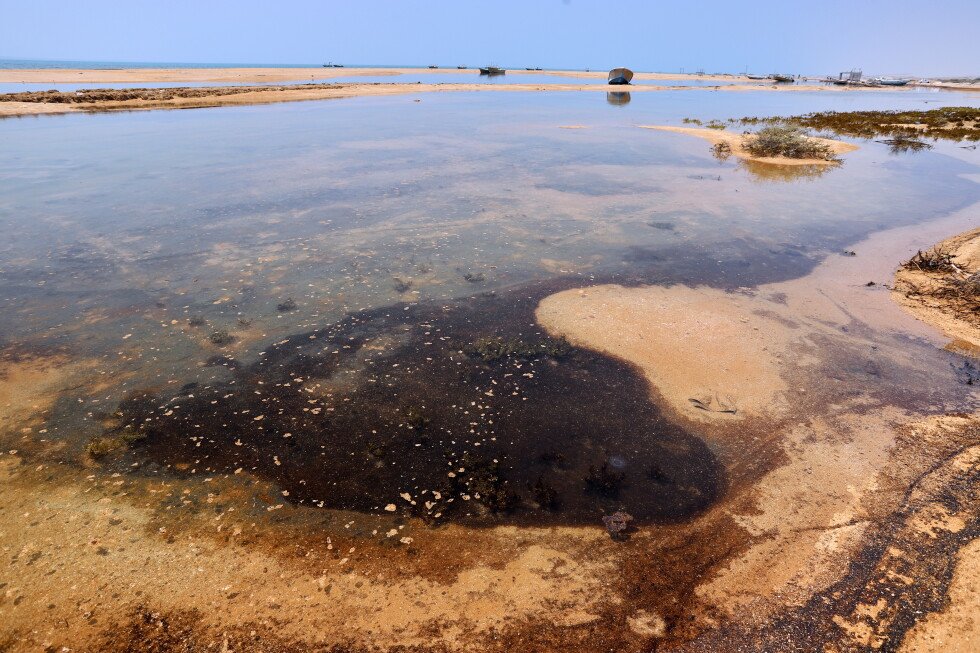
Oil spills spreading off the coasts of Iran and Oman are raising concerns about environmental damage as oil shipments have come under fire in the Iran war.
Iran said Thursday it’s working to clean up an oil spill off Qeshm Island in the Strait of Hormuz. Images distributed by Iran’s semiofficial news agency ISNA showed oil fouling the island’s beaches.
While Iran hasn’t said what caused the spill, the firm TankerTrackers.com says it appears to have started with an Iranian attack on a bulk carrier off Oman. Iran has repeatedly attacked shipping in the strait since the U.S. and Israel attacked Iran on Feb. 28.
Oman is responding to another spill in the Arabian Sea, coming from a tanker grounded off its southern coast. The tanker Caroline Bezengi — a sanctioned vessel believed to be part of Russia’s “shadow fleet” — has been grounded since reporting an explosion in June. No party has claimed responsibility and the cause is unknown.
A British maritime risk and response company said Thursday it has been hired to salvage the tanker and stop the oil leak off Oman. Oil from the ship has been spreading for weeks, reaching shores hundreds of kilometers (miles) north of the vessel.
JD Vance says Iran war will end with US in stronger position
Vice President JD Vance appeared to be lowering expectations for the Strait of Hormuz to return to the way it was before the war. He predicted in an interview on Fox News Channel that the war will end with the U.S. in a stronger position, with Iran not having a nuclear weapon, and with the Strait of Hormuz “returned to a place where oil and gas prices are stable for the American people.”
He did not say anything about the strait being open and toll-free for transiting ships, as he had in the past.
Vance’s comments also seemed to suggest that the administration was more acutely focused on the economic impact of the war than the original aims of the war itself.
“That’s goal number one: keep oil and gas cheap for Americans all over our country,” he said.
The second goal, according to Vance, is to ensure that Iran will never get a nuclear weapon.
Kushner will head to Middle East for talks on Gaza
President Donald Trump’s son-in-law and negotiator Jared Kushner will travel to the Middle East next week to try to advance plans for an end to the conflict in Gaza after a deal recently announced by the Trump administration ran into Israeli opposition.
An official with the Board of Peace, the body Trump established to oversee the fragile ceasefire in the Israel-Hamas war, said Kushner, board high representative Nickolay Mladenov, and executive board member and former British Prime Minister Tony Blair would arrive in Israel on Sunday.
The group will then travel to Cairo, where meetings of a Palestinian technocratic group set to assume control of Gaza under a U.S.-brokered ceasefire deal have been taking place for the past several months, said the official, who spoke on condition of anonymity because planning for details of the trip has not yet been finalized,
The trip was reported earlier by Axios.
— Matthew Lee in Washington
___
Click here for full AP coverage on developments in the West Bank.