
Lifestyle
I asked Ruby Bridges and other civil rights icons to walk my Fashion Week runway — because Black history belongs front and center

Ruby Bridges, the Black schoolgirl who integrated a formerly whites-only school in the South. Cecil Williams, who was famously photographed drinking from a whites-only fountain. John Carlos and Tommie Smith, the athletes who raised their fists during the U.S. national anthem at the 1968 Mexico City Olympics. These faces of the civil rights movement are familiar to anyone who’s read a history book. Last week, they popped up somewhere unexpected: a New York City runway.
And it’s all due to a college basketball star turned fashion founder, Lanny Smith, who featured the iconic figures — alongside the children of Martin Luther King Jr. and Malcolm X — for Actively Black’s spring/summer show on Sept. 12. But growing up, Smith never saw a future in fashion; his only dream was to play in the NBA. “I had no plan B. That was my plan A, B and C,” he tells Yahoo. So when the Houston-born hoopster was signed to the Sacramento Kings in 2009, it seemed like everything was falling into place. And then 33 days after finalizing the contract, he was hit with a career-ending injury.
“I went through depression. I went through an identity crisis, the fear of not knowing what I was going to do with the rest of my life,” says Smith, now 40 years old. “I still have moments where that what-if creeps into my mind, and it’s a painful what-if. But with the support of my mother and my family, I quickly transitioned.”
He created a sports apparel brand called Active Faith — a Christian faith-based clothing line launched in 2010 with the help of basketball players Anthony Tolliver and Stephen Curry. But a number of catalysts, including the success of the film Black Panther and the resurgence of the Black Lives Matter movement, got Smith thinking about starting another brand centered around his identity as a Black man and giving back to the community. That brand became Actively Black.
Speaking to Yahoo’s Kerry Justich, Smith shares in his own words why he launched the athleisure brand in 2020 — and why centering his show on civil rights icons who are very much still living is an important reminder that history isn’t as distant as we think.
The movie Black Panther came out in 2018. Seeing that Black superhero on the screen — a superhero with skin like mine, hair like mine — and seeing the way the diaspora and Black people really gravitated toward this movie and the way it made us feel … I remember saying to myself, I’m going to create a brand that makes my people feel the way that Black Panther made us feel. Put the idea on the shelf again and fast-forward to 2020.
After the murder of George Floyd, Breonna Taylor and Ahmaud Arbery, I saw a lot of brands make a lot of, what felt to me, performative declarations about what they were going to do to help the Black community. It felt like it was just messaging that was part of their marketing strategy. I felt like it was disingenuous, and I felt like it was really a slap in the face that so many brands were making performative declarations.
But instead of us asking them to do what we felt they should be doing, instead of asking for a seat at the table, [I thought], Let’s just build our own table. … If we can create this brand that celebrates and champions Black culture that can also scale, we can give back to our community and uplift our community in meaningful ways that are not empty pledges and performative promises.
A purpose-driven brand
Everything we do points back to uplifting our people and giving back. We’ve held Black mental health events for the community. We’ve done fitness events for the community. We donate to Black Mamas Matter, an organization that is fighting against the abysmal Black maternal mortality rate, where Black women are dying at three times the rate of anyone else in this country during pregnancy. We donate to Black Kids Code, which is helping young Black kids get access to STEM and coding. There are so many ways that we give back to the community, and that is at the heart of everything that we do. But we’ve also just been blessed with incredible collaborations and partnerships.
We ended up getting the official collaboration for Wakanda Forever, the sequel to Black Panther, which was a full-circle moment for me. That really put us on the map and opened people’s eyes to what Actively Black was. That opened the door to Lonnie Ali, Muhammad Ali’s wife, finding out about us and wanting to do something with us. Now we have a Muhammad Ali collaboration, a Bob Marley collaboration, a collaboration with the Tupac estate, Malcolm X’s estate, Martin Luther King’s estate, etc.
So as we have been creating these collections that honor these icons in Black culture and Black history, we’ve been able to kind of develop relationships with their family and the people who represent their estates. The respectful way that we have gone about doing it — making sure that they approve whatever design, whatever product goes out, making sure that we’re paying them the royalties on the revenue that comes in from that — there’s a real relationship that has been formed.
Fast-forward to us putting on this show and me having the concept of wanting to put living Black history on display, I was able to reach out to these different entities, these different estates and have those conversations. I’m just so humbled that they trusted my vision and agreed to be there for this.
Putting living Black history on display
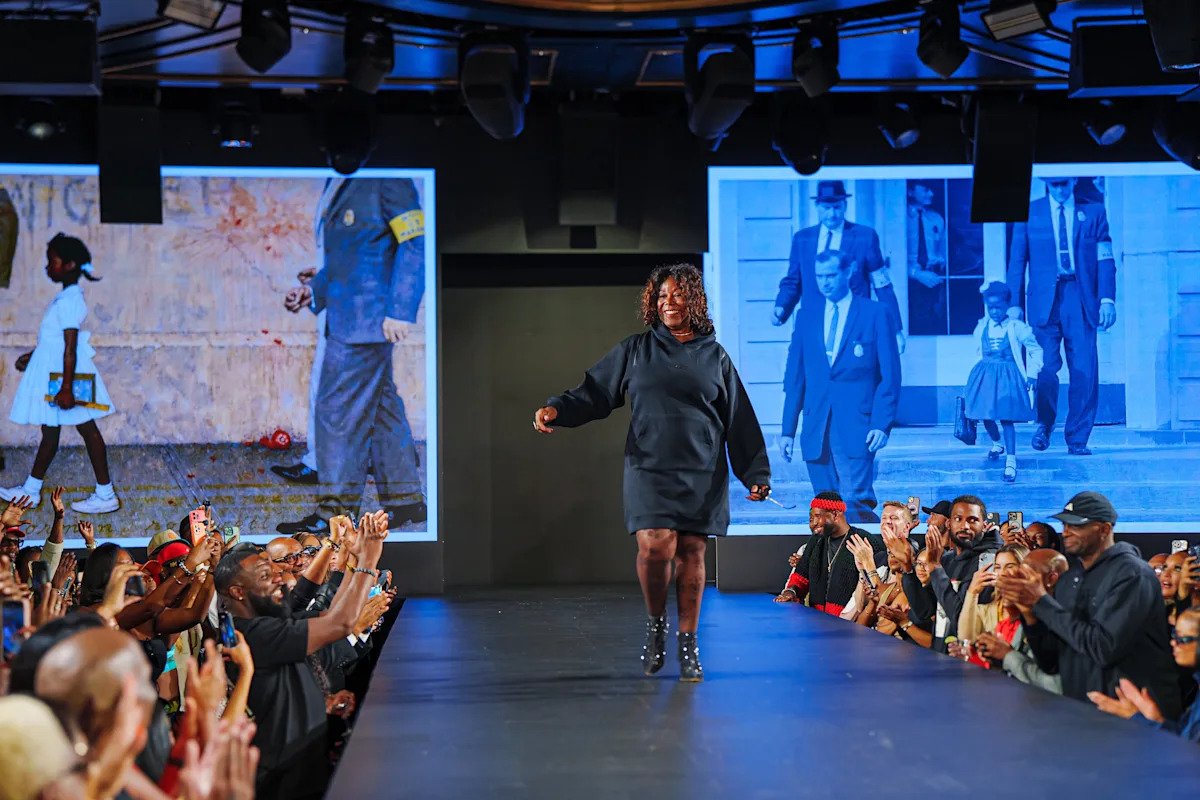
The reality is Black history is under attack right now. Black history is being removed from school curriculum, from books, libraries and museums. … One of the pieces of rhetoric that is being used to erase it is that things happened so long ago, we need to get over it. But then you see Ruby Bridges walk out today, and you’re like, Wait a minute, she’s still here. She just turned 71, and she looks like she’s 45. That didn’t happen that long ago.
Ruby Bridges is one of the civil rights figures who Smith had walk on the runway. Footage of her being escorted into a whites-only school was displayed behind her. (Anja Stoll)
We played the audio that was captured from when Ruby Bridges was actually walking [with federal marshals to an all-white school]. You hear the ugliness of it — and it was very ugly, to hear these adults calling this little girl the N-word and threatening her. … It transported everybody who was in that room to actually being there and hearing what Ruby Bridges had to hear as she walked to school every day. Then for the Ruby Bridges to actually walk out after that, I mean, you could just feel everybody in the room just gasp almost.
When she walked back out the second time, they actually stood up and gave her that standing ovation, which was a beautiful thing. For me, it was like, as a little girl, you had to walk and hear so much hate. I just wanted her to walk again and just hear so much love.
When you see Martin Luther King Jr.’s daughter and Malcolm X’s daughter walk out, it makes it real to you that they literally lost their fathers to political violence. These were little girls who had to grow up without their father, and they’re still here.
Cecil Williams has a photo that goes viral every Black History Month. He’s drinking out of a whites-only water fountain with this look of defiance. Once again, people think, Oh, that happened so long ago. But Cecil Williams walked on that runway at my show. It kind of recalibrates the concept of time because it makes you see that this really is in this same lifetime. These people actually lived through that. It makes it impossible for you to disregard the effects of Jim Crow and systemic racism and all those things when those people who went through it, at the crux of it, are literally still living.
Cecil Williams wearing an item from his own collaboration with Actively Black. (Anja Stoll)
As the show was happening, people were crying backstage, people were crying in the audience. The energy was just so palpable throughout the building. … It still doesn’t feel real.
‘This is not a fashion show’
The title of the show was ”This Is Not a Fashion Show.” The fact that nobody is talking about the clothes is actually a great thing. … That means that the mission was accomplished, and we did what we set out to do, which was to create this moment of impact. People are going to remember for a long time how they felt, whether it was at the show or watching the clips online.
I’ve had an opportunity to speak with each of the legends that graced that runway afterward, and to hear them feel so fulfilled, to hear them feel so happy about that moment, and being able to feel that love that they got, it’s like being able to give people their flowers while they’re still here to smell them.
Ilyasah Shabazz, Malcolm X’s daughter, she’s texted me every day since, just talking about how amazing it was. Cecil Williams has said that there’s been a huge increase in the traffic of people who are coming to his [civil rights] museum in South Carolina and who are calling and saying that they enjoyed watching him in the show.
Ilyasah Shabazz, Malcolm X’s daughter, and Bernice King, the daughter of Martin Luther King Jr., walk the runway with photos of their parents on either side of them. (Anja Stoll)
The fact that they get to feel this love is so incredible, but also the fact that so many people have responded, saying, “I needed to see this right now. This was needed for right now.” It’s the best feeling ever.
This is the purpose of Actively Black. This is why I started this company: to do the things that weren’t being done, and to do it authentically, and to do it boldly and unapologetically. … The authenticity that we bring is something that I will never, ever compromise.
This has been edited for length and clarity.