
President
Florida’s redistricting fight puts DeSantis back in Republican spotlight

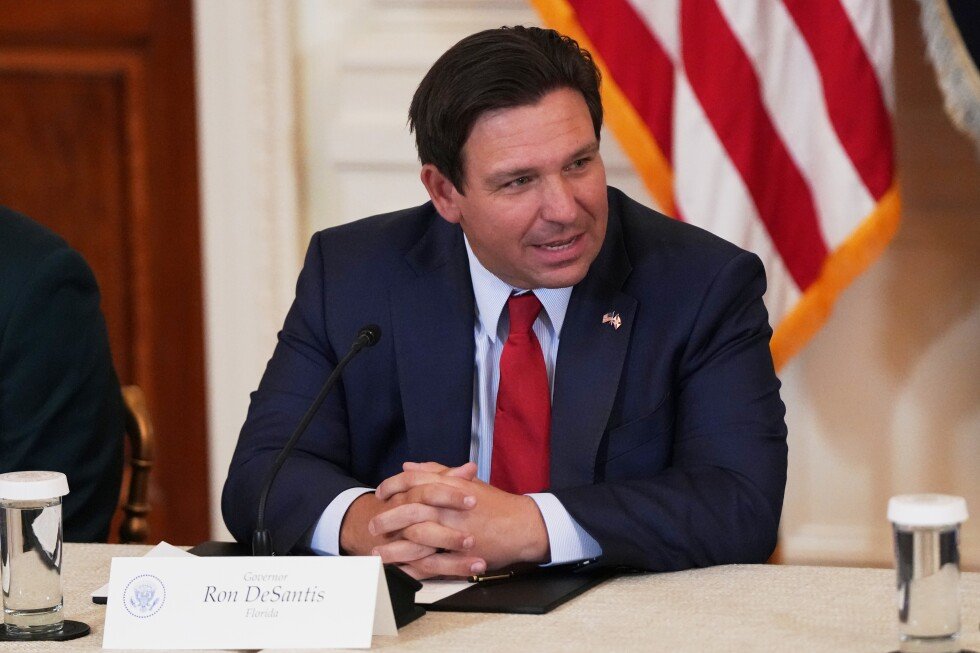
TALLAHASSEE, Fla. (AP) — Ron DeSantis was once the future of the Republican Party, a battle-tested conservative twice elected as governor of Florida. Then Donald Trump steamrolled him on his way back to the White House.
Now, more than two years after DeSantis ended his presidential campaign and endorsed Trump, the governor has called a special legislative session on redistricting and other issues that will put him back in the national spotlight and maybe remind Republicans that he could lead the party one day.
But there are also risks involved for the 47-year-old governor, and they became immediately apparent after lawmakers convened Tuesday.
DeSantis is pushing lawmakers to redraw Florida’s congressional map as part of a coast-to-coast redistricting battle ahead of November’s midterm elections. His proposal, released the day before the session began, would make it easier for Republicans to win up to four more seats, equivalent to Democrats’ potential gains from last week’s referendum in Virginia.
The governor also wanted the GOP-dominated Legislature to adopt new regulations for artificial intelligence and loosen vaccine requirements. However, those proposals quickly hit a roadblock when House Speaker Daniel Perez, a Republican but not a DeSantis acolyte, told members he would not advance legislation on those issues.
The governor’s maps are on a fast track, with a House vote planned Wednesday and the Senate set to move quickly thereafter. In Washington, GOP leaders and strategists have expressed confidence in DeSantis’ maps, but some Republicans still are worried that a gerrymandered map could backfire and allow Democrats to pick up seats.
DeSantis already faces tough prospects on the national stage, even with Trump constitutionally barred from running for a third term in 2028. DeSantis has had a relatively low profile during Trump’s second presidency and would likely have Vice President JD Vance and Secretary of State Marco Rubio, another Floridian, to contend with in a Republican presidential primary.
“The window for Ron looks reasonably narrow at this point,” said Whit Ayres, who served as DeSantis’ pollster in his first campaign for governor in 2018.
DeSantis’ office did not immediately respond to a request for comment on Tuesday. On X, DeSantis called the House move on AI and vaccines “typical political shenanigans.”
Meanwhile, the governor has embraced the national redistricting fight. When House Minority Leader Hakeem Jeffries, D-N.Y., last week dared Florida Republicans to go ahead with their special session, the governor punched back with the kind of aggressiveness he showed in the early days of his failed White House bid.
“I will pay for you to come down to Florida and campaign,” DeSantis said of Jeffries. “I’ll put you up in the Florida governor’s mansion. We’ll take you fishing.”
DeSantis wants four more Republican seats
DeSantis unveiled his proposed congressional map to Fox News on Monday even before it had been widely circulated to lawmakers — a point Democrats emphasized.
“Y’all should be pissed off,” Democratic Sen. Shevrin Jones of Miami-Dade told his Republican colleagues. “The governor has no respect for us.”
The governor’s map, if approved, would reshape districts in Democratic areas around Orlando, Tampa Bay, Miami and Fort Lauderdale. DeSantis argued that the 2020 census shortchanged the state’s population, making it necessary to redraw the lines. The changes could cost Reps. Jared Moskowitz and Debbie Wasserman Schultz, among others, their seats. The current maps yielded a 20 to 8 Republican tilt in 2024. DeSantis’ version would aim for an advantage of 24 to 4.
DeSantis first announced the special session in January, months after Trump started pushing Republican-run states to redraw their congressional boundaries. What followed has been a tit-for-tat battle, with each party looking for an edge in the midterms.
The Virginia referendum celebrated by Democrats faces a court challenge, and the Virginia Supreme Court on Tuesday declined to immediately lift an order from a lower court that bars the state from certifying the passage of the ballot measure. Another legal battle is playing out in Wisconsin where Democrats also hope to pick up another seat or two.
There’s no guarantee that new maps will play out the way parties hope. For example, Texas based its revised lines largely on Trump’s performance in 2024, redistributing the president’s voters across more districts to pull them into the Republican column. But Trump’s popularity has waned since his reelection, including among Latino voters who figure prominently in the state.
Florida could face a similar conundrum. Creating more majority-Republican districts could leave margins thin enough to allow for Democratic victories, especially if there’s an anti-Trump backlash at the polls this year.
Brian Ballard, an influential Florida lobbyist who has been DeSantis’ top fundraiser, said it’s worth remembering that DeSantis was the muscle behind the current map that expanded Republicans’ advantage.
“He’s incredibly smart and capable,” Ballard said. “And he doesn’t get enough credit for that map. He’s done this before.”
Florida legislative leaders are not rubber stamps for DeSantis
As it did Tuesday, the Florida House has grown more willing to buck the governor in recent sessions. Perez and Senate President Ben Albritton made clear for weeks that they were not drawing their own proposals and would react only to what DeSantis put forward.
Albritton sent multiple memos to senators reminding them of Florida’s state constitutional limits on redistricting and the requirement that it not be done as a blatantly partisan act.
Perez sidestepped questions Tuesday about whether the maps violate those requirements, which Florida voters approved by a nearly 2-to-1 margin in 2010. Democrats and political advocates have promised legal challenges and said repeatedly Tuesday that shameless partisanship is at play.
“We are here because the president of the United States gave an order,” Jones, the Democratic senator, said. “Shame on us.”
Beyond redistricting, DeSantis was effectively asking House members to approve AI and vaccine proposals that they refused even to advance out of committee earlier this year.
On AI, DeSantis wanted to require tech companies to ensure children cannot interact with chatbots without parental permission. He also wanted to prevent AI from generating harmful material for minors. That proposal put DeSantis at odds with Trump, who wants the federal government to be the regulator of AI technology. Perez said he sides with the president, calling AI a “national security issue” that is “bigger than just one state.”
On vaccines, DeSantis wanted to add a conscience-based exemption to public school vaccine requirements, similar to the existing religious exemption. That aligns him with the anti-vaccine portion of the Trump base that was instrumental in making Robert F. Kennedy Jr. the U.S. health secretary.
Perez countered that vaccine requirements in the U.S. “have been working for decades” and said he remains uncomfortable with “children being in school without measles and mumps and polio and chickenpox vaccines.”
Political observers are watching — even at the White House
Ballard downplayed any political concerns for DeSantis. What may seem to some as strained relations with certain Republican legislative leaders, he said, is simply measuring DeSantis against the opening years of his tenure.
“I mean, he went from batting a thousand to maybe batting .600,” Ballard said, using a baseball analogy for the governor who played the sport while attending Yale. “That isn’t failure.”
During the last Republican presidential primary, DeSantis initially gave conservative establishment figures and key donors an option other than Trump, who grew frustrated by the challenge and mocked the governor as “Ron DeSanctimonious.”
But Trump seemingly forgave DeSantis when he dropped out of the race and endorsed Trump following his victory in the Iowa caucuses. He even promised to call DeSantis by his actual name.
There’s more bad blood within the White House, though. Chief of Staff Susie Wiles, a Floridian, managed DeSantis’ razor-thin 2018 victory, only for the pair to have a falling out.
Wiles did not respond to a request for comment. But Ayres said he’s certain she’s paying attention.
“Donald Trump has a long memory, and Susie Wiles has a longer one,” he said. “And that doesn’t bode well for Gov. DeSantis to be Donald Trump’s Republican successor.”
_____
Scott Bauer in Madison, Wisconsin, and Nicholas Riccardi in Denver contributed.