
Education
As school year begins, Lebanon’s displaced families are anxious

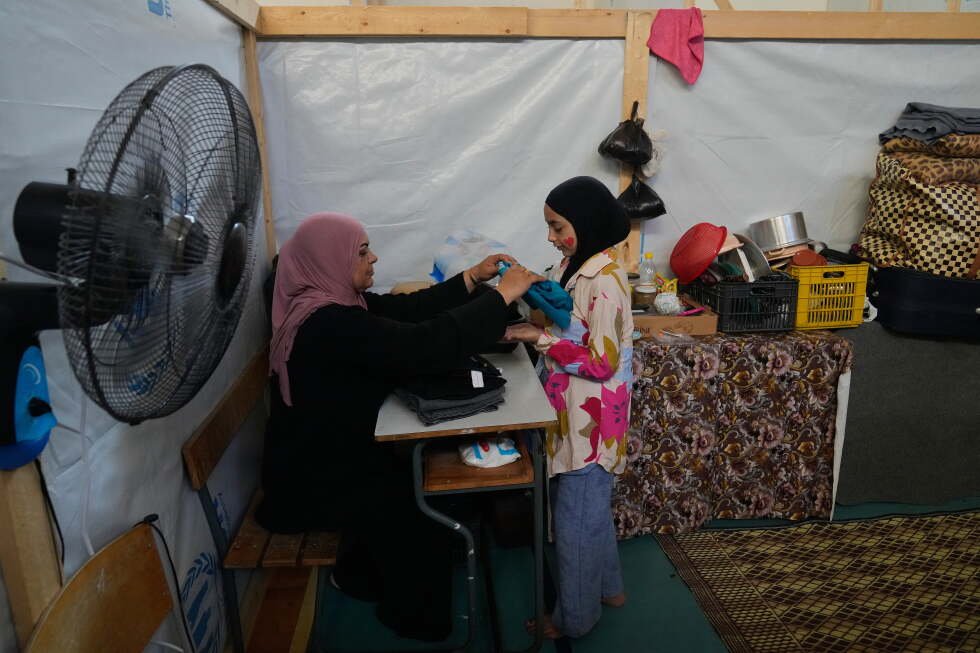
TYRE, Lebanon (AP) — Eleven-year-old Fatima Khashab helps her mother tidy the small area where their family sleeps, in a row of makeshift living quarters in a school gymnasium.
About 200 families are sheltering in the school in Lebanon’s southern coastal city of Tyre. Most are from villages farther south that have been destroyed in the latest war between Israel and the Iran-backed Lebanese militant group Hezbollah or are occupied by Israeli forces, like Fatima’s hometown of Mansouri.
The school year will start on Sept. 15, but thousands of displaced people still shelter in public schools. With negotiations between Israel and Lebanon — and between the U.S. and Iran — stalled, there is no political solution in sight that would allow them to go home.
Education officials say they have a plan to reopen the schools while maintaining shelters for families with nowhere to go. But anxiety is high.
“We don’t know if we will be able to go back to our village or if the crisis will get even worse. Nobody except for God knows what’s going to happen,” said Fatima’s mother, Randa al-Taki, 51.
On top of that, she said, “Our children are deprived of school, and we don’t know if they are going to learn this year or not.”
Education is again disrupted for children in Lebanon
Lebanon has traditionally prided itself on its education system. Its economy relies on sending educated young people abroad to work. They send remittances and make investments back home.
That system is in danger of crumbling.
Since 2019, Lebanon has been battered by an economic collapse, the COVID-19 pandemic, the 2020 Beirut port explosion and two wars. The current conflict has disrupted education for hundreds of thousands of children.
“There’s an estimated at least four years of learning loss now,” said Nora Ingdal, Lebanon country director for Save the Children, which has set up learning spaces for displaced children. “A sixth grader is actually on the level of a second grader.”
At the height of the current conflict, half of Lebanon’s public schools were used as shelters, disrupting education for more than 250,000 students, according to a report by the Arab Center for Research and Policy Studies, a Qatar-based think tank.
Nasser Yassin, the center’s director in Beirut and a former Lebanese government minister who was in charge of the crisis response during the 2024 war, said the government should have used other places for shelters whenever possible, not schools.
“We should not respond to a displacement crisis by creating a long-term education crisis,” he said.
About 350,000 people remain displaced
The latest conflict between Israel and Hezbollah began on March 2, when the militant group fired rockets across the border two days after Israel and the U.S. launched a war on Iran.
At the height of the war, some 1.2 million people were displaced in Lebanon.
Since late June, a shaky truce has allowed most to return home. In Beirut, the displacement crisis is no longer visible the way it was early in the war, when tents lined the seaside corniche and families slept in their cars along main thoroughfares.
But the Israeli military still occupies large swaths of southern Lebanon and has said it won’t withdraw before Hezbollah is fully disarmed, a prospect that appears unlikely. Israeli troops have demolished houses in areas they control and launched strikes that they say target Hezbollah militants.
“Every day we see how they are demolishing our village with bulldozers, and they’re either blowing up the houses or bombing them in front of our eyes, and we can’t do anything,” al-Taki said of Israel’s military. She is unsure if their house is still standing. Lebanon’s state news agency reported new airstrikes and shelling on their hometown over the weekend.
Around 350,000 people remain displaced, according to the U.N. humanitarian office. While most have rented apartments or moved in with relatives, some 21,000 still stay in collective shelters.
Some have been displaced since the previous Israel-Hezbollah conflict, which erupted into full-scale war in September 2024.
That’s the case for Malak Abu Sari, 11, whose home was destroyed. Her family is staying in the school in Tyre.
Fatima’s family was displaced in 2024, too, but they were able to return home before fleeing in March, early in the current war, and again about a month ago after briefly going back.
‘We feel that we’re suffocating’
At the school, Fatima’s family is surrounded by relatives and former neighbors. The familiar faces make them feel less alone. Humanitarian groups organize activities for the children. One woman brought her cockatiel when she fled, and children stop by to play with him.
But the families chafe at the lack of privacy.
“We have a place to stay in the school, and thank God for that, but to be honest, we feel that we’re suffocating between these tarps,” al-Taki said.
Before the war, the family made a living farming zaatar, a herb used in a popular Levantine spice mix. Her husband sold snacks from a tuk-tuk on beaches. Now they’ve missed the zaatar season, and there’s no work.
Fatima pines for her old life. She misses being in her own bed and not in a cramped room with tarps for walls.
“I miss a lot of things,” she said. “I want to go back to school and stay in our own house.”
Online learning poses a challenge
Georgia Hachem, adviser to Lebanon’s education minister, said around 80 schools are still serving as shelters, but many host a small number of families.
In some cases, those schools will reopen for classes while part of the facility continues as a shelter. In other cases, families will be consolidated in a single location. In Beirut, the ministry will move displaced families to unused buildings.
“We have a solution for every single shelter, and no student will be left without a seat,” Hachem said.
The bigger issue, she said, is the 340 schools damaged in the war, with some 30 of them destroyed and no funds to repair them. Other schools are inaccessible in occupied areas.
After the war began, the education ministry offered online classes to students whose schools closed, but families in shelters often have internet problems and limited resources, Ingdal said.
“Maybe there’s one device in the family and you have five kids who are going to learn,” she said.
Most students can return to school in person this year, Hachem said, but a handful of schools will remain online.