
President
Virginia Supreme Court weighs whether to block new US House districts

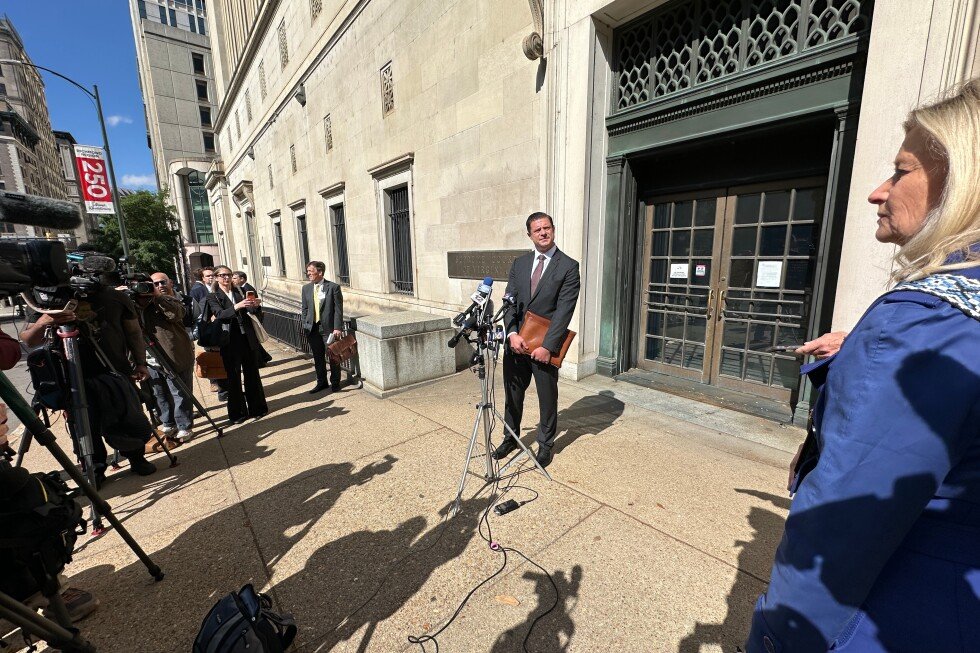
RICHMOND, Va. (AP) — Virginia Supreme Court justices on Monday questioned whether the state’s Democratic-led legislature complied with constitutional requirements when it sent a congressional redistricting plan to voters, in a case that carries high stakes for the balance of power in the U.S. House.
The new districts, which could net Democrats four additional seats, won narrow voter approval last week. But a Republican legal challenge contends the General Assembly violated procedural rules by placing the constitutional amendment before voters to authorize the mid-decade redistricting. If the court agrees that lawmakers broke the rules, it could invalidate the amendment and render last week’s statewide vote meaningless.
The Virginia court proceedings mark the latest twist in a national redistricting battle between Republicans and Democrats seeking an advantage in a November midterm election that will determine whether Republicans maintain their narrow majority in the U.S. House.
President Donald Trump kicked off a tit-for-tat round of gerrymandering last summer when he urged Texas Republicans to redraw districts to their favor in an attempt to win several additional House seats. That set off a chain reaction of similar moves in other states, leading to the voter approval last week of Virginia’s new map.
Next up is Florida, where Republican Gov. Ron DeSantis has proposed a congressional redistricting plan that could essentially cancel out Virginia’s changes by giving Republicans an improved chance of winning additional seats. The redistricting is on the agenda for a special session of the GOP-controlled Legislature beginning Tuesday.
Virginia arguments focus on what counts as an ‘election’
During Monday’s arguments, the Virginia Supreme Court focused on whether the new congressional districts should be invalidated because of the process used by lawmakers. The justices issued no immediate ruling.
Because the state’s redistricting commission was established by a voter-approved constitutional amendment, lawmakers had to propose an amendment to redraw the districts. That required approval of a resolution in two separate legislative sessions, with a state election sandwiched in between, to place the amendment on the ballot.
The legislature’s first vote occurred last October — while early voting was underway but before it concluded on the day of the general election. Judicial questioning focused on whether that was too late, because early voting already had begun.
Attorney Matthew Seligman, who defended the legislature, argued that the “election” should be defined narrowly to mean the Tuesday of the general election. In that case, the legislature’s first vote on the redistricting amendment occurred before the election and was constitutional, he told judges.
But an attorney arguing for the plaintiffs, Thomas McCarthy, said “election” means the entire period during which people can cast ballots, which lasts several weeks in Virginia. If that’s the case, then the legislature’s initial endorsement of the redistricting amendment came too late to comply with the state constitution, he said.
Attorneys argue over the rights of voters
The purpose of Virginia’s two-step amendment process, with an intervening election, is so voters can know whether legislative candidates support or oppose a proposed constitutional amendment, McCarthy said.
He pointed to the case of Democratic voter Camilla Simon, one of the plaintiffs in the lawsuit alongside Republican state lawmakers, who cast an early vote last fall for Democratic Del. Rodney Willett. After she voted, Willett sponsored the Democratic redistricting amendment, and Simon wished she could have undone her vote, McCarthy said.
“None of these voters had any idea this was coming, and that’s not how this process is supposed to work,” McCarthy told the justices.
Those defending the Democratic redistricting plan also contend that the voters’ will should be respected.
The people voted to ratify the constitutional amendment, “and the challengers are asking to overturn that democratic result,” Seligman told reporters after the arguments.
Nationwide redistricting battle has no clear winner so far
So far, the two major parties have battled to a near draw in the states that have redrawn their congressional maps for this year’s midterms.
Republicans think they could win up to nine more seats under revised districts in Texas, Missouri, North Carolina and Ohio. Democrats think they could win as many as 10 additional seats under new districts in California, Utah and Virginia. But legal challenges remain in both Virginia and Missouri.
Virginia currently is represented in the U.S. House by six Democrats and five Republicans who were elected from districts imposed by a court after a bipartisan redistricting commission failed to agree on a map after the 2020 census. The new districts, which won voter approval last Tuesday, could give Democrats an improved chance to win 10 districts.
Some candidates already have begun campaigning based on the new districts in advance of the state’s Aug. 4 primary election.
More court battles could remain in Virginia
In January, a judge in rural Tazewell County, in southwestern Virginia, ruled that lawmakers failed to follow their own rules for adding the redistricting amendment to a special session last fall. Circuit Judge Jack Hurley Jr. also ruled that lawmakers failed to initially approve the amendment before the public began voting in last year’s general election and that the state had failed to publish the amendment three months before the election, as required by law. As a result, he said, the amendment is invalid and void.
The Virginia Supreme Court placed Hurley’s order on hold and allowed the redistricting vote to proceed before hearing arguments on the case.
During Monday’s arguments, justices also raised questions about the ability of lawmakers to expand the agenda for their special session and whether the three-month public notice requirement was important enough to thwart a voter-approved amendment.
Republicans have filed at least two additional legal challenges, which also are winding their way through the courts.
___
Lieb reported from Jefferson City, Missouri. Associated Press writers Allen G. Breed in Richmond and Nicholas Riccardi in Denver contributed to this report.