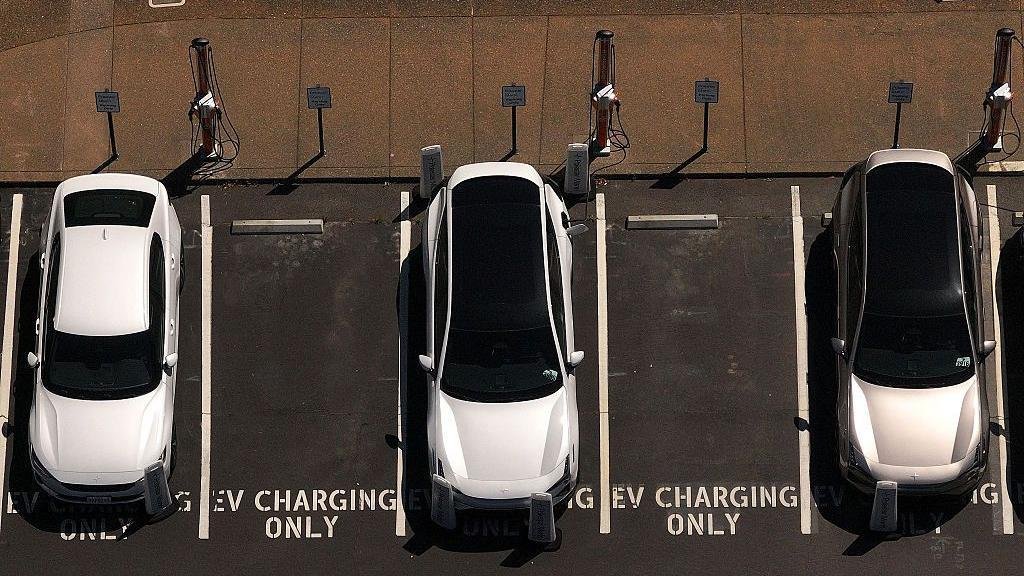
You could be forgiven for thinking that electric cars might finally be gaining momentum in the US.
After all, sales of battery cars topped 1.2 million last year, more than five times the number just four years earlier. Hybrid sales have jumped by a factor of three.
Battery-powered cars accounted for 10% of overall sales in August – a new high, according to S&P Global Mobility.
And in updates to investors this week, General Motors, Ford, Tesla and other companies all reported record electric sales over the past three months.
This marked a bright spot in an industry wrestling with the fallout from still high interest rates and buyers on edge over inflation, tariffs and the wider economy.
But analysts say the boom was caused by a dash to buy before the end of a government subsidy that helped knock as much as $7,500 (£5,588) off the price of certain battery electric, plug-in hybrid or fuel cell vehicles.
With that tax credit gone as of the end of September, carmakers are expecting momentum to shift into reverse.
“It’s going to be a vibrant industry, but it’s going to be smaller, way smaller than we thought,” Ford chief executive Jim Farley said at an event on Tuesday.
“I expect that EV demand is going to drop off pretty precipitously,” the chief financial officer of General Motors, Paul Jacobson, said at a conference last month, adding it would take time to see how quickly buyers would come back.
Even with the recent gains, the US, the world’s second biggest car market, stood out as a laggard in electric car sales compared to much of the rest of the world.
In the UK, for example, sales of battery electric and hybrid cars made up nearly 30% of new sales last year, according to the International Energy Agency (IEA). Latest industry figures suggest that number is even higher.
In Europe, they accounted for roughly one in five sales, while in China, the world’s biggest car market, sales of such cars accounted for almost half of overall sales last year, according to the IEA, and they are expected to become the majority this year.
Take-up in some other countries, like Norway and Nepal, is even greater.
Electric vehicles (EVs) tend to account for a smaller share of sales in Latin America, Africa and other parts of Asia – but growth there has been surging.
Analysts say adoption in the US has been slowed by comparatively weak government support for the sector, which has limited the kinds of subsidies, trade-in programmes and rules that have helped the industry in places such as China, the UK and Europe.
Story Continues
Former President Joe Biden pushed hard to increase take-up, aiming for electric cars to account for half of all sales in the US by 2030.
His administration tightened rules on emissions, boosted demand through purchases for government fleets, nudged carmakers to invest with loans and grants for EV investments, spent billions building charging stations and expanded the $7,500 tax credit as a sweetener for buyers.
Supporters cast those efforts in part as a competitive imperative, warning that without these US carmakers would risk losing out to competitors from China and other countries.
But President Donald Trump, who recently called climate change a “con job”, has pushed to scrap many of those measures, including the $7,500 credit, arguing that they were pushing people to buy cars they would not otherwise want.
“We’re saying … you’re not going to be forced to make all of those cars,” he said this summer, while signing a bill aimed at striking down rules from California, which would have phased out sales of petrol-only cars in the state by 2035. “You can make them, but it’ll be by the market, judged by the market.”
[Bloomberg via Getty Images]
Electric cars have become more affordable in the US in recent years – but they still cost more than comparable petrol-powered vehicles.
And Chinese carmakers like BYD, which have made rapid inroads in other markets thanks to low prices, have been effectively shut out of the US, due to high tariffs targeting cars made in China, backed by both Biden and Trump.
As of August, the average transaction price of an electric car in the US was more than $57,000, according to auto industry research firm Kelley Blue Book, about 16% higher than the average for all cars.
The least expensive battery car on offer, a Nissan Leaf, costs about $30,000 (£22,000). By comparison, several models can be found for under £20,000 in the UK.
Analysts say what buyers do next hinges on how carmakers set prices in the months ahead, as they contend not only with the end of the tax credit but also tariffs on foreign cars and certain car parts that Trump introduced this spring.
Hyundai said this week it would offset the loss of the tax credit by lowering the price for its range of Ioniq EVs. But Tesla said the cost for monthly lease payments of some of its cars would rise.
Stephanie Brinley, associate director of S&P Global Mobility, said she did not expect to see many firms follow Hyundai’s example, given the pressures from tariffs.
While some buyers may opt for EVs anyway, “next year is going to be hard,” she warned, noting that her firm is calling for overall car sales to fall by roughly 2% in 2026.
“It would have been difficult enough if all you had to deal with is new tariffs, but with new tariffs and the incentive going away, there’s two impacts.”
Carmakers had already been scaling back their investments in electric cars.
Researchers say Trump’s policy changes could reduce those investments even more.
“It’s a big hit to the EV industry – there’s no tiptoeing around it,” said Katherine Yusko, research analyst at the American Security Project
“The subsidies were initially a way to level the playing field and now that they’re gone the US has a lot of ground to make up.”
However Ms Brinley said she was hesitant to declare the US behind in an industry still testing out technology alternatives.
“Is [electric] really the right thing?” she said. “Saying that we’re behind assumes that this is the only and best solution and I think it’s a little early to say that.”