
President
Will White House media dinner be rescheduled? Some say it shouldn’t

NEW YORK (AP) — And now, back to our regularly scheduled programming.
Or … maybe not?
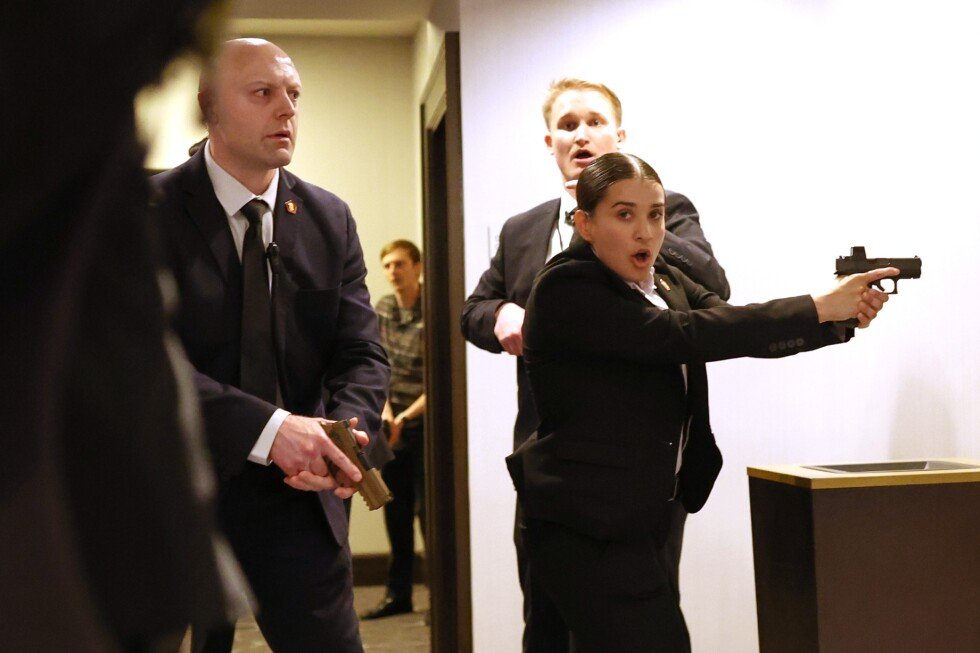
More than three weeks after the White House Correspondents’ Association dinner was thrown into chaos and panic when a man stormed the Washington Hilton lobby and opened fire in what prosecutors say was an attempt to kill President Donald Trump, the event has yet to be rescheduled.
The association “continues to weigh options for rescheduling the event,” its president, Weijia Jiang of CBS News, said from China last week where she was covering Trump — alongside whom she hit the floor that night as shots rang out.
“We will do this again,” Jiang had said then. Trump, for his part, said on social media the dinner would be rescheduled within 30 days (though it’s not up to him), which would bring it to late this month.
That seems hardly likely, at least not an event that would accommodate close to 3,000 people. WHCA board members are scoping out smaller venues, a person familiar with the situation said, with the understanding that, if rescheduled, it would necessarily be a pared-down event — a nod to financial as well as security concerns. A return to the Washington Hilton, or a full-scale dinner anywhere, is not foreseen.
But whether the event can be rescheduled is only one question on the dinner table.
The other is, should it? And for some, who already felt uneasy with the idea of the media hobnobbing with officials it covers, the answer is getting easier. They’re thinking, to paraphrase George and Ira Gershwin, that this might be a good time to just call the whole thing off.
Is the event a ‘bad look’?
There have always been critics. One of those is Kelly McBride, ethics expert at the Poynter Institute, a journalism think tank. McBride had written before the event that it was a “bad look,” and still feels the same way. This despite the contention, from the dinner’s defenders, that the event is both a fundraiser for journalism scholarships and a robust celebration of the First Amendment.
“It undermines the public faith in how the press does its work, and it makes it looks like we are pals with the people we cover,” McBride said last week.
McBride adds that the attack was “deeply unfortunate” — a Secret Service officer was shot and is recovering. The challenge now, she says, is managing optics. And security concerns could complicate that.
“You’d have to make the Secret Service happy,” she says. “I don’t know you do that unless it is in a government facility. But it can’t be in a government facility.” That, of course, would give the appearance of compromising the WHCA.
To McBride, the problem evokes the inherent tension in an event whose stated purpose, she feels, has been overshadowed by the presence of the U.S. president. Any U.S. president.
“I can’t imagine how they can possibly redo this event this year in a way that would accomplish everything they need,” she says. “It sure would be easier just to call the whole thing off.”
Some security experts disagree that the event raised serious security issues.
“Can it be done safely? I would argue that it was done safely the first time,” said Jeff James, a retired Secret Service officer who now runs a security company.
“The gunman never even got to the same floor as the president. He was stopped within about 30 feet of reaching the middle perimeter,” James said. “He never came close to being within handgun range, let alone shotgun range.” He called the response a clear success for the Secret Service.
Anthony Cangelosi, a former Secret Service agent and lecturer at the John Jay College of Criminal Justice, also feels the response was successful, and says the Secret Service was prepared for a “lone wolf” scenario like the one that occurred. Suspect Cole Tomas Allen of Torrance, California was staying in the hotel at the time.
“Obviously the optimal venue is one where there is nobody (else) there, like an arena, where the only people are the attendees and the protectees,” says Cangelosi. ”But you have to work with what you have, and they did a very good job.”
Not enough talk about press freedom
One of the guests attending that night was Jodie Ginsberg, chief executive officer of the Committee to Protect Journalists. Ginsberg says she attended in order to keep reminding people of the importance of press freedom. But she has been struck by how little emphasis there usually is on that subject.
“It’s a big, extremely expensive social event at a time when journalists are being laid off in continuing high numbers,” Ginsberg said.
“It sticks in my craw that at a time when journalists are under threat like never before — last year was the deadliest year ever in CPJ’s history for journalists — more journalists being harassed online, more journalists are in jail than ever before, journalists in the U.S. are being raided by the FBI, arrested covering protests, knocked to the ground by ICE,” she said. “And none of that is really reflected at all in those four days of parties.”
She fears that “we’re still sort of raising a toast to press freedom, yet often without having the courage to stand up in its defense when it actually gets threatened.”
Former CBS News executive Marcy McGinnis doesn’t think the dinner should be rescheduled for a practical reason: the money raised for scholarships had already been raised.
“I am troubled by the optics, for sure,” adds McGinnis, co-founder of Exact Communication. “But I believe journalists who believe in true journalism, and holding power to account, will and are able to do their job when they have to cover someone — even if they hobnobbed at the dinner.”
One scenario that Trump raised in the aftermath is clearly not on the table: holding the dinner in his yet-to-be finished White House ballroom.
“We need the ballroom,” the president said, and his Justice Department has used the issue to try to pressure preservationists to drop their lawsuit over the $400 million project on the site of the former East Wing.
That, though, is untenable for reasons beyond the fact that it is far from finished. “It can never be in the ballroom,” McBride says, for the WHCA to maintain any credibility.
Whether, and wherever, the event might be rescheduled, one guest will not be attending.
“I’m never going to another,” says Ginsberg of the CPJ. “I’ve had this conversation with a few colleagues from different organizations. I think the time has come to think about how we spotlight the importance of the First Amendment, of a free press, of the importance of journalism in a different way. I don’t think that this is it. “
___
Jocelyn Noveck covers the intersection of media and entertainment for The Associated Press.