US Politics
Even a former law clerk for conservative Justice Clarence Thomas is warning about giving Trump too much power

Your support helps us to tell the story
From reproductive rights to climate change to Big Tech, The Independent is on the ground when the story is developing. Whether it’s investigating the financials of Elon Musk’s pro-Trump PAC or producing our latest documentary, ‘The A Word’, which shines a light on the American women fighting for reproductive rights, we know how important it is to parse out the facts from the messaging.
At such a critical moment in US history, we need reporters on the ground. Your donation allows us to keep sending journalists to speak to both sides of the story.
The Independent is trusted by Americans across the entire political spectrum. And unlike many other quality news outlets, we choose not to lock Americans out of our reporting and analysis with paywalls. We believe quality journalism should be available to everyone, paid for by those who can afford it.
Your support makes all the difference.
Read more
An influential conservative legal scholar who once clerked for Justice Clarence Thomas has raised alarm bells at the Supreme Court’s recent trend of handing President Donald Trump more power, warning that it defies the original interpretation of the Constitution.
Over the last nine months, the conservative wing of the court has expanded Trump’s authority, allowing him to remake the federal government in his vision, including by firing the heads of independent agencies such as the Federal Trade Commission, National Labor Relations Board and the Merit Systems Protection Board.
While the liberal justices of the court, as well as Democratic officials, have loudly decried the court’s decision, Caleb Nelson, a professor at the University of Virginia law school whose work is consistently cited by members of the conservative wing of the court, has joined them.
In a sharp rebuke of the court’s interpretation of executive authority, Nelson wrote in a piece for NYU’s Democracy Project that justices could hand the president “more power, I think, than any sensible person should want anyone to have, and more power than any member of the founding generation could have anticipated.”
Nelson, who clerked for Thomas in the late 90s and has had work featured by the conservative legal group the Federalist Society, criticized the Supreme Court for misinterpreting both the history and text of the Constitution.
open image in gallery
“Bombshell! – Caleb Nelson, one of the most respected originalist scholars in the country, comes out against the unitary executive interpretation of Article II,” William Baude, another influential legal scholar, wrote on Bluesky.
Richard Pildes, a professor at NYU who co-founded the Democracy Project, told the New York Times, “If a highly respected originalist scholar like Professor Nelson, on whom the court relies frequently, denies that originalism supports the unitary executive theory, that inevitably raises serious questions about an originalist justification for the court’s looming approach.”
“Caleb Nelson is one of the most principled people I’ve met in academia,” Rutger’s law professor Adam Crews wrote on X. “And so perhaps unsurprisingly, I think he’s spot on—and the Court should admit it.”
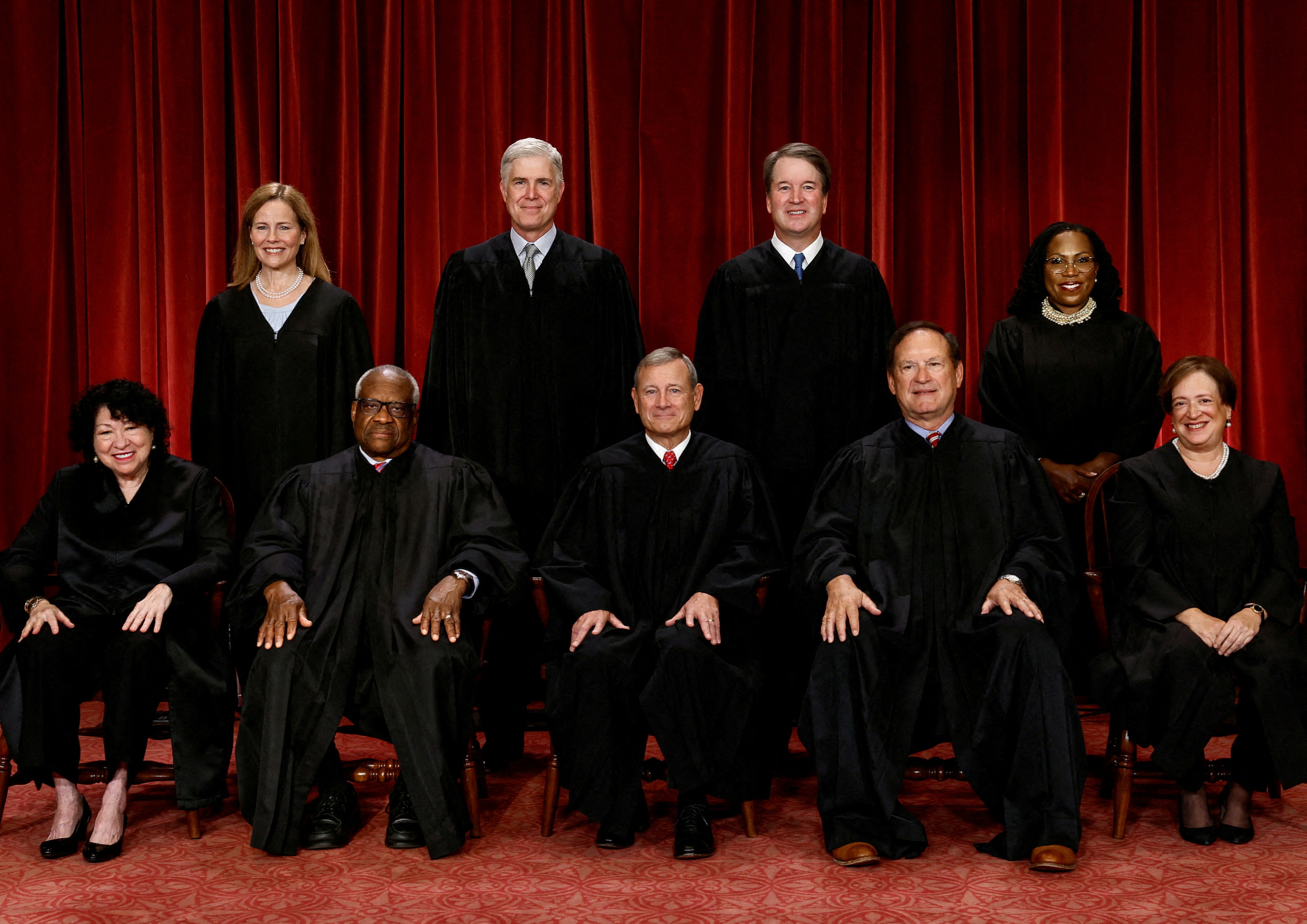
Nelson, along with Justices Thomas, Samuel Alito, Neil Gorsuch and Amy Coney Barrett, identify as “originalists” or those who believe the Constitution should be interpreted as it was originally written.
Article II of the Constitution states, “Executive Power shall be vested in a President of the United States of America.” Some legal scholars have used that clause to argue in favor of unitary-executive theory, or the idea that the president has sole authority over the entire executive.
Under that argument, independent federal agencies cannot act independently from the White House – despite Congress setting them up as such to prevent influence from the president. But this is the argument Trump and others have used to convince the court he should be permitted to remove those in charge of independent agencies.
open image in gallery
But in Nelson’s article, published in September, he said the court, under Chief Justice John Roberts’s guidance, has incorrectly interpreted Article II to allow the president sweeping power and ignored the framers’ intentions to separate powers among branches of government.
“I am an originalist, and if the original meaning of the Constitution compelled this outcome, I would be inclined to agree that the Supreme Court should respect it,” Nelson wrote. “But both the text and the history of Article II are far more equivocal than the current Court has been suggesting.”
Nelson warned that justices should consider “consequences” of the interpretation they chose in a case with as much gray area as the one about firing the heads of independent agencies.
“I hope that the Justices will not act as if their hands are tied and they cannot consider any consequences of the interpretations that they choose,” Nelson added.