The Trump administration is bailing out Argentina in a move critics are saying has more to do with politics than economics or American interests.
That means $20 billion US taxpayer dollars will be used to bail out a country led by a close ally of President Donald Trump: chainsaw-wielding, libertarian Javier Milei.
“Argentina faces a moment of acute illiquidity,” Treasury Secretary Scott Bessent wrote on X Thursday. “The US Treasury is prepared, immediately, to take whatever exceptional measures are warranted to provide stability to markets.”
Meanwhile, the US federal government is nearing two weeks of being shut down and US businesses and industries continue to reel from Trump’s ongoing trade war.
Here are some key details about the administration’s extraordinary financial rescue of Argentina.
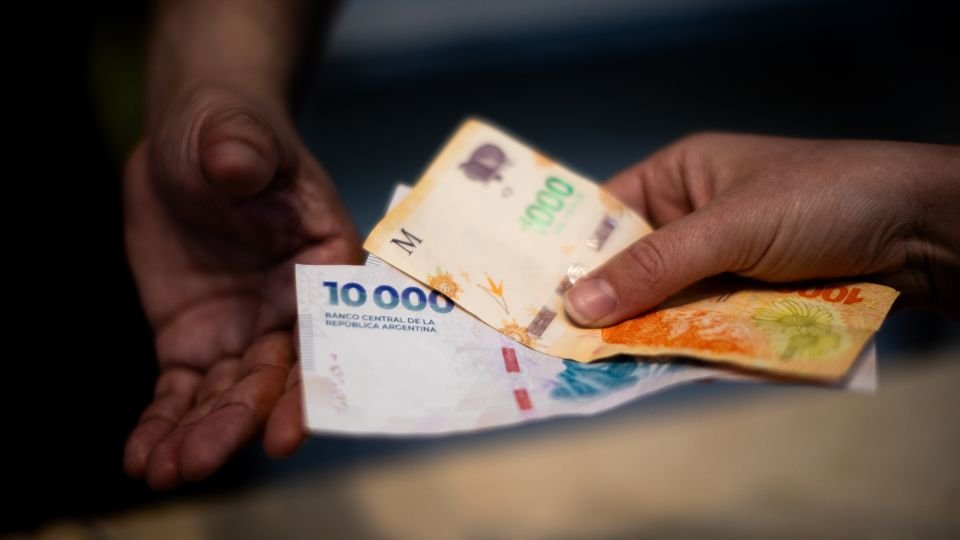
A customer pays for food with Argentine peso banknotes in the financial district of Buenos Aires, Argentina, on September 8, 2025. – Tomas Cuesta/Bloomberg/Getty Images
Argentina is at risk of a financial collapse.
The country’s currency fell sharply after President Milei’s party suffered a significant defeat in elections last month. The losses shook investors’ confidence in Milei’s ability to see through his economic reforms.
Milei has slashed government spending, cut regulations and fired tens of thousands of public-sector workers since taking office in 2023. His administration has seen some success; inflation in Argentina eased this year to the slowest monthly pace in more than four years.
Argentina’s President Javier Milei (R) speaks next to legislative candidate Manuel Adorni (C) and Argentina’s Secretary General of the Presidency Karina Milei during an open-air political rally at Parque Sarmiento in Cordoba, Argentina on September 19, 2025. – Diego Lima/AFP/Getty Images
The Trump administration has argued that Argentina’s financial strife could spill over into other economies if it isn’t contained swiftly.
Administration officials say they also see a risk of Argentina, a major economy in South America, strengthening its ties with China.
The next legislative elections in Argentina take place on October 26.
On Thursday, Bessent confirmed on social media that Argentina’s bailout is moving forward in two keys ways.
Bessent said the administration has finalized a $20 billion currency swap agreement with Argentina’s central bank, allowing it to exchange its local currency for the US dollar.
It’s essentially a $20 billion loan, experts say.
Treasury Secretary Scott Bessent appears in the in the Oval Office of the White House on September 25, 2025 in Washington, DC. – Andrew Harnik/Getty Images
Trump’s top economic official also said the administration “directly” purchased an undisclosed amount of Argentine pesos. It’s only the fourth time since 1996 that the United States has bought another country’s currency, according to the Federal Reserve Bank of New York.
These measures are aimed at stabilizing Argentina’s financial markets.
The United States has provided foreign countries with financial lifelines before, usually when the stability of the global economy is at risk or when a close geopolitical ally, such as Mexico, finds itself underwater and could damage to US creditors and investors.
Story Continues
But this bailout isn’t urgent, it’s happening at an awkward time, and critics are accusing Trump of using billions of American dollars just to prop up one of his own personal allies.
“The Treasury’s decision to offer a ‘swap’ in Argentina is really a signal that Washington is willing to wield its financial tools for political purposes in ways that depart from past norms,” wrote Heidi Crebo-Rediker, a former chief economist at the State Department, and Douglas Rediker, a former US representative on the International Monetary Fund’s executive board, in a Financial Times column published on October 2.
This is all while the US government is shut down, which has resulted in more than a million federal workers being furloughed or working without pay.
“It is inexplicable that President Trump is propping up a foreign government, while he shuts down our own,” Democratic Sen. Elizabeth Warren of Massachusetts said in a statement on Thursday.
Meanwhile, the result has been a one-two punch against American farmers from Trump’s own policies. American farmers are having a tough year, in no small part because of Trump’s bid to reshape global trade. And Argentina’s bailout inadvertently worsened their plight.
China, a major buyer of US soybeans, halted purchases of the commodity in May in response to Trump’s trade war. Then, after Argentina temporarily scrapped export taxes on grains, China swooped in and bought tens of thousands of pounds of Argentine soybeans instead.
“Why would USA help bail out Argentina while they take American soybean producers’ biggest market??? We shld use leverage at every turn to help hurting farm economy Family farmers shld be top of mind in negotiations by representatives of USA,” Republican Sen. Chuck Grassley of Iowa wrote on X on September 25.
Beyond Millei, China, and the Argentine treasury, critics say the bailout also stands to greatly benefit wealthy fund managers who are major holders of Argentine debts and assets.
The bailout would deliver a major windfall to Rob Citrone, a billionaire hedge fund manager with significant investments in Argentina. “Bessent’s personal and professional relationship with Citrone has spanned decades,” according to independent journalist Judd Legum.
“Trump promised ‘America First,’ but he’s putting himself and his billionaire buddies first and sticking Americans with the bill,” Warren said in a statement Thursday. Eight Democrats, including Warren, have introduced a bill in Congress to prevent Argentina’s bailout.
But Bessent told CNBC recently that “this trope that we’re helping out wealthy Americans with interest down there couldn’t be more false.”
“What we’re doing is maintaining a US strategic interest in the Western Hemisphere,” he added.
For more CNN news and newsletters create an account at CNN.com