A meeting in the Oval Office doesn’t appear to have lessened the chances of a partial government shutdown, with both sides leaving the gathering saying no deal is in the immediate offing.
“We have very large differences,” said Senate Democratic Leader Chuck Schumer after he left the Oval Office.
Vice President JD Vance went further, saying in a separate appearance: “I think we’re headed to a shutdown.” Republican Senate Leader John Thune added of the Democratic approach: “This is purely and simply hostage taking.”
The lack of progress boosts the odds of the first government shutdown since 2019, which could begin on Wednesday morning at 12:01 a.m. ET without a last-minute deal.
Such a stalemate could produce unpredictable economic impacts, some of which could be felt quickly and others that could grow with each passing day.
Read more: How a government shutdown would affect your student loans, Social Security, and more
Some effects are already in evidence in currency markets, but much of the market focus for now is on the government’s economic data, which will cease being published and gathered if a stoppage goes forward.
That comes as both investors and the central bankers at the Federal Reserve are looking for all the information they can get about both the slowing labor market and persistent inflation ahead of another policy meeting in October.
House Minority Leader Hakeem Jeffries and Senate Minority Leader Chuck Schumer speak to reporters after meeting with President Donald Trump ahead of a September 30 deadline to fund the government. (REUTERS/Jonathan Ernst) ·REUTERS / Reuters
“It’s important to understand the U.S. economy is already on a knife’s edge — the labor market has softened and inflation has risen,” noted Michael Linden of the Washington Center for Equitable Growth this week. “Adding a government shutdown to the mix certainly won’t help.”
A new and unpredictable feature around the shutdown is a Trump administration promise to consider mass firings if there is no deal, but details are scarce so far on how deep any permanent cuts could go.
The country could also wrestle with a host of familiar effects seen in previous shutdowns, from Transportation Security Administration (TSA) agents being forced to work without pay to national parks closed to visitors to no one being available at the IRS to answer the phones for tax questions.
Deliberations remain ongoing — and last-minute votes in the Senate are tentatively scheduled — but with expectations low that they will do much more than repeat the failed efforts seen earlier this month, short of a last-minute sea change in the political dynamic.
“They are going to have to do some things because their ideas are not very good ones, they are very bad for the country,” Trump said Monday afternoon of the Democrats.
Here is a closer look at three areas where a shutdown could be noticed quickly:
A contingency plan released Monday by the Department of Labor laid out how its Bureau of Labor Statistics (BLS) would “completely cease operations” during a stoppage.
The agency would temporarily go from a workforce of 2,055 to just one full-time employee.
The agency’s fulsome calendar of economic releases would grind to a stop — starting with Friday’s jobs report. The already gathered data would then eventually be released but might wait for the duration of a shutdown.
And the longer a stoppage goes on, the more future data could be impacted, with “all active data collection activities” ceasing, per the BLS plan.
US President Donald Trump participates in a press conference at the White House on September 29. (JIM WATSON/AFP via Getty Images) ·JIM WATSON via Getty Images
That raises the prospect that October’s economic data — from the Consumer Price Index to newer jobs data — would not only be delayed but would be less complete in a way that could be felt even after a shutdown has ended.
Another key source of government economic data — such as quarterly GDP numbers and the Personal Consumption Expenditures (PCE) price index — is the Bureau of Economic Analysis operated by the Department of Commerce. As of Monday afternoon, that agency’s contingency plan had not yet been published.
The length of any stoppage may determine the effects on the data and the larger economy.
Experts have said that significant economic effects are quickly reversed during at least a limited shutdown — which often sees government spending cease but then quickly catch up when the government reopens.
Perhaps the most novel feature of a potential coming shutdown surrounds a plan to use the stoppage to not just furlough government workers but remove at least some of them from their positions permanently.
A directive circulated last week from President Trump’s Office of Management and Budget (OMB) directed agencies “to use this opportunity to consider Reduction in Force (RIF) notices,” adding that the possible permanent cuts would be in areas “not consistent with the president’s priorities.”
The idea is for these agencies to eventually reopen and retain “the minimal number of employees necessary to carry out statutory functions.”
Such a move would represent a sharp departure from past shutdown procedures, where a wide swath of government workers were furloughed temporarily but with the promise of not just a return to work but also back pay after the shutdown ends.
It remains to be seen how aggressively various agencies will take up the directive, but the president himself told NBC News over the weekend, “We are going to cut a lot of the people that … we’re able to cut on a permanent basis” if the government shuts down.
Vice President JD Vance and other Republicans speak after the Oval Office meeting. (REUTERS/Jonathan Ernst) ·REUTERS / Reuters
A shutdown will leave government employees, including military personnel, temporarily without a paycheck but with many being asked to continue reporting to work.
A perennial public-facing example of this dynamic is at airports, with both air traffic controllers and TSA agents expected to continue working even in a shutdown.
Past shutdowns have seen higher-than-normal unscheduled absences — especially among the lower-paid TSA workforce — leading to some disruptions.
In a recent Yahoo Finance appearance, Breeze Airways founder and CEO David Neeleman said that air travel will be “fine” during a shutdown, adding, “Good thing it’s not a really peak travel time of year.”
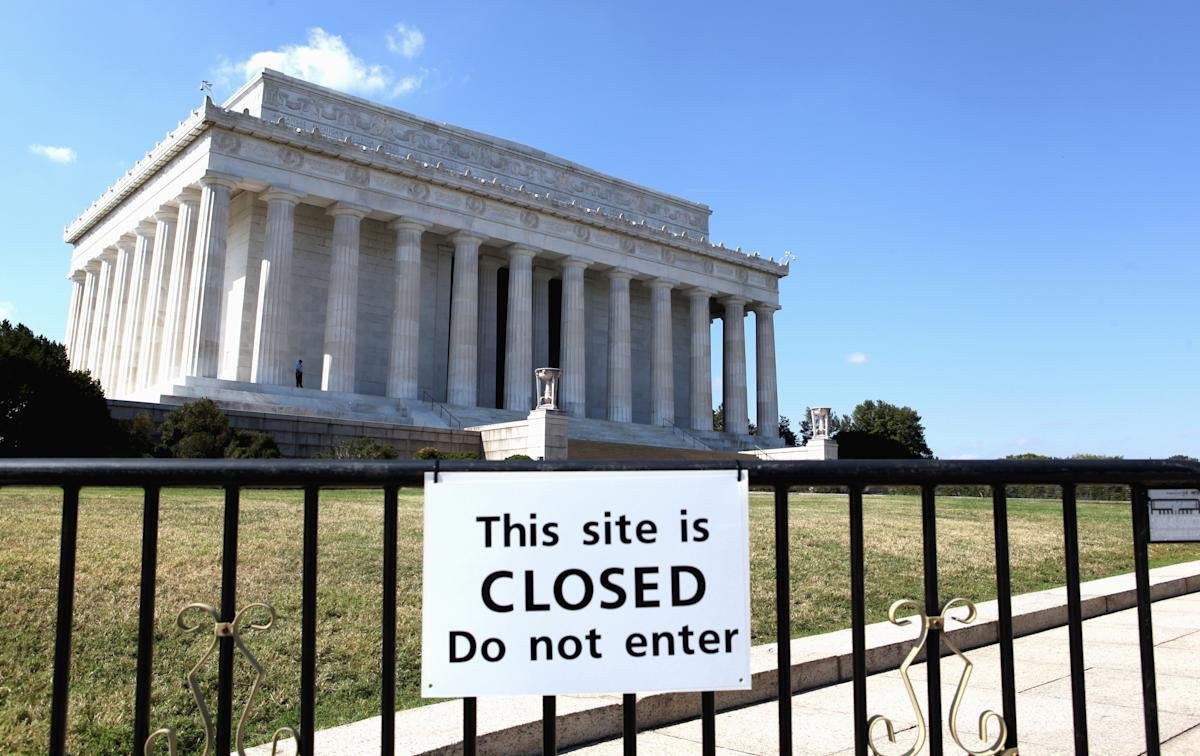
Other prominent closures in past shutdowns have been national parks, with everything from scenic natural areas to major tourist attractions shuttered.
A closed sign entrance for the Lincoln Memorial is seen during a government shutdown in 2013. (Basri Sahin/Anadolu Agency/Getty Images) ·Anadolu Agency via Getty Images
The IRS is also again set to close operations such as call centers during a shutdown. And regulators overseeing financial markets will be cut back.
The most recently available plan from the Securities and Exchange Commission (SEC) lays out a plan to only keep on hand an “extremely limited number of staff members available to respond to emergency situations.”
Getting a passport will still be possible, but historically has been more difficult with many government buildings closed.
After Monday’s Oval Office meeting, House Speaker Mike Johnson said “this is serious business” and ticked through the list of agencies that would face challenges, from FEMA to food assistance programs, adding, “All that which is funded by the government would stop.”
Meanwhile, many services would remain open.
Medicare benefits and Social Security checks will continue going out. And a number of entities — including the Federal Reserve — are expected to see minimal effects as they aren’t primarily funded by Congress’s annual appropriations process.
The nation’s public schools — those are funded at the local level — will also remain open, although some federally funded programs like Head Start have historically shuttered during stoppages.
Finally, the mail will still be delivered, as the US Postal Service is largely self-funded through things like the sale of stamps.
Ben Werschkul is a Washington correspondent for Yahoo Finance.
Click here for political news related to business and money policies that will shape tomorrow’s stock prices
Read the latest financial and business news from Yahoo Finance