US Politics
UN human rights rapporteur calls on United States to lift sanctions on Cuba

Your support helps us to tell the story
From reproductive rights to climate change to Big Tech, The Independent is on the ground when the story is developing. Whether it’s investigating the financials of Elon Musk’s pro-Trump PAC or producing our latest documentary, ‘The A Word’, which shines a light on the American women fighting for reproductive rights, we know how important it is to parse out the facts from the messaging.
At such a critical moment in US history, we need reporters on the ground. Your donation allows us to keep sending journalists to speak to both sides of the story.
The Independent is trusted by Americans across the entire political spectrum. And unlike many other quality news outlets, we choose not to lock Americans out of our reporting and analysis with paywalls. We believe quality journalism should be available to everyone, paid for by those who can afford it.
Your support makes all the difference.
Read more
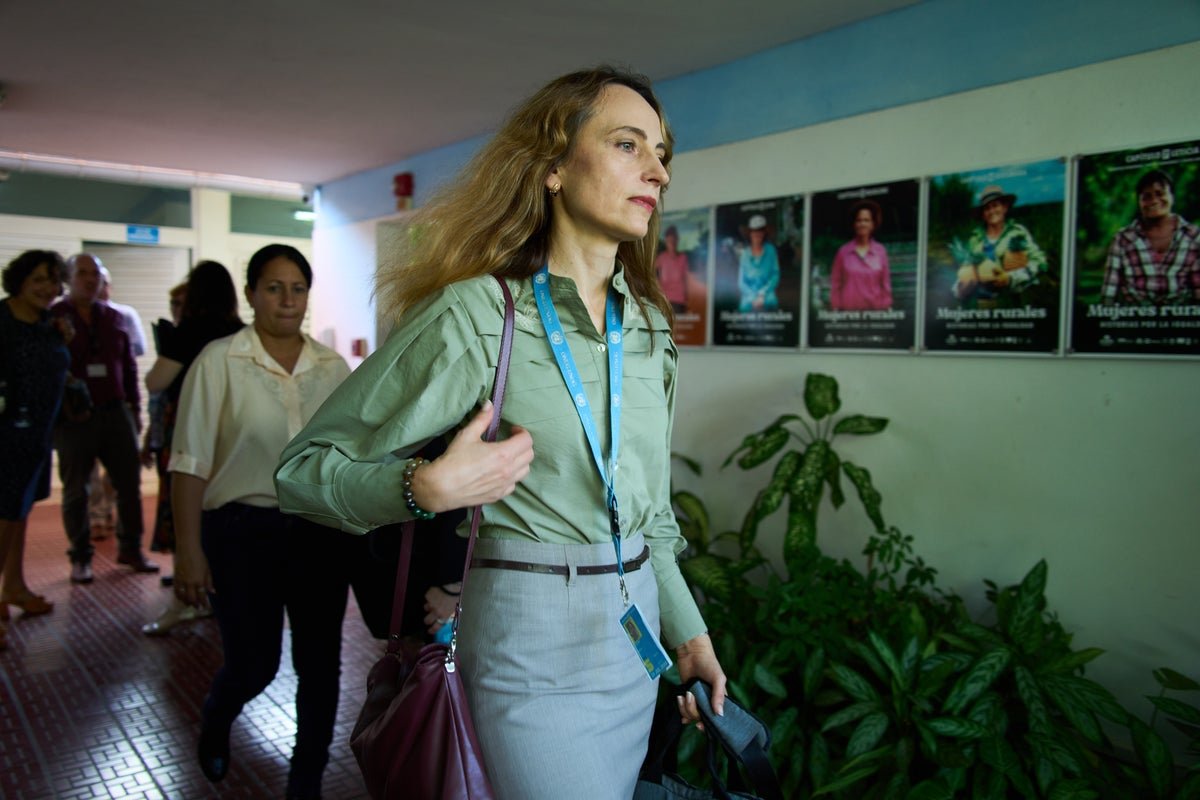
A United Nations human rights expert on Friday urged the United States to lift its sanctions on Cuba, saying they are impacting the island’s entire population, hitting sectors including health care, nutrition and education.
Alena Douhan, Special Rapporteur of the United Nations Human Rights Council, said it was her second visit to Cuba – her first was in 2023 – and that she has observed a further deterioration of all sectors due to stricter measures imposed by Washington.
“For the communities with low income, the higher inflation as well as the scarcity of resources makes it very difficult to even get proper nutrition,” she said, calling on the United States to stop using sanctions and “maximum pressure constraints.”
In late October, the U.N. General Assembly voted overwhelmingly to condemn the U.S. economic embargo of Cuba for a 33rd year.
Cuba has struggled since 2020 with an economic and energy crisis. Its gross domestic product has shrunk, and its 10 million residents have endured blackouts, food shortages and inflation. Cuban officials have blamed the economic squeeze on the COVID shutdowns, stricter U.S. sanctions and other factors.
“As we talk about children as a very vulnerable group, the fact that those kids are not getting sufficient meals means that the educational and cultural programs as well as the participation in any development activity of children are substantially reduced” because there are no resources to do it, she said.
Douhan said Cuban are being affected by a medicine shortage.
“As I reflected in my report, 69% of the medicine necessary for the people in Cuba are not available that is why we are observing the growing of the mortality rate,” she said.
The embargo was imposed in 1960 after Fidel Castro led a revolution that toppled dictator Fulgencio Batista and nationalized properties belonging to U.S. citizens and corporations.
In 2016, Cuban President Raul Castro and President Barack Obama officially restored relations. That year, the U.S. abstained, for the first time, on the General Assembly resolution calling for an end to the embargo.
Obama’s successor, Donald Trump, sharply criticized Cuba’s human rights record. The U.S. again voted against the resolution in 2017 and ever since.
Sanctions increased significantly during Trump’s first term, continued under his successor, President Joe Biden, and were tightened again after Trump returned to office this year.