US Politics
Trump oversees ‘historic’ ceasefire deal as Thailand and Cambodia end long-standing border dispute

Your support helps us to tell the story
From reproductive rights to climate change to Big Tech, The Independent is on the ground when the story is developing. Whether it’s investigating the financials of Elon Musk’s pro-Trump PAC or producing our latest documentary, ‘The A Word’, which shines a light on the American women fighting for reproductive rights, we know how important it is to parse out the facts from the messaging.
At such a critical moment in US history, we need reporters on the ground. Your donation allows us to keep sending journalists to speak to both sides of the story.
The Independent is trusted by Americans across the entire political spectrum. And unlike many other quality news outlets, we choose not to lock Americans out of our reporting and analysis with paywalls. We believe quality journalism should be available to everyone, paid for by those who can afford it.
Your support makes all the difference.
Read more
Donald Trump has hailed a “historic” ceasefire between Cambodia and Thailand after both nations signed an expansion of the peace deal to end their border conflict.
The US president, who was in Malaysia on Sunday, had used the threat of higher tariffs against both countries to force them to agree to end a century-old dispute that has killed dozens and displaced hundreds of thousands.
President Trump announced that both sides had agreed to cease all hostilities and that the “peace deal” would save millions of lives.
At least 18 Cambodian prisoners of war would be released following the ceasefire extension. The agreement mandates both sides to begin removing heavy weapons from the border.
The deal was signed shortly after Mr Trump landed in Malaysia, his first stop on a five-day tour of Asia. He watched as Cambodian prime minister Hun Manet and his Thai counterpart, Anutin Charnvirakul, signed the agreement at the annual summit of the Association of Southeast Asian Nations (Asean).
“We did something that a lot of people said couldn’t be done,” Mr Trump said. Mr Manet called it a “historic day”, and Mr Charnvirakul said the agreement created “the building blocks for a lasting peace”.
“Because of America’s strong commitment to stability and peace in this region and every region where we can do it, my administration immediately began working to prevent the conflict from escalating,” said Mr Charnvirakul, describing the agreement as a peace treaty. “We just did the deal and reported the deal. Everybody was sort of amazed that we got it done so quickly,” he said, noting that the United Nations was not involved.
Before the signing of the deal, Mr Manet thanked Mr Trump for his “decisive lead” and “tireless efforts” in July to end the conflict. “No matter how difficult and complex a dispute may be, they must be resolved by peaceful means,” he said.

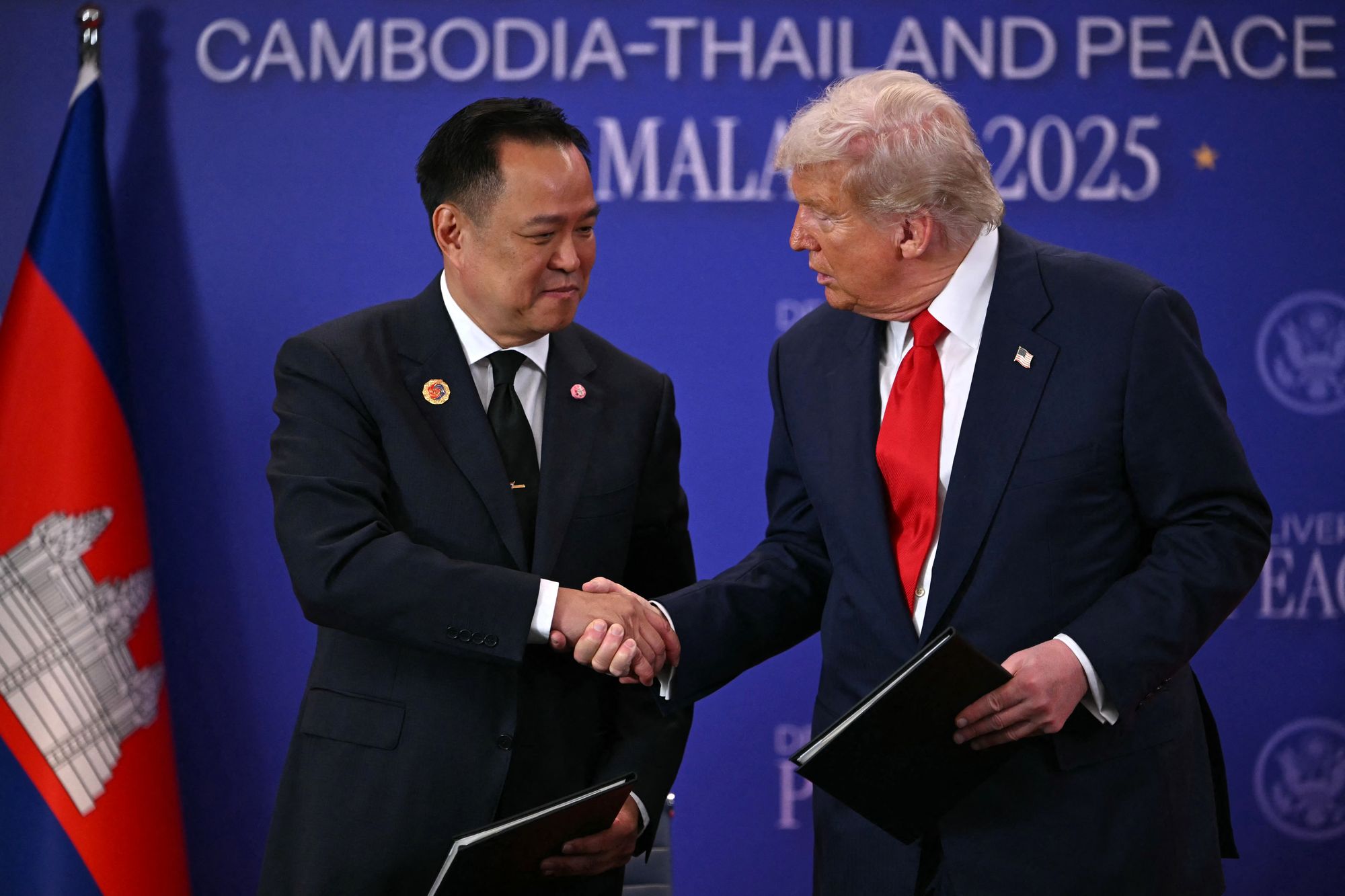
The two nations committed to establishing an Asean observer team, military de-escalation and removal of heavy weapons from the border area. They also agreed to coordinate the removal of landmines, which were the trigger for the fighting after a Thai soldier on border patrol was maimed.
Thailand has accused Cambodia, one of the world’s most landmine-scarred countries, of laying new ordnance, which it denies.
In July the two neighbours fought the worst border clashes in a decade, resulting in the deaths of nearly 40 people and displaced hundreds of thousands. Both sides traded artillery fire and airstrikes along contested stretches of their 817km border. They have competing territorial claims, and violence periodically flares along the border.
The violence began at a flashpoint near the ancient Ta Moan Thom temple in Thailand’s Surin province, and quickly spread to other disputed areas. Cambodian officials accused Thailand of launching airstrikes and dropping bombs on roads inside its territory.
A truce, brokered by the Malaysian prime minister, Anwar Ibrahim, was reached on 28 July after Mr Trump said he had spoken to the leaders of Thailand and Cambodia.
Mr Trump had threatened to withhold trade agreements unless the fighting stopped. A shaky truce has persisted since.
Earlier this month, Cambodia accused Thailand of broadcasting high-pitched “ghost sounds” along the disputed border after the country’s human rights commission urged the UN to investigate what it described as psychological warfare.
“This declaration reflects our will to resolve differences peacefully in full respect of sovereignty and territorial integrity,” Mr Charnvirakul said on Sunday.
Mr Trump also signed separate economic deals with Cambodia and Thailand. A White House official said he would also sign a critical minerals agreement with Malaysia.
The president’s trip will continue with visits to Japan and South Korea and could conclude with a meeting with the Chinese leader, Xi Jinping.