US Politics
Top diplomats of China, Cambodia and Thailand meet as Beijing seeks to strengthen role in dispute

Your support helps us to tell the story
From reproductive rights to climate change to Big Tech, The Independent is on the ground when the story is developing. Whether it’s investigating the financials of Elon Musk’s pro-Trump PAC or producing our latest documentary, ‘The A Word’, which shines a light on the American women fighting for reproductive rights, we know how important it is to parse out the facts from the messaging.
At such a critical moment in US history, we need reporters on the ground. Your donation allows us to keep sending journalists to speak to both sides of the story.
The Independent is trusted by Americans across the entire political spectrum. And unlike many other quality news outlets, we choose not to lock Americans out of our reporting and analysis with paywalls. We believe quality journalism should be available to everyone, paid for by those who can afford it.
Your support makes all the difference.
Read more
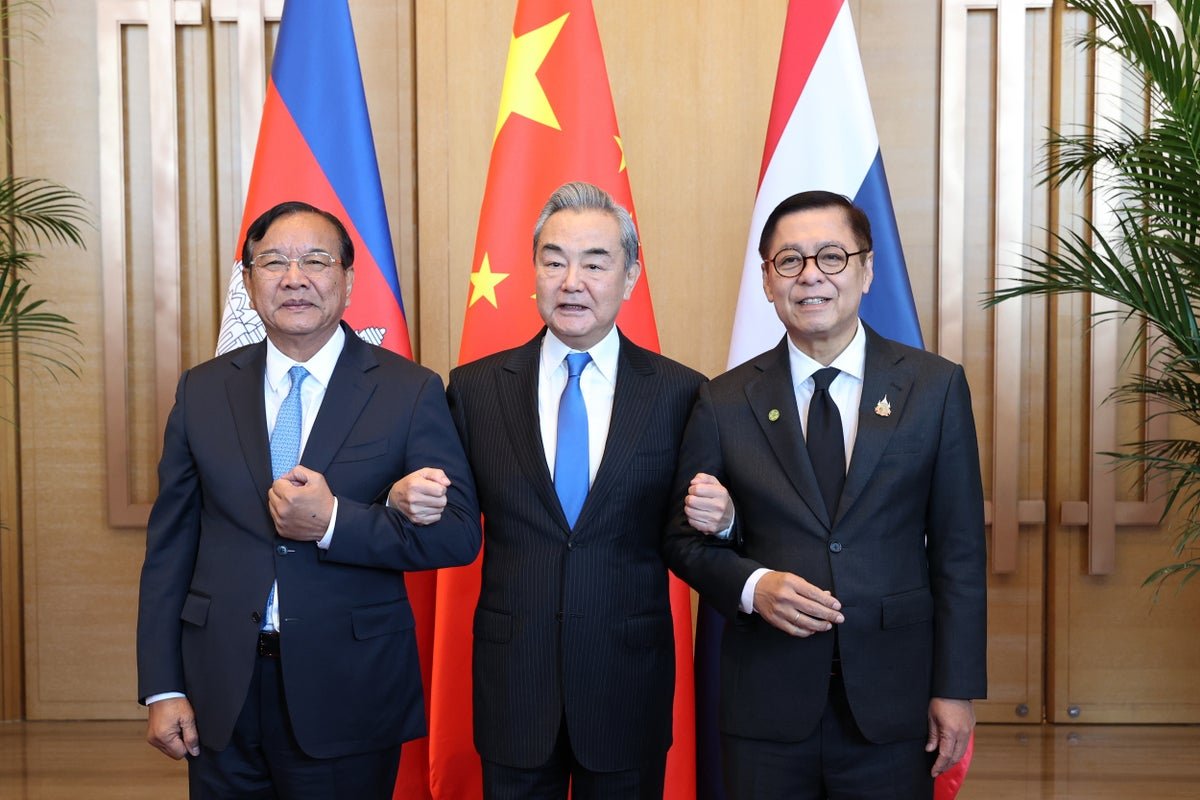
Foreign ministers from Cambodia and Thailand convened with their Chinese counterpart on Monday as the Beijing government, building on its expanding presence in the world diplomatic arena, sought to play a stronger mediating role in the violent border dispute between the two Southeast Asian countries.
The trilateral meeting, held in a southwestern Chinese province north of the contested border, came two days after Thailand and Cambodia signed a fresh ceasefire agreement to end weeks of fighting that killed more than 100 people and forced hundreds of thousands to be evacuated on both sides of the border.
Chinese Foreign Minister Wang Yi called for joint efforts to promote regional peace, stability and development, which is language typical for China in such situations.
“Allowing the flames of war to be reignited is absolutely not what the people of the two countries want, and not what China, as your friend, wants to see. Therefore, we should resolutely look ahead and move forward,” Wang said during the meeting Monday in Yunnan province.
It was noteworthy that the meeting was held there, nearer to the dispute and to Southeast Asia, rather than in Beijing, the Chinese capital and seat of government about 1,300 miles (2,500 kilometers) northeast.
Hopes for peace expressed
Cambodian Foreign Minister Prak Sokhonn said he believed the latest ceasefire would last and would create an environment for both countries to work on their relations and resume the previously agreed-upon ways to settle their differences, according to a Chinese interpreter.
Thai Foreign Minister Sihasak Phuangketkeow also expressed hopes for peace with neighboring countries, the interpreter said.
The Thai Foreign Ministry later said in a statement that China volunteered to be a platform to support peace between the two countries and Thailand reiterated that adjustments of ties should be conducted “on a step-by-step basis.”
“The Thai side will consider the release of 18 soldiers after the 72 hours ceasefire observation period and requests that Cambodia facilitate the return of Thais along the border,” the ministry said.
A day after the fresh pact was signed, Sihasak and Prak Sokhonn held separate meetings with Wang on Sunday, the first day of the two-day gathering.
The meetings represented China’s latest efforts to strengthen its role as an international mediator and, in particular, its influence in Asian regional crises. As China grows and becomes more of an economic and political force regionally and globally, Beijing has spent the past decade and more working in various ways to increase its voice as a third party in diplomatic matters.
Disputes continue
The two Southeast Asian countries originally reached a ceasefire in July. It was brokered by Malaysia and pushed through under pressure from U.S. President Donald Trump, who threatened to withhold trade privileges unless Thailand and Cambodia agreed. The preliminary pact was followed by a more detailed October agreement.
But Thailand and Cambodia carried on a bitter propaganda war, with minor, cross-border violence continuing. The tensions erupted into heavy fighting in early December.
The Saturday agreement calls for Thailand, after the ceasefire has held for 72 hours, to repatriate 18 Cambodian soldiers who have been held prisoner since the earlier fighting in July. Their release has been a major demand of the Cambodian side.
The agreement also calls on both sides to adhere to international agreements against deploying land mines, a major concern of Thailand.
Cambodian Prime Minister Hun Manet on Monday issued a statement to all Cambodian combatants along the border with Thailand.
“Even though we can still fight,” he said, “as a small country we still have nothing to gain from prolonging the fighting for a long time.”
___
Sopheng Cheang in Phnom Penh, Cambodia, and Liu Zheng in Beijing contributed to this report.