
Breaking News
Republicans fear Trump backlash could cost them Senate control

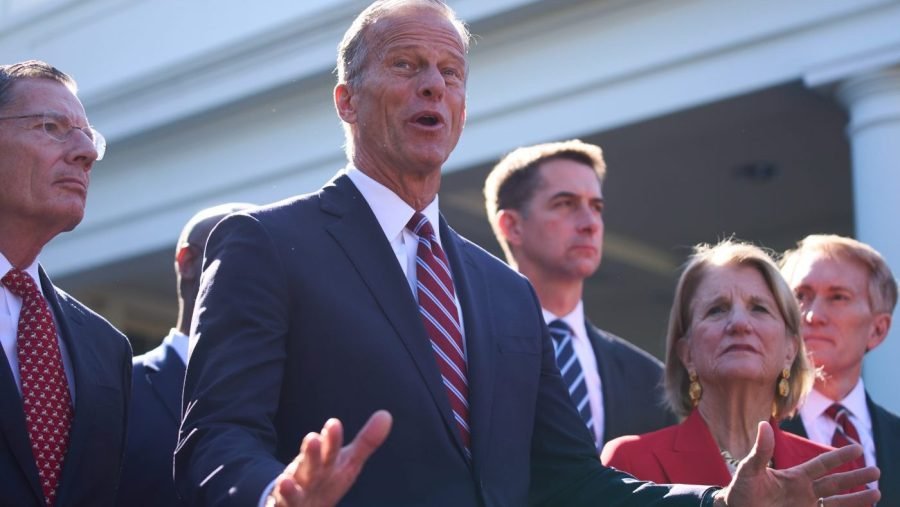
Senate Republicans are concerned that public backlash to President Trump’s handling of the economy and his aggressive deportation policies could give rise to a Democratic wave that not only sweeps away the House Republican majority, but also threatens their own three-seat majority in the upper chamber.
The latest alarm bell rang over the weekend when Democratic candidate Taylor Rehmet won a state Senate seat in a North Texas district that President Trump won by 17 points in 2024, a stunning upset that GOP senators say should serve as a “wake-up call” heading into November.
One GOP senator who attended a Tuesday briefing at the National Republican Senatorial Committee (NRSC) said concern over the approaching midterms “should be very, very high.”
The lawmaker called Saturday’s loss in the Texas special election “a wake-up call” and said Republican senators in battleground states, such as Sen. Susan Collins (R) in Maine and retiring Sen. Thom Tillis (R) in North Carolina, have repeatedly warned Senate colleagues that the party faces a “deteriorating” political environment.
“Senators are saying more and more loudly that they’re very, very concerned about the environment, that it’s continuing to deteriorate. They say it over and over again,” the senator said of discussions within the GOP conference about “political headwinds” facing GOP candidates.
Sen. Ted Cruz (R-Texas) called Rehmet’s 14-point victory in Tarrant County despite being heavily outspent by his Republican opponent “a rough night.”
“It underscores the need for Republican turnout in November,” he warned.
Republicans think they have a good chance of keeping control of the upper chamber, but they’re not dismissing the possibility that a Democratic wave could grow so large that it sweeps Democrats to victory in Republican-leaning states such as Ohio, Alaska or possibly Iowa.
Senate Republicans control a 53-seat majority, and Vice President Vance can break ties, which means Democrats need a net gain of four seats to recapture the upper chamber.
A second Republican senator who requested anonymity told The Hill that voters across the political spectrum aren’t happy with Trump’s handling of the economy and inflation, and a growing number of independents are turned off by his administration’s aggressive deportation tactics in Minneapolis.
“Republicans are right to be worried about the midterms,” the lawmaker said. “You can feel when the water temperature changes, and it feels like it’s going to change in a second.”
Senate Majority Leader John Thune (R-S.D.) said Republicans need to do a better job of talking about their efforts to cut taxes and reduce regulation to spur economic growth.
“I don’t take any of these elections lightly. I think what happened in Texas … it’s something that ought to capture our attention and remind us we need to up our game and do a better job of not only putting up a record of accomplishment for the American people, but then being able to deliver that message,” Thune said after Republican senators received a briefing on this year’s battle for the Senate.
Senate Republicans said NRSC Chair Tim Scott (R-S.C.) was careful at Tuesday’s meeting not to sound too alarmed about Senate Republicans’ chances in November, but they said he has privately confided his concern about recent polling trends.
Trump’s approval rating stands at 42.2 percent and his disapproval rating is 54.6 percent, according to an average of recent national polls compiled by Decision Desk HQ.
A Harvard CAPS/Harris poll released Monday showed 51 percent of voters thought Trump was doing a worse job as president than former President Biden.
A CNN poll conducted by SSRS and published in mid-January found 55 percent of Americans said Trump’s policies have worsened economic conditions, while 32 percent said the economy has gotten better under Trump.
A Fox News poll of 1,005 registered voters conducted in late January found 54 percent of respondents thought the country was worse off today than a year ago, while 31 percent said things had gotten better. And the poll found 7 in 10 registered voters said the economy is in bad shape.
A third GOP senator who requested anonymity said history shows the midterm election of a president’s second term is usually a bloodbath for the president’s party. The Republican lawmaker pointed to 2014, when Republicans picked up nine Democratic-held Senate seats during President Obama’s second term.
The huge gain allowed Republicans to capture control of the Senate after eight years in the minority.
Democrats had recaptured the Senate in 2006, the midterm elections of former President George W. Bush’s second term.
“It’s the typical six-year itch election, second midterm,” the lawmaker said of this year’s election. “There’s going to be a blue wave — if there was a Democrat in power, there’d be a red wave. It’s the major of midterms.
“The question is it going to be 2 feet, 5 feet or higher than that. It’s still too early to predict what’s going to happen, but clearly we’re more on the defense,” said the Republican senator, who argued the electoral map favors Republicans.
Only one Republican incumbent, Collins, is running in a state that voted for Biden in 2020 and former Vice President Kamala Harris in 2024.
Democrats may have their best pickup opportunity in North Carolina, a state Trump carried by 3 points in 2024. There they have recruited popular former Gov. Roy Cooper (D) to run for Tillis’s open seat.
Tillis was expected to run for reelection but surprisingly announced his retirement after Trump excoriated him on social media for balking at Medicaid cuts in the One Big Beautiful Bill Act that Republicans passed last year to enact Trump’s tax agenda.
Tillis has repeatedly warned that if voters’ views of the economy don’t shift substantially by the second quarter of 2026, Republicans could be in for a rough election night in November.
Other incumbents who could face competitive general election races — Sens. Jon Husted (R-Ohio), Dan Sullivan (R-Alaska), John Cornyn (R-Texas) and Ashley Moody (R-Fla.) — are running in states Trump won handily in 2020 and 2024.
And Democrats have to defend their seats in swing states such as Georgia, where Sen. Jon Ossoff (D-Ga.) is a top Republican target, and in Michigan, Minnesota and New Hampshire, where Democratic incumbents are retiring at the end of this year.
GOP lawmakers said they might shrug off a Democratic upset win in a remote part of deep-red Texas, but they’re worried it’s part of a pattern of strong Democratic performances in recent months.
Polls show rising voter dissatisfaction over the economy has coincided with Democrats winning sweeping victories in New Jersey’s and Virginia’s gubernatorial and state-level races late last year and a surprisingly strong Democratic showing in a Tennessee special election in December.
Some Republicans fear Trump’s unpopularity is spreading to some GOP incumbents.
A Morning Consult tracking poll of voters across 50 states found Collins and Sullivan had 54 percent and 47 percent disapproval ratings, respectively. The survey published late last month found that only retiring Sen. Mitch McConnell (R-Ky.) had a higher disapproval rating, at 63 percent.
Thune argued Tuesday that Republican candidates are well-positioned and will have tens of millions of dollars spent in their defense this fall.
“We feel really good about where our Senate races are. The Dems are targeting a number of our incumbents, and so we got some races that are going to be expensive and hard-fought in places like Maine and North Carolina. The Democrats are bullish on other states like Ohio and Alaska,” he said.
But the Senate GOP leader acknowledged in December that Republicans face “headwinds” heading into November after Democratic candidate Aftyn Behn turned in a strong showing in the special election to represent Tennessee’s 7th Congressional District, which Trump won by 22 points in 2024.
“We have to sharpen our message and make sure that we’re giving people a reason to vote for us in the midterms next year,” he cautioned.
Copyright 2026 Nexstar Media, Inc. All rights reserved. This material may not be published, broadcast, rewritten, or redistributed.
For the latest news, weather, sports, and streaming video, head to The Hill.