
President
Montana mechanic walks free after more than 100 days in jail on immigration charges

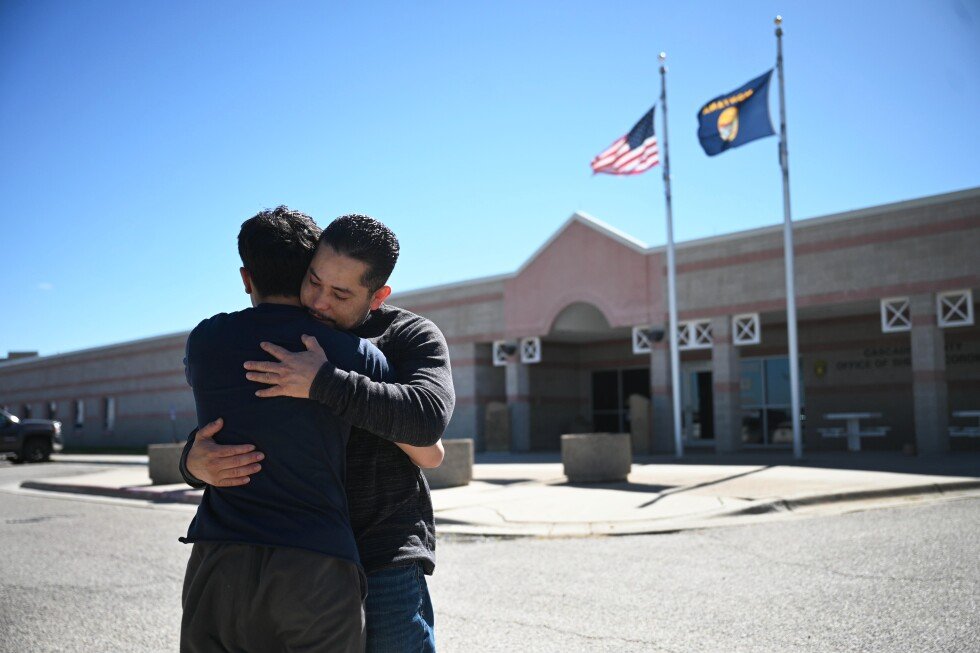
A federal judge in Great Falls ruled to release Froid diesel mechanic Roberto Orozco-Ramirez from jail on Wednesday evening, siding with his lawyers on their argument that his continued detention was unlawful. On Thursday around 10:50 a.m., after more than 100 days behind bars, Orozco-Ramirez walked out of the Cascade County Detention Center and embraced his oldest son.
Both wiped tears from their eyes and got in the car to return to Froid, where dozens of people planned to celebrate his return.
“I need to go home,” Orozco-Ramirez said. “It’s been a long time, but we made it.”
“Let’s get you the hell out of here,” said his lawyer, Laura Christoffersen.
In a court filing Wednesday, U.S. District Court for the District of Montana Chief Judge Brian Morris wrote that Orozco-Ramirez, an undocumented immigrant, who has been detained since January, should be released from Cascade County Detention Center in Great Falls within 24 hours. Morris called the Trump administration’s interpretation of the longstanding immigration law “erroneous” and said people accused of entering the country illegally have a right to due process.
“Such indifference from the executive branch to the Constitution’s guarantee of freedom from arbitrary confinement represents grave cause for concern,” he stated in a ruling.
“I’m excited of course,” Orozco-Ramirez’s 19-year-old son, Roberto Orozco-Lazcano said, sitting in a car outside the detention center Thursday morning, awaiting his father’s release. “This is the news I’ve been waiting for for so long.” He said he was cooking mole Wednesday night at home when his mom told him about the judge’s ruling.
“I really couldn’t believe it,” he said.
Christoffersen, Orozco-Ramirez’s lawyer, said she was celebrating the ruling.
“A person, alien or not, cannot be deprived of his liberty without the right to be heard or statutory procedures followed,” she said, standing in the waiting area of the Cascade County Detention Center Thursday morning. “The credit here is all due to the good people of Froid, my hometown, of which I am so proud. They were able to raise the money needed to find an expert in immigration law in the matter of a couple of days.”
Froid residents raised tens of thousands of dollars for Orozco-Ramirez’s legal fund and family since he was arrested in January. Johnny Sinodis, a California-based immigration attorney, represented Orozco-Ramirez in court on Tuesday.
Marvin Qualley, a school bus driver and farmer who is close with Orozco-Ramirez and his family, said he was “really excited” to hear the news of his release.
“I saw the other three boys this morning,” Qualley said of Orozco-Ramirez’s three other sons. “And they were just ecstatic. It was pretty cool.”
This is the second case the Froid resident’s lawyers effectively won. In April, lawyers for the government dropped the felony illegal re-entry charge against him. Within days, Orozco-Ramirez’s lawyers filed a civil lawsuit against various law enforcement and federal entities, including the Cascade County Detention Center and U.S. Customs and Immigration Enforcement (ICE), alleging that his continued detention was unlawful.
Though judges in New York, Georgia and Ohio have made similar rulings on similar cases involving undocumented immigrants in recent months, this seems to be the first ruling of its kind in Montana.
Randy Tanner, a lawyer for the U.S. Attorney’s Office for the District of Montana, who represented various law enforcement and federal agencies in court, said his office was reviewing the judge’s order but did not comment on the ruling.
HOW A DIESEL MECHANIC ENDED UP IN JAIL
Orozco-Ramirez, a diesel mechanic, Little League coach and father of four, was arrested by Border Patrol on Jan. 25 and has been detained ever since. His January arrest shocked the tiny, conservative, northeast Montana town of Froid, population 195, and has captured the attention of people far beyond the state.
The federal government initially charged Orozco-Ramirez with illegal re-entry in January. A citizen of Mexico, Orozco-Ramirez came to the U.S. as a minor, was deported in 2009 and has been living in Froid for the last decade. His lawyers fought the illegal re-entry charge, and on April 13, the government dropped the charge. But for the last month, Orozco-Ramirez — like thousands of undocumented immigrants across the country — has remained detained.
Days after the government dropped its illegal reentry charge, federal immigration enforcement officials transferred Orozco-Ramirez around 100 miles away to the Havre Sector Border Patrol office. Then, between April 16 to May 4, federal immigration enforcement officials moved him across the West, transferring him from there back to the Cascade County Detention Center, to a county jail in Idaho, to a federal immigration facility in Washington, to a federal facility in Arizona, back to the county jail in Idaho and, eventually, back to the Cascade County Detention Center in Great Falls, where he has been since May 4.
HIS LATEST DAY IN COURT
On Tuesday, about 50 people — many of whom drove seven hours from Froid to attend — filled all six wooden benches inside a court room in the Great Falls federal courthouse to hear a judge rule on the civil case.
Wearing jeans and black Orozco Diesel sweatshirts, Orozco-Ramirez’s four sons, ages 8 to 19, sat in the front row. Their classmates sat beside them. Among other attendees were the boys’ school bus driver, school superintendent and their friends’ parents. People like Jill Joyce, who lives three hours away in Gallatin Gateway and who had never met Orozco-Ramirez but wanted to show him support, also showed up. Students from Froid, who weren’t able to attend, gathered early Tuesday morning to take a picture wearing Orozco Diesel shirts to demonstrate support.
Much of the Tuesday hearing centered around the Trump administration’s new interpretation of decades-old immigration policy. Last July, ICE issued a legal memo expanding criteria for which immigrants the agency considers eligible for mandatory detention.
Previously, undocumented immigrants who had been living in the U.S. long-term with no criminal history were eligible for bond. Under the new guidance, those who enter the country illegally are subject to mandatory detention and not eligible for bond.
That new interpretation of the law has been the subject of legal battles amid the Trump administration’s national immigration crackdown. Federal appeals courts based in New York, Georgia and Ohio have rejected the Trump administration’s no-bond policy. But circuit courts headquartered in Louisiana and Missouri have sided with the Trump administration on the issue. Until Wednesday, no judge in Montana had weighed in on the legal question at hand.
Orozco-Ramirez’s lawyers are separately challenging his initial deportation in 2009 in the 9th Circuit Court of Appeals. Because that case is ongoing, they say federal immigration enforcement officials cannot legally detain or deport Orozco-Ramirez unless something drastically changes in his case. Sinodis, Orozco-Ramirez’s lawyer, said he was happy Orozco-Ramirez could reunite with his family.
“Roberto is a truly exceptional individual, as can be easily seen by the outpouring of support that the community has given him and his family,” he wrote in an emailed statement to Montana Free Press. “Unfortunately, countless other productive and well-respected individuals throughout the country are being subjected to unlawful physical confinement in immigration jails for no other reason but to appease the administration.”
Standing outside the federal courthouse in Great Falls on Tuesday afternoon, Dana Strandlund, a welder in Froid, said he thought Orozco-Ramirez’s detention was “senseless” and “cruel.”
“It was always so distant,” he said of the topic of immigration. Orozco-Ramirez’s arrest, he added, was a shock to people who never thought Trump’s national immigration crackdown would reach their rural, conservative and mostly white corner of the state.
“But then again, during the run-up to the elections, it’s all you hear about on the radio and T.V.,” he said.
News of Orozco-Ramirez’s release spread across social media on Thursday. While many celebrated his release, others critiqued his approach to entering the United States.
If immigrants like Orozco-Ramirez are “such great people, why didn’t they come here the legal way?,” one commenter wrote in response to MTFP’s article on Facebook.
“The man actually works and has for a long time,” another commenter wrote on the same thread. “Give him U.S. citizenship, now.”
___
Mara Silvers contributed reporting.
___
This story was originally published by Montana Free Press and distributed through a partnership with The Associated Press.