
Breaking News
Hawaii’s Kilauea volcano erupts, blasting lava 1,000 feet into the sky

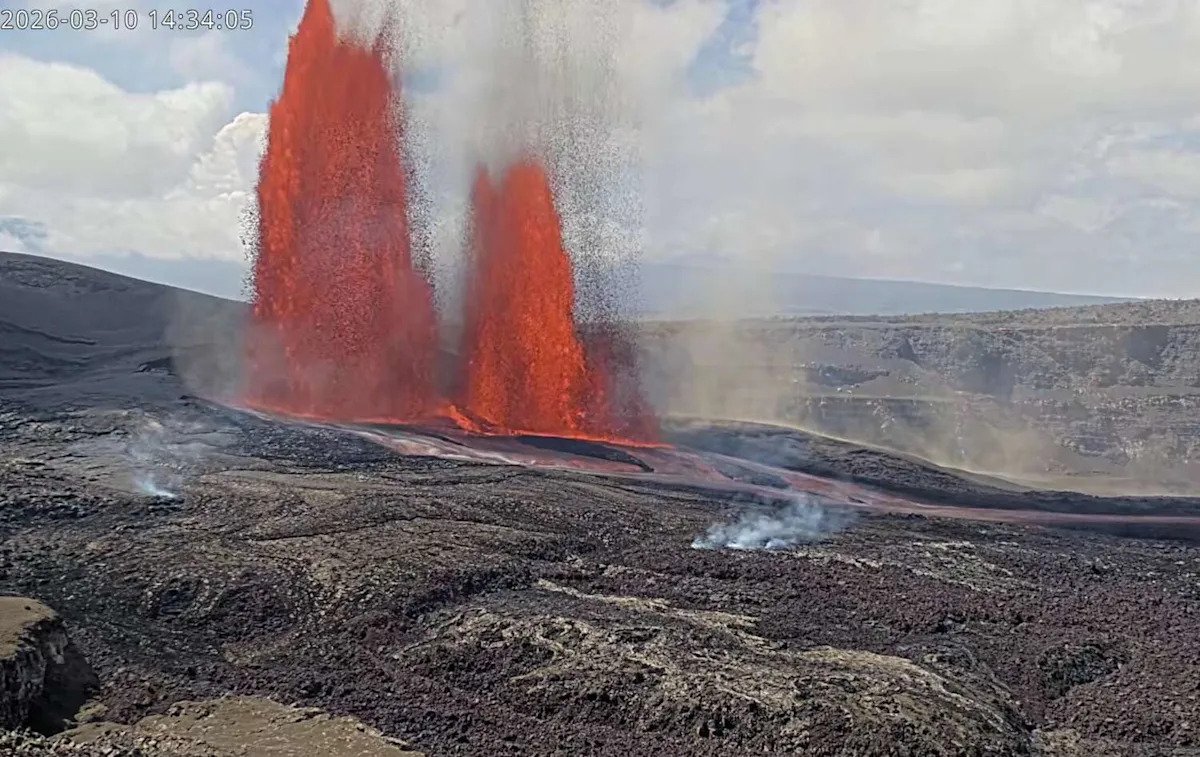
Lava from Hawaii’s Kilauea volcano shot as high as 1,000 feet into the air Tuesday, sending ash and volcanic debris across parts of the Big Island and forcing officials to close sections of Hawaii Volcanoes National Park and a key highway.
The eruption began at about 9:17 a.m. Hawaii time inside Halemaʻumaʻu crater at Kilauea’s summit, according to the U.S. Geological Survey’s Hawaiian Volcano Observatory.
Scientists said the eruption – the 43rd episode since the volcano reawakened in December 2024 – quickly intensified into towering fountains of molten rock and thick plumes of smoke.
A livestream from the crater showed bright-red lava jets bursting skyward as volcanic fragments rained down on nearby areas.
“Vigorous fountaining has started,” Hawaii Volcanoes National Park officials wrote in a Facebook update.
Authorities closed the park’s summit area because of “significant tephra fall,” the term for fragments of volcanic rock, ash and glass blasted from eruptions.
Officials had reported no injuries or structural damage as of early Tuesday evening.
Falling debris also forced the closure of a roughly 16-mile stretch of Highway 11 between mile markers 24 and 40, a major route circling the island, according to the Hawaii County Civil Defense Agency and the state Department of Transportation.
Officials warned that some debris falling from the sky was unusually large.
“Golf course housing and Highway 11 are being hit with tephra up to 5 inches,” observatory monitors said in a field update.
Communities near the park, including Volcano Village and Mauna Loa Estates, reported volcanic fragments and ash falling across roads and properties, according to local authorities. One resident reported more than an inch of tephra accumulating on roads in a nearby golf course subdivision, the USGS said.
The National Weather Service issued an ashfall warning for areas downwind of the eruption, including Mountain View, Glenwood and other communities around the volcano.
Officials warned that ash and volcanic glass can irritate the eyes, skin and respiratory system and can also contaminate rainwater collection systems common across parts of the island.
County officials opened an evacuation shelter at a district gymnasium to assist residents or travelers affected by the road closures, though no one had checked in shortly after it opened, county spokesperson Tom Callis said.
Despite the dramatic display, scientists said lava flows remain confined to the crater within Hawaii Volcanoes National Park and have not threatened homes or buildings.
Kilauea, one of the world’s most active volcanoes, has been erupting intermittently for more than a year, with previous episodes sending lava fountains more than 1,100 feet into the air, according to the U.S. Geological Survey.
The eruption comes as a powerful storm system is forecast to bring torrential rain and possible flooding across Hawaii this week, the National Weather Service said.
The Associated Press contributed to this report.
This article originally published at Hawaii’s Kilauea volcano erupts, blasting lava 1,000 feet into the sky.