US Politics
Finally, Donald Trump has realised he’s been played by Israel

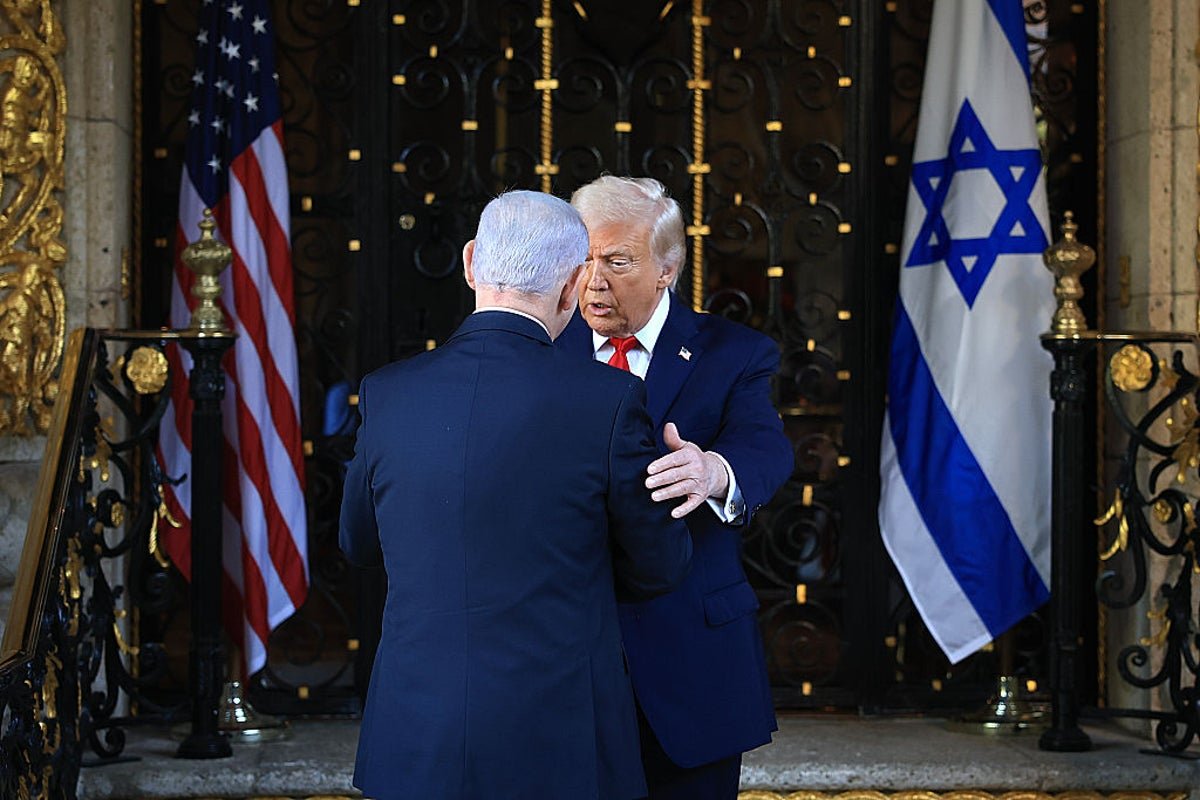
The public spat between Donald Trump and Benjamin Netanyahu about the conduct of the war with Iran has raised a familiar charge that both are now involved in “mission creep”.
That phrase – not heard much in this conflict so far – has been a favourite cliché in the commentary of most wars over the past 75 years, from Suez and Vietnam, to the decade-long international ventures in Iraq and Afghanistan this century.
Mission creep is when a military operation is extended beyond the original intent and scope – breaching the original mandate and budget.
Trump is furious, according to Israel’s Channel 12 television, about Benjamin Netanyahu’s call for a general insurrection across Iran following the assassination of the lead negotiator Ali Larijani, and the commander of the Basij public order militia, Gholamreza Soleimani.
Despite having urged regime change in the first hours of the war on 28 February, Trump slammed Israel’s PM for telling the US to exhort all Iranians to take the streets to overthrow the regime, which according to Israel intelligence is cracking up. “Why the hell should we tell people to take to the streets when they’ll just get mowed down?” Trump is reported to have told Netanyahu in a phone call.
They agreed to wait to see if Iranians would use the annual festival of fire, Chaharshanbe Suri, for mass street demonstrations. “Our aircraft are hitting the terrorist operatives on the grounds, the crossroads, the city squares,” Netanyahu allegedly claimed. “This is meant to enable the brave people of Iran to celebrate the Festival of Fire.”
For Trump, this is mission creep. The White House is suggesting that popular uprising and revolution were not part of the original war plan – even though for the government in Jerusalem regime change is a core aim. This week, Trump has told Republicans in Congress that his aim was the destruction of Iran’s ballistic missile forces, nuclear arsenal potential, Iranian’s navy, and support for terrorist proxy groups. He has not mentioned regime change for weeks.
Fearing Trump wants to cut a deal to end hostilities this weekend, Netanyahu is reported to have asked his generals to mount an “all-out blitz on top targets” in Iran over the next 48 hours.
The closure of the Straits of Hormuz, and the choking of oil and gas exports from the Persian Gulf, seem have dented Trump’s belief that his Iran ‘excursion’ could be over soon. He, too, seems on the cusp of mission creep by ordering two Marine Expeditionary Groups and a battle group of paratroopers from the 82nd Airborne Division to the Gulf – a roster of more than 10,000 soldiers. According to Pentagon leaks, the ground forces could take and occupy the major oil terminal at Kharg Island in the upper Gulf, and Larak Island near the critical narrows of the Straits themselves.
Landing commandos and paratroopers without any formal ceasefire agreement in place, and trying to force passage of the Straits, is a huge gamble. Ground operations weren’t in the original plan, which was pretty sketchy at best. Nor was the need for the most sophisticated air defence missiles , THADD, which had to be moved hastily from South Korea to shore up anti-missile defences in Israel and the Gulf states, where they have been distinctly lacking.
Mission creep means trouble. Once forces are committed in hot spots, plans have to be adjusted and augmented to meet new threats. But the large expansion of missions – such as the UK’s to Iraq from 2003 and in Afghanistan from 2001 – had to be called to account. In 10 years, the UK increased its forces in Helmand from 3,000 troops to nearly 20,000 at one point.
We seem to be looking at a similar expansion in both the US and Israeli military effort against Iran and its proxies like Hezbollah in Lebanon. Both the Israelis and Americans talk of “escalation management” – based on the shaky notion that you need to escalate and reinforce in order to get out more quickly.
Few Israelis expect a quick resolution to the battle with Iran, however. Here another piece of modern strategic jargon comes into play. Some of the most realistic Israeli commanders and strategists are resigned to the tactics of “mowing the grass”. This means that you have to fight to defeat foes like Hamas, Hezbollah, the IRGC and the Iranian state even, on a serial and generational basis. It became accepted doctrine of IDF Israeli commanders in Gaza from 2018 that fighting Hamas would be like mowing grass, a cycle due to be repeated as Hamas grew and trained each new crop of fighters.
There is silent recognition that the regime and its security network is far from destroyed. Some of the most far-sighted British commanders confronting the Taliban insurgents in Helmand, John Lorimer and Mark Carelton-Smith, who both ended their careers as generals, realised that they were involved in a grass-mowing campaign – and that the Taliban was an enduring and endemic culture.
Two other military terms once in vogue to the commentariat deserve a comeback – exit strategy and, more technically, the notion of an operational ‘end state.’ Today we heard of ‘off ramp’ solutions – a buzzword for a quick and dirty get-out from an awkward crisis like Iran and the Hormuz Straits trap. Instead the plan for Trump’s ‘excursion’ should have had a clear end state for operations, and then an exit strategy of how to get out and go home. In the inebriated videogame thinking of Pete Hegseth’s Pentagon I suspect there was no such thing.
So there now looms the spectre of the most hackeneyed military cliché in the book: never reinforce failure. In the fog of war now enveloping the Middle East, I fear the forces of Operation Roaring Lion and Epic Fury may be about to do just that – escalate their missions, and reinforce failure.