US Politics
Fears Trump will veto G7 joint statement on Russia sanctions and Israel

Your support helps us to tell the story
From reproductive rights to climate change to Big Tech, The Independent is on the ground when the story is developing. Whether it’s investigating the financials of Elon Musk’s pro-Trump PAC or producing our latest documentary, ‘The A Word’, which shines a light on the American women fighting for reproductive rights, we know how important it is to parse out the facts from the messaging.
At such a critical moment in US history, we need reporters on the ground. Your donation allows us to keep sending journalists to speak to both sides of the story.
The Independent is trusted by Americans across the entire political spectrum. And unlike many other quality news outlets, we choose not to lock Americans out of our reporting and analysis with paywalls. We believe quality journalism should be available to everyone, paid for by those who can afford it.
Your support makes all the difference.
Read more
Efforts by the world’s biggest democracies to toughen sanctions against Russia and hold a joint position on the Middle East crisis look set to be thrown into chaos by Donald Trump.
The US President, who landed in Alberta, Canada late on Sunday night, opened off his remarks at the G7 summit by suggesting it had been a “mistake” to boot Russia out of the former G8.
It had already been reported by CBS News that Trump does not intend to sign a G7 statement related to Israel and Iran, citing unnamed U.S. officials.


open image in gallery
A draft document discusses monitoring Iran, calls for both sides to protect civilians and reups commitments to peace, according to CBS News.
With the crisis escalating between Iran and Israel, the Middle East has become the top priority of the summit with Sir Keir joining others in urging for a “de-escalation”.
But the situation with the Ukraine war is an added complication for those present.
In a briefing with journalists ahead of a session discussing sanctions on Russia, the UK prime minister’s spokesman was unable to confirm if there would be a joint position on sanctions.
While details of a new sanctions regime are set to be revealed on Tuesday, the second and final day of the summit, it is widely believed that President Trump will not support the other members of the G7.
The Downing Street spokesman said he “did not want to get ahead of the meetings” and would not comment specifically on the UK’s understanding of the US position while underlining Sir Keir’s “warm relationship” with the president.

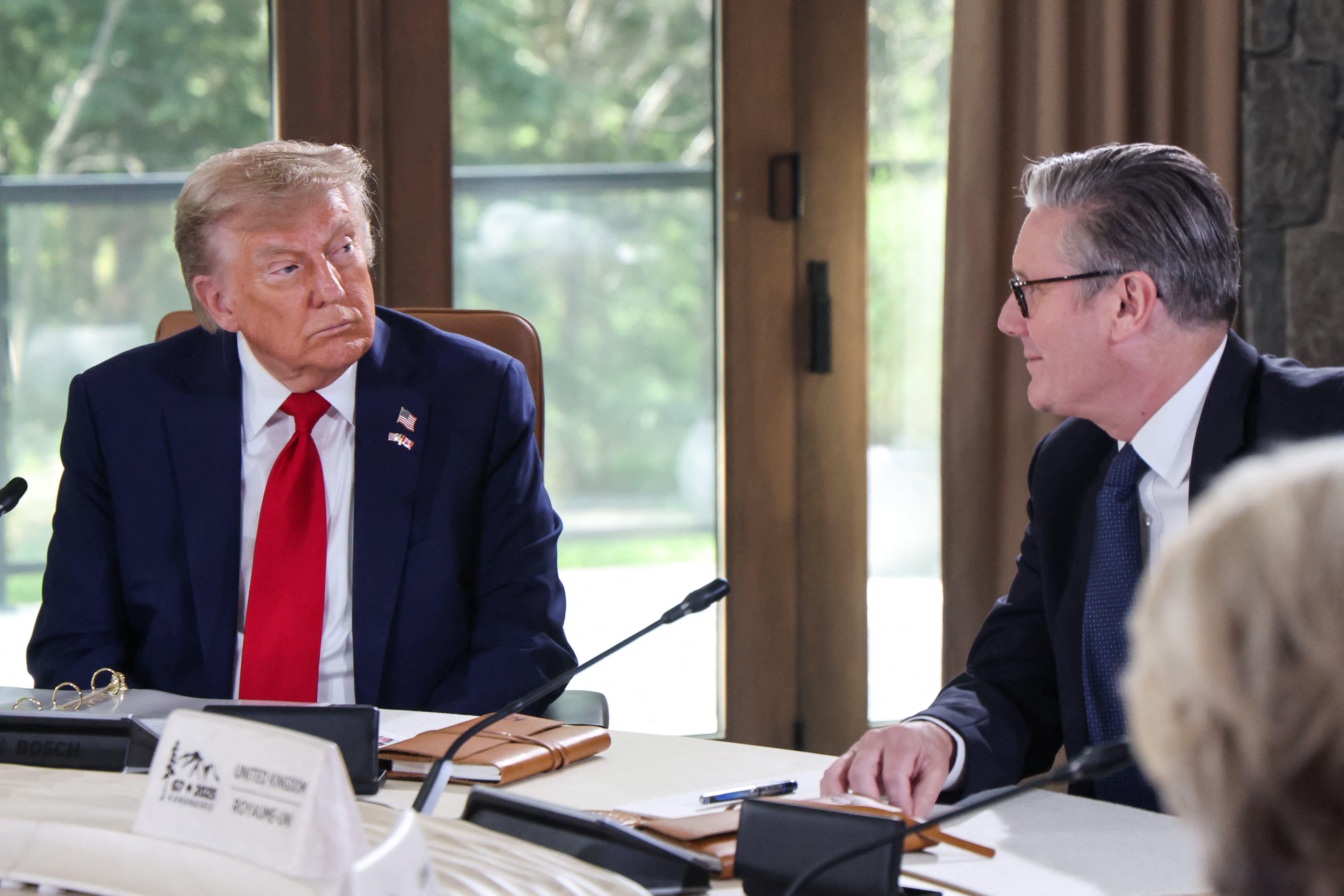
open image in gallery
Trump has been seeking to end the war in Ukraine by attempting to force a ceasefire which has been resisted by Moscow.
However, with Ukraine president Volodymyr Zelensky also joining leaders at the G7 memories of President Trump’s furious attack on him in the Oval Office in March still hang over proceedings.
The sanctions would be aimed at choking off Russia’s military industrial complex with Sir Keir saying it is important that “Russia does not hold all the cards” in the conflict.
The remark appeared to mirror the claim made by Trump to Zelensky in the Oval Office that “Ukraine does not hold any cards”.
However, the divisions were evident at a photocall at the top of President Trump’s meeting with Canadian P Mark Carney at the start of the summit.
In it the US president suggested China should be allowed into the top club of the G7 and claimed it was a mistake Russia had been thrown out.
Downing Street said is “happy with the make-up” of the G7, Downing Street said after Donald Trump’s suggested that kicking Russia out of the group was a mistake.
Asked if the Prime Minister agreed with the US president’s remarks, a Number 10 spokesman said: “I think obviously those comments are a matter for the US.”
He added: “The Prime Minister goes ahead with the G7 and is happy with the make-up of it.”
A former British diplomat has said European nations might try to send “co-ordinated messages” to Donald Trump at the G7 summit.
Earlier, Sir Mark Lyall Grant, a former UK ambassador to the United Nations, told the Today Programme on BBC Radio 4 that all the members of G7 had a “negative consensus”.
He said: “No-one participating wants Iran to have a nuclear weapon. They are all concerned about escalation and particularly spillover – attacks on their own nationals or interests in the region, or indeed their own countries. None of them wants to get directly involved.
“Japan and Canada have been the most critical of Israel, the USA and Germany are more standardly pro-Israel and other Europeans are somewhere in the middle.
“Much depends on President Trump. He clearly doesn’t want to get involved but is talking about the countries doing a deal, which is unrealistic.
“Europeans ganging up on President Trump doesn’t work very well. He is so unpredictable, it is difficult to see where he will come out.