
Economy
Europe mulls counter-tariffs, ACI against the U.S. amid Greenland crisis

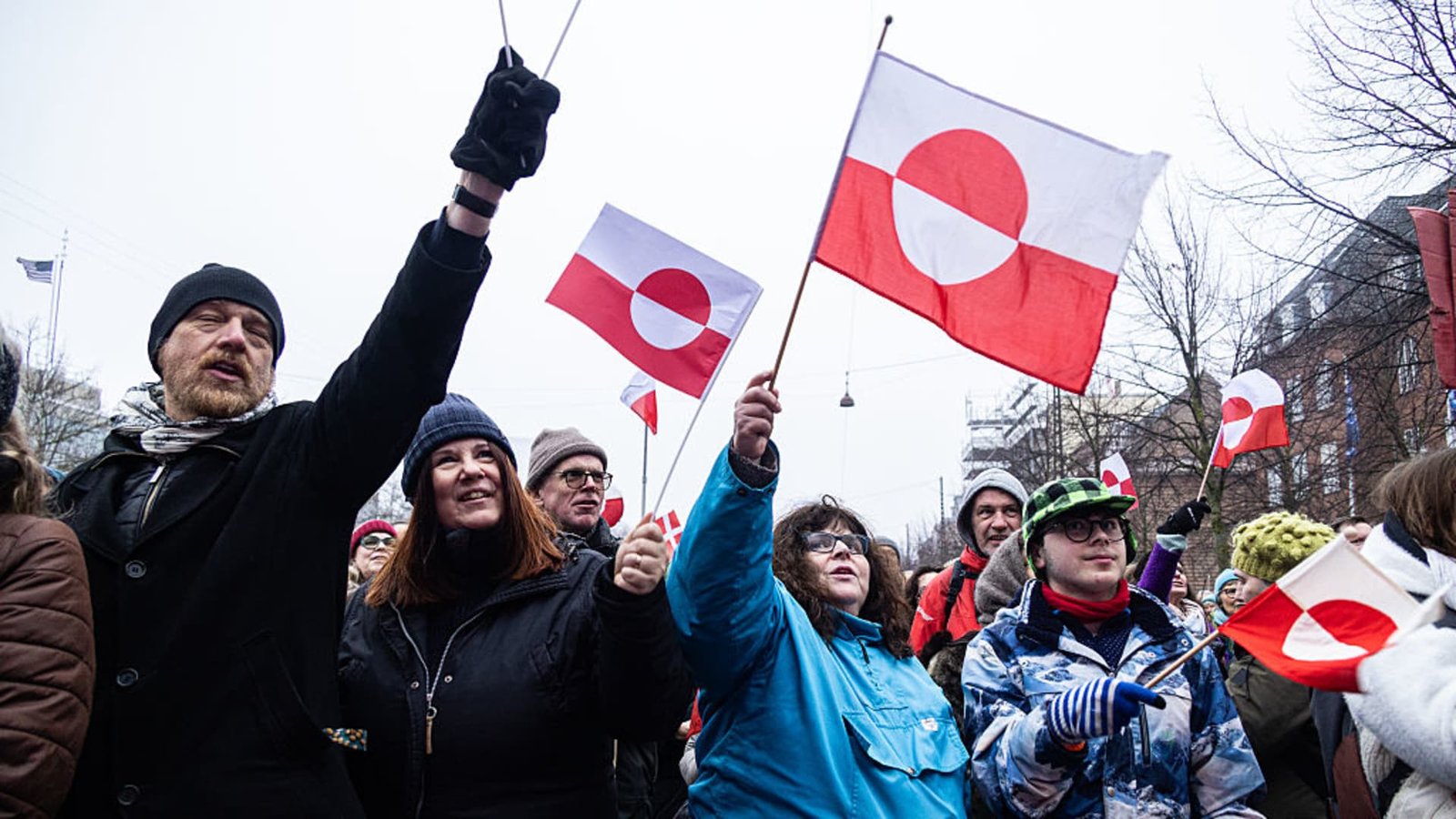
A protester takes part in a demonstration to show support for Greenland in Copenhagen, Denmark, on Jan. 17, 2026.
Tom Little | Reuters
European states are reportedly considering retaliatory tariffs and broader punitive economic counter-measures against the U.S. after President Donald Trump threatened fresh export levies, deepening a rift over Greenland.
Trump announced Saturday that eight European countries would face increasing tariffs, starting at 10% on Feb. 1 and rising to 25% on June 1, if a deal is not reached allowing Washington to acquire Greenland, the mineral-rich island which is a semi-autonomous territory of Denmark.
The proposed tariffs would target Denmark, Norway, Sweden, France, Germany, the U.K, the Netherlands and Finland. The duties would come on top of existing export tariffs to the U.S., currently standing at 10% for the U.K. and 15% for the EU.
Regional diplomats held an emergency meeting in Brussels on Sunday afternoon to discuss their response to Trump’s threat to escalate tariffs, with France reportedly pushing for the EU to use its strongest economic counter-threat to the U.S., known as the “Anti-Coercion Instrument” (ACI).
Protesters wave Greenland flags during a demonstration under the slogans ‘hands off Greenland’ and ‘Greenland for Greenlanders’ in front of the US embassy in Copenhagen, Denmark, on January 17, 2026.
Nurphoto | Nurphoto | Getty Images
The much-vaunted instrument is seen as a nuclear option when it comes to economic counter-measures as it could see the EU restrict U.S. suppliers’ access to the EU market, excluding them from participation in public tenders in the bloc, as well as putting export and import restrictions on goods and services and putting potential limits on foreign direct investment in the region.
Despite being seen as a “big bazooka” against Trump’s tariffs playbook, it has not been used before, and regional leaders have already said they want to pursue dialogue with the U.S. in the coming days to resolve the rift over Greenland.
The Financial Times reported that the EU was contemplating imposing 93 billion euros ($108 billion) worth of tariffs, as well as considering the use of the ACI.
Meanwhile, Reuters reported that the European Parliament will likely now suspend its work on the EU-U.S. trade deal struck last July. The assembly had been due to vote on removing many EU import duties on U.S. goods on Jan. 26-27, but that approval could now be delayed, Reuters reported.
French Finance Minister Roland Lescure said Monday that the EU “must be prepared” to use its anti-coercion mechanism, in comments translated by Reuters.
While France is more gung-ho about the ACI, Germany is among the countries that have tended to shy away from using it before.
“The key question to watch is whether the EU will try to keep the confrontation confined to such a more “classic” trade war, or whether calls for a harsher line prevail,” Carsten Nickel, deputy director of Research at Teneo, said in emailed comments.
“Representing the latter camp, France has called on its partners to formally invoke the EU’s so-called anti-coercion instrument … [but] other EU member states, including Germany, will likely remain careful.”
The reasons for this divide are multifaceted, Nickel noted, including factors such as France traditionally advocating for a more independent European role in continental security, and it being less export-dependent than other nations like Germany.
Months of wrangling ahead?
European leaders were quick to react to Trump’s surprise tariff threat, with U.K. Prime Minister Keir Starmer commenting Saturday that “applying tariffs on allies for pursuing the collective security of NATO allies is completely wrong,” while French President Emmanuel Macron described them as “unacceptable.”
Nonetheless, leaders are expected to use the World Economic Forum taking place in Davos, Switzerland, this week, as an opportunity to try to talk to Trump, who is addressing the forum on Wednesday.
President Donald Trump attends a bilateral meeting with European Commission President Ursula von der Leyen during the 50th World Economic Forum (WEF) annual meeting in Davos, Switzerland, January 21, 2020.
Jonathan Ernst | Reuters
Economists warn that, much like last year when months of wrangling took place before a trade deal was signed between the U.S. and EU, this spring will likely be dominated by similarly thorny discussions over Greenland.
“My base case is that the Feb. 1 [tariffs] deadline is going to be postponed as diplomatic measures are implemented,” Mohit Kumar, chief European economist at Jefferies, told CNBC Monday.
“That said, I think this is different from the usual TACO [Trump Always Chickens Out] trade. For Greenland, the position for Europe is very clear: it’s not for sale, and they will not tolerate aggression … But what Trump has shown is that he wants Greenland. I don’t see how the issue is going to go away that soon. So we are looking at months, or potentially quarters, of uncertainty over tariffs.”
“For Europe it’s a negative. Growth will be reduced,” he warned, ahead of what could be a frantic market day for European bourses on Monday, with regional indexes looking set to slump at the open.