
Breaking News
At a White Castle airport kiosk, we glimpsed a bleak fast-food future

Subscribe to The Post Most newsletter for the most important and interesting stories from The Washington Post.
BOSTON LOGAN INTERNATIONAL AIRPORT – If you’ve watched “Harold & Kumar Go to White Castle” as many times as I have, you understand why I think every trip to this sanctuary of steamed sliders must be an adventure. Intoxicants must be ingested. Vehicles must be stolen. Arrests must be made. Enemies must be humiliated. And the night must end with a celebratory stack of tiny burgers, if only to prove you survived the ordeal.
As a piece of pop-culture filmmaking, “Harold & Kumar” straddles a line between crude, bro-culture comedy and gleeful social satire, as two high-functioning Asian American stoners confront racism, both casual and explicit, in their single-minded quest for a tray of midnight sliders. Their mission to locate an open White Castle takes on more meaning with each hardship they face until, at the very end, they fully grasp the role of a four-walled restaurant in society: as a place for rest and restoration, especially after a dark night of the soul in suburban America.
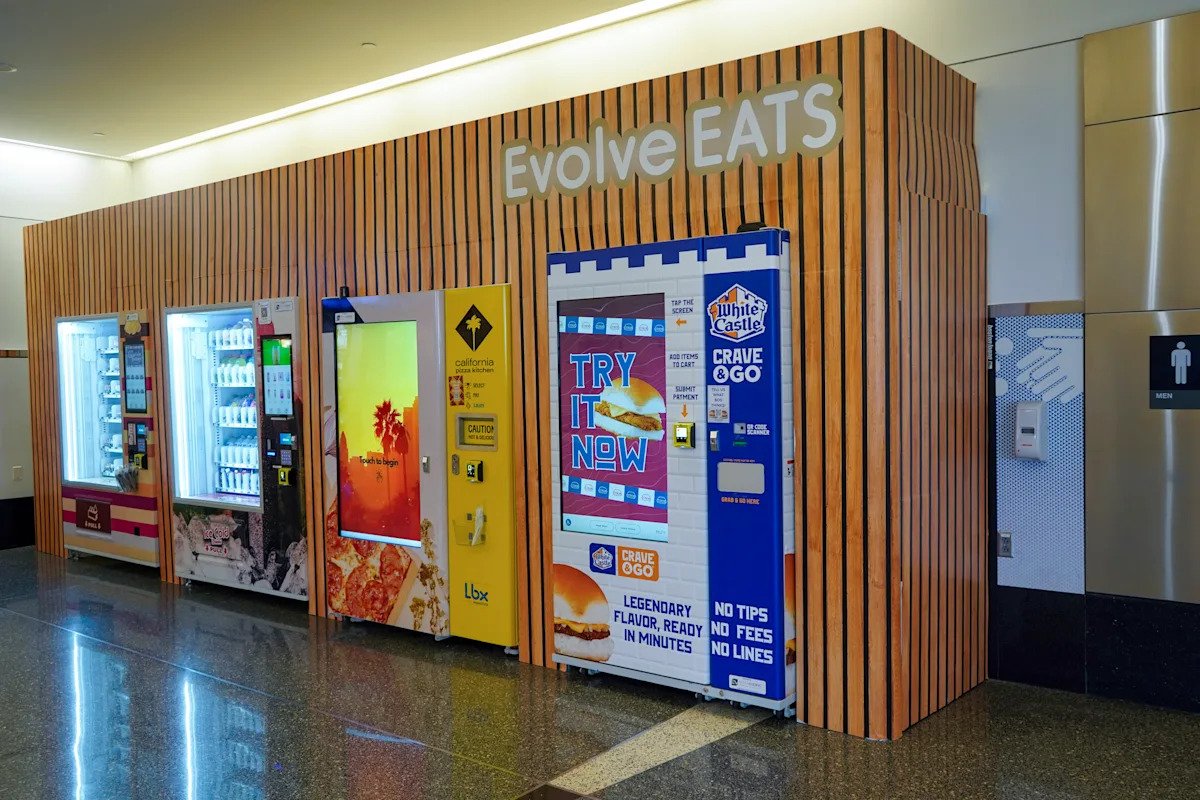
I’m thinking a lot about this film while staring blankly at the new White Castle vending machine inside Terminal A at Logan International Airport in East Boston. The machine is tucked into a line of similar kiosks selling items from California Pizza Kitchen and the Cheesecake Factory, all conveniently located next to the men’s room. Ostensibly there to serve the red-eye flights that leave travelers scrambling to find something to eat late at night, the White Castle kiosk is pretty much all about mechanical efficiency and human erasure, two concepts that are, I think it’s safe to say, diametrically opposed to adventure of any kind.
There are at least two White Castle vending machines inside Logan, one on either side of security. They are, I should point out, the first New England locations for the chain, which is mostly concentrated in the Midwest – especially Illinois, Michigan and Ohio – New York and New Jersey. The kiosks are part of a larger move by food-service companies, such as airport operator Evolvending, to work with technology firms and major brands to bring automated dining to the people. They’ve made a brutal calculation here: Chains like White Castle can quickly establish a foothold in airports by eliminating costly restaurant build-outs and full-time staffs. The benefits to the business are obvious, but for the consumer, the deal is more complicated: The chains are asking us to sacrifice human connection for sheer convenience, a trade-off that might work in an airport, where many just want to get from Point A to Point B without speaking to a single soul.
The thing is, this human erasure won’t be limited to airports. The new generation of vending machines will eventually find a home on university campuses, at government agencies, even in local hospitals. (I’m trying to imagine the level of denial required to gulp down a four-pack of White Castle sliders while waiting on a loved one’s angioplasty, but I guess we’ve had plenty of practice at this: McDonald’s has long had outlets in hospitals.)
It’s interesting to me to see how Evolvending views its new-school vending machines, like those in Logan. Neil Thompson, during his tenure as chief operating officer for Evolvending, told a podcaster last year: “We don’t think of them as vending machines. They really are unstaffed restaurants. It’s a great marriage of food technology and then machine technology coming together to re-create restaurant-quality meals.”
If by “restaurant-quality meals” Thompson simply means “hot food,” you could argue he has a point. For years, the vending industry has struggled to design autonomous machines that could cook food to order. Earlier attempts at such high-tech equipment were often too costly, too complex or too risky, according to a recent Vending Times article. This may explain why, for generations, the only thing most Americans could buy hot from a machine was a cup of coffee.
I still remember the first time I ordered an Americano from the CafeX kiosk in San Francisco. The slinky mechanical arm was programmed to wave hello and perform a touchdown dance between orders, the kind of behavior that’s adorable from a robot, but not necessarily a barista with a “DEATH TO DARK ROASTS” tattoo on his forearm. The caffeine robot in San Francisco often draws a crowd. The White Castle machine in Boston draws flies. Over the course of two hours or so, I literally saw no one order at the kiosk other than me and Victoria Caruso, the Washington Post Food team’s editorial aide and videographer, who joined me on the trip.
The 55-inch screen on the front of the kiosk is little more than an oversize tablet on which you punch in your selections. Your options are limited to sliders, either two or four to an order: original, classic cheese, cheddar bacon cheese, and chicken and cheese. Prices range from $7.95 to $13.50 depending on the style and number of sliders you order. You’ll find no sausage breakfast sliders on the menu. No crinkle-cut fries. No mozzarella sticks. No panko fish sliders. No milkshakes. Someone should tell this unstaffed restaurant that sliders do not make a meal.
After you place an order, the kiosk turns into a large countdown clock, which provides a rough estimate of when your sliders will appear in the “grab & go” window, still encased in their plastic sleeves and outer packaging. I half-expected to see microplastics on the ingredients list. A White Castle representative tells me the sliders are stored cold inside the kiosk and transferred to a “heating unit” once ordered. Despite repeated attempts, I couldn’t get anyone to tell me what the “heating unit” actually is, but if I were a betting man, I’d place my money on a microwave. It is White Castle’s recommended method for heating its frozen sliders from the grocery store.
The moment you bite into this vending machine slider, you realize the whole unstaffed restaurant analogy falls apart. These burgers are not restaurant-quality. They’re barely freezer-section quality: The heated buns often sport more wrinkles than a Shar Pei, and there’s no pickle buried between them because a pickle chip, when zapped in a microwave, looks like a scab on a Teenage Mutant Ninja Turtle. (Yes, I microwaved a pickle chip to see what it looks like.)
These airport sliders – especially the original – are sad approximations of the ones sold at White Castle restaurants. Anyone who has inhaled the genuine article knows what I’m talking about: The original White Castle slider is as elusive as sunlight on your cheek. It’s a burger in which air is a primary ingredient: It combines with beef, bun, salt, pickle, yeast and onions to make one minimalist, unmistakable bite. There’s nothing else like it in fast food.
The sliders at a White Castle restaurant can stand on their own. The vending-machine variations are in desperate need of assistance, which I gave them thanks to the friendly crew at Buffalo Wild Wings in Terminal A. They handed me some packets of ketchup and mustard, gratis. Perhaps this is sacrilege to adherents to the White Castle gospel, but let me tell you: These second-tier sliders were exponentially better with condiments. I should add, though, that nothing could save the chicken and cheese sliders, whose breaded chicken-and-rib cutlets had the slimy, slippery texture of night crawlers.
Could it be that I’m asking for too much here? Maybe these kiosk sliders are everything you could ever want when stuck in Terminal A at 11 p.m., when every other counter operator has closed up for the night. Everything is relative in the world of airport dining.
One major drawback to vending machine dining became obvious when I tried the Cheesecake Factory kiosk. The slice of Belgian chocolate cheesecake that I ordered got stuck on its tiny conveyor belt and didn’t slide onto the electronic shelf that was supposed to ferry it to the bottom drawer, where I could grab it. I gave the stupid machine a piece of my mind – and a swift bump in the chest – to dislodge my dessert. It finally released from its rubber runway and tumbled below. But it made no difference: My brief window of opportunity had come and gone. The kiosk now blocked my cheesecake from entering the bottom drawer, where I could fetch it. I ordered some cupcakes, thinking the machine would give me both. It gave me only the cheesecake.
Who could I complain to about this theft? I spotted a QR code to scan to share my “feedback,” but passing along my angst wouldn’t get me any closer to my sweets. I ate the costs, but not the cupcakes. Does this count as an adventure?
In the end, these kiosks offer something of a Faustian bargain: They’ll serve you burgers (or cheesecake or a pizza) in exchange, not for your soul, but for your silent acknowledgment that automation is the inevitable future of fast food in America, as labor and other costs continue to rise. White Castle and others are angling not just for your dining dollar. They’re seeking your acceptance that a hot meal doesn’t demand a cook, a server, a food runner, a bus boy or any of those pesky positions normally found at a restaurant, airport or elsewhere.
It’s rare that you can eat sliders and, at the same time, sense the existential dread of an entire class of workers. I hope I’m wrong. To my mind an unstaffed restaurant is not a “restaurant” at all. Harold and Kumar would find no restoration here. And neither will you or I or anyone else after a great adventure, or just the normal frustrations of daily air travel.
Related Content