
President
White House war promo blends pop culture imagery with combat footage

Peaceful and violent, in video game screenshots and movie clips and on professional playing fields, the icons come fast and furious in quick-cut footage — some of the most renowned slivers of 21st-century American popular culture, harnessed by the Trump administration to promote the freshly launched war with Iran.
The White House’s social media feed has issued a series of pumped-up videos that mix real Iran war explosions with movie action heroes, gaming footage and bone-crunching football tackles, leading critics like a top cleric of the U.S. Catholic Church to condemn a trivialization of deadly real-life conflict.
Clips from “Braveheart,” “Superman,” “Top Gun,” “Breaking Bad,” and “Iron Man.” All appear cut between declassified imagery of what is presumably the Iran war. Even the cartoon likeness of SpongeBob SquarePants is spliced in, asking, “You wanna see me do it again?” in between images of buildings, planes and vehicles blown up by American bombs. The caption on one bomb-heavy post: “Courtesy of the Red, White and Blue” — the title of a post-9/11 Toby Keith song about war that is subtitled “The Angry American.”
People wait in line for theater presentations for video games including Batman, Mortal Kombat X and Shadow of Mordor at the WB Games booth at the Electronic Entertainment Expo, Wednesday, June 11, 2014, in Los Angeles. (AP Photo/Jae C. Hong, File)
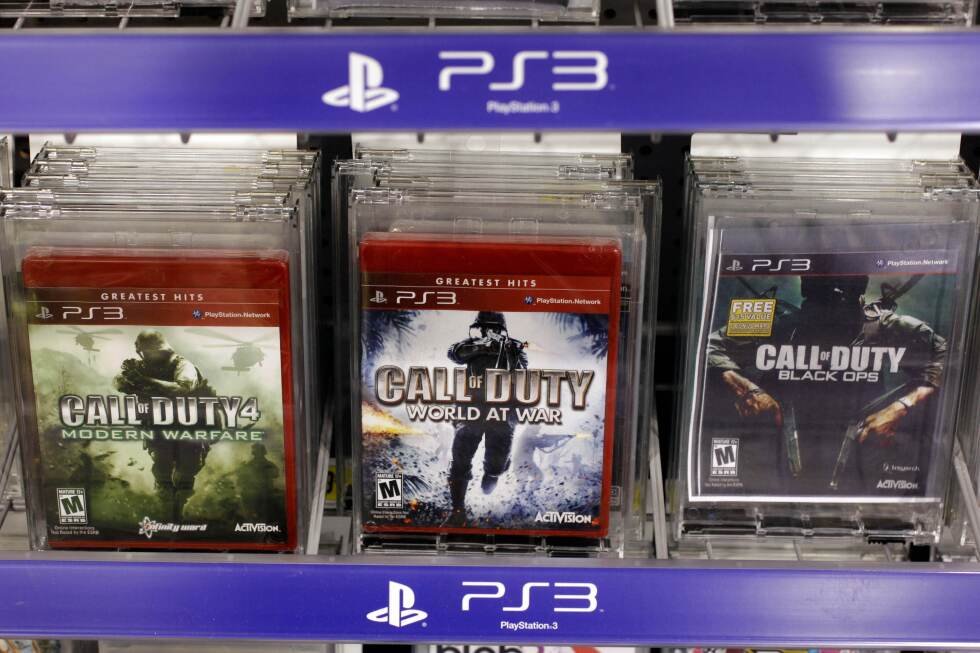
The fiction-meets-reality product of the White House’s aggressive social media team cuts a wide swath through cultural touchstones that resonate with young men, including the video games Call of Duty, Grand Theft Auto, Mortal Kombat and Halo. Two videos feature NFL and college football tackles and Major League Baseball home runs — with the cracks of bats interspersed with explosions.
They’re set to ominous or aggressive music, including Childish Gambino’s “Bonfire,” Miami XO’s “Bazooka” and AC/DC’s “Thunderstruck.” One of the White House postings described the video as “JUSTICE THE AMERICAN WAY,” accompanied by flag and fire emojis.
It’s hard not to see the thinking here: The more cinematic the content, the more people might support the war.
Two actors call for their depictions to be removed from videos
The sounds and images of American popular culture, a sure attention-getter in many contexts, have increasingly been used in politics in recent decades, at least as far back as Bill Clinton’s use of Fleetwood Mac’s “Don’t Stop” during his 1992 presidential campaign. Never, though, has a White House built and disseminated content quite like this, drawing explicit parallels between the aggressive moments of modern entertainment — a video game kill shot, a hard football hit, a towering home run — and battle footage to amplify the enthusiasm for war.
What’s happening with the White House videos, which some call the “gamification” of war, hasn’t landed well in some quarters.
Ben Stiller accepts the awards for best comedy for “Tropic Thunder” at the 14th Annual Critics’ Choice Awards, Thursday Jan. 8, 2009, in Santa Monica, Calif. (AP Photo/Chris Pizzello, File)
Two actors whose work appeared in the videos — Ben Stiller, who starred in the 2008 movie “Tropic Thunder,” and Steve Downes, who portrays Master Chief, the protagonist in Halo — said the material was used without permission and called for their depictions to be removed.
Stiller said on X that he had “no interest in being part of your propaganda machine. War is not a movie.” Downes called the videos “disgusting and juvenile war porn.” Neither the NFL nor Major League Baseball would comment on the use of their footage in the war videos.
The discussion reached a high level in the U.S. Catholic Church as well. Cardinal Blase J. Cupich, the archbishop of Chicago, said he found it sickening to see a war that has brought real death and suffering being treated like a video game. That approach, he said, dishonors the people who have died, including U.S. servicemen.
Archbishop of Chicago, Cardinal Blase Cupich, answers a journalist’s question during an interview with The Associated Press, in front of St. Bartholomew church, in Rome, Thursday, Oct. 9, 2025. (AP Photo/Gregorio Borgia, File)
“Our government is treating the suffering of the Iranian people as a backdrop for our own entertainment, as if it’s just another piece of content to be swiped through while we’re waiting in line at the grocery store,” Cupich said in a weekend statement. “But, in the end, we lose our humanity when we are thrilled by the destructive power of our military.”
Asked for comment, the White House would not say whether or not it would accommodate artists who said their work was used without permission.
“America’s heroic warfighters are meeting or surpassing all of their goals under Operation Epic Fury,” said White House spokeswoman Anna Kelly. “The legacy media wants us to apologize for highlighting the United States Military’s incredible success, but the White House will continue showcasing the many examples of Iran’s ballistic missiles, production facilities, and dreams of owning a nuclear weapon being destroyed in real time.”
It’s not the first time this White House has trotted out game-related memes. Last year, it posted a drawing of Trump dressed as Master Chief. In another, it made Trump look like a blocky Minecraft character with the caption: “America’s most pro-gamer president.”
Every war has a psychological dimension, and this seems to be part of it, said Zia Haque, director of the Baker Institute for Peace and Conflict Studies at Juniata College in Pennsylvania. “We live in a digital age, and I see this as a use of the space to propagate the message across the board,” he said.
A motivation to be cool?
Some observers also cast the administration’s content as potential efforts to encourage gamers to join the military. It wouldn’t be a first: The Pentagon’s efforts to recruit players date to at least 2002, with the release of a first-person shooter called America’s Army. The Defense Department also sends recruiters to video game conventions and esports tournaments.
Today, many of Trump’s loudest fans are young white men who are gamers and heavy consumers of sports and popular culture — and thus likely a receptive audience for such imagery and music.
Many young men are motivated to join the military because they want to be cool like the people they see in action movies, said Ray Deptula, who recently retired from the U.S. Navy after 24 years and rose to the rank of commander. That’s what motivated him, he said. So he can see the appeal of the videos.
Gamers play “Halo Wars 2″ at the Xbox Media Showcase at E3 2016, Monday, June 13, 2016, in Los Angeles. (Photo by Casey Rodgers/Invision for Microsoft/AP Images, File)
But, he says, there’s a caveat — a big one.
“That’s not what your life is going to be like,” said Deptula, who recently wrote a novel, “A Dog Before a Soldier,” about a young man who joined the military out of desperation during the Revolutionary War. “Your life is going to be about hard work and humility.”
But Jeff Fromm, co-author of “Marketing to Gen Z,” has doubts about the videos’ long-term effectiveness.
Many young people in Generation Z are keenly interested in transparency and the values of organizations they are seeking to join, and Fromm questions whether the current administration rates highly in those areas.
Sometimes the overlap between real life and game culture is accidental. Last week, Trump posted on Truth Social that defense contractors had agreed to “quadruple Production of the ‘Exquisite Class’ Weaponry.” Policy experts were puzzled — but Final Fantasy XIV players were reminded of the game’s most powerful weapons. Still, the president probably wasn’t calling for the game’s Exquisite Wrathgrinder to go into production.
___
Associated Press correspondents Matt Brown in Washington and Ali Swenson in New York contributed to this report.