
Breaking News
We visited the ‘Pooptomac’ sewer spill. Here’s what we found.

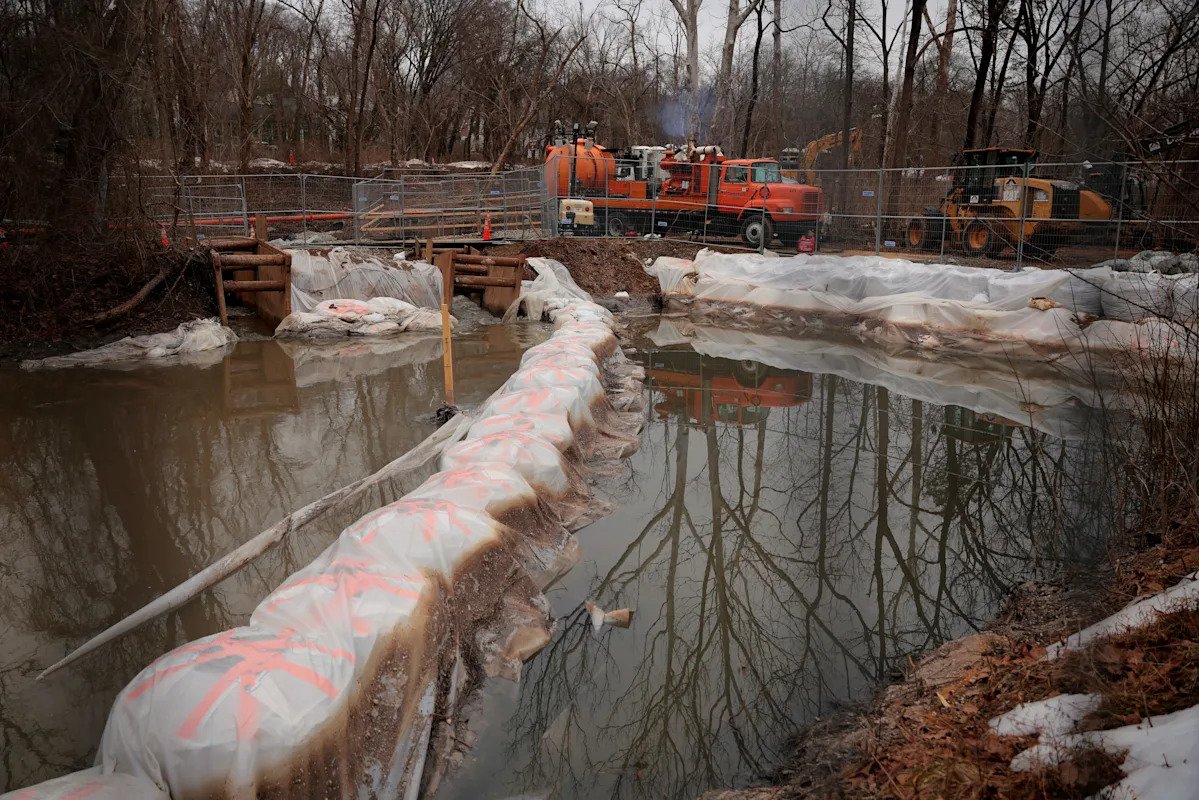
CABIN JOHN, MD – When a collapsed pipe began spewing millions of gallons of sewage into the beloved waterways near the tight-knit community of Cabin John, word spread like wildfire.
So did the smell.
As temperatures rose after a massive winter storm, the stench wafted into homes closest to the Potomac River, making what’s considered the toniest part of the neighborhood feel “like being in a Porta John,” according to Jack Mandel, who has lived in the area since the turn of the century.
“Typically, I’ll go down there probably four or five days a week, just in the afternoons, at the very least,” Mandel said. “And none of us want to get anywhere near it because we have dogs and kids.”
The community, which Mandel playfully describes as “crunchy,” is home to many miles of walking and biking trails, canoe and kayak enthusiasts, and over half a dozen community and environmental groups. The Potomac Interceptor sewer system has been a concern there for decades and the sewage spill, one of the largest in U.S. history, has sparked fears among residents about the lasting impacts on the river.
DC Water, the utility authority that operates the Potomac Interceptor, says no new sewer overflow has gone into the river since Jan. 29. But local researchers have detected high levels of fecal-related bacteria and disease-causing pathogens in the river, including E. coli and bacteria that cause staph infections.
“The environmental impact of this, I assume, is going to be fairly devastating,” said Mandel, chairperson of the Minnie’s Island Community Conservancy.
Community ‘heartbroken’ over sewage spill
Philip Gray used to enjoy paddling down the river in a canoe or floating in an inner tube, beer in hand, toward his home in Cabin John. But he won’t be going in the river for a while now that the nearby waterways have earned nicknames like the “Pooptomac” and “Schitt’s Creek,” referencing the popular TV show.
More than 200 million gallons of wastewater flowed into the Potomac River after a section of the Potomac Interceptor, a sewer line in the Washington, DC, suburb of Montgomery County, Maryland, collapsed on Jan. 19. Footage from the site shows sewage erupting out of the ground into a typically dry part of the nearby canal and then onward into the Potomac.
Gray, former head of The Cabin John Citizens Association, got a text from a friend about the overflow not long after it happened and went to see it for himself. He said the outpouring of sewage was “astonishing” to witness.
“After you’ve kind of been walking through and it smells, it’s in your nose and stuff,” he said. “Even like 20 minutes later, you’re wondering, ‘am I still smelling it?’ ”

David Hearn, an Olympic canoeist, and Philip Gray, former head of The Cabin John Citizens Association, chat about repairs to Potomac Interceptor.
David Hearn, an Olympic canoeist, has been paddling on the river for almost 60 years. He and his wife rode their bikes along the canal the day after the collapse and were devastated by what they saw.
“We’re just heartbroken over this,” Hearn said. “This is a crown jewel of wilderness and white water, placid water, outdoor activity.”
‘Hope has dimmed’ for a swift solution
This is not the first time the Interceptor has caused headaches for the community. Decades ago, an intense odor escaped into Cabin John through vents along the Interceptor, Gray said, and community leaders fought to ensure the charcoal filters designed to control the smell were properly maintained.
“I thought that maybe that was the last I would smell of the gases coming from the sewer pipe, the Interceptor,” he said. “But not so, now 26 years later, here we are.”
And it seems the problem is here to stay. Pumps have been installed to divert sewage around the collapsed pipe, leaving the area with what Gray described as “an open canal sewage situation.”
Actual repairs to the pipe, estimated to take four to six weeks, can’t begin until a stronger bypass system is activated and the massive rocks blocking the Interceptor can be removed, one by one.

David Hearn, an Olympic canoeist, speaks with Sherri Lewis, a spokesperson for DC Water, at the site of a historic sewage spill.
“You can’t just suck that out with a vacuum and it’s not like excavating where you can go in with a big claw and dig it out either… you can’t just yank everything out; you could potentially cause another collapse and you don’t want that either,” Sherri Lewis, a spokesperson for DC Water, said as she overlooked the work site.
Seeing the deluge contained offered residents an initial burst of hope, but now “it seems like that hope has dimmed a little bit,” said Heidi Lewis, co-president of The Cabin John Citizens Association.
Once the Interceptor is fully operational, DC Water will accelerate plans to rehabilitate more than 2,700 linear feet of the pipe over the course of nine to 10 months, “significantly strengthening its reliability for years to come.”
But Heidi Lewis hopes the catastrophe will push DC Water to look for more wastewater solutions.
“It’s shown that a 60-year-old pipe is really not equipped to carry the increasing load that it’s being asked to carry,” she said. “And so this disaster hopefully has them considering much longer-term plans on how to handle the growth in communities.”

Earthen barriers near Lock 10 on the C&O Canal help redirect sewage back into the Potomac Interceptor after a section of the 6-foot-wide sewage pipe collapsed last month between the Clara Barton Parkway and the canal on Feb. 16, 2026 in Cabin John, Maryland.
Small suburb thrust into the national spotlight
And now, the trouble that broke out in Cabin John has been thrust into the national spotlight. Nearly a month after the spill, President Donald Trump criticized the cleanup efforts – pointing a finger at Democrats and Maryland’s Gov. Wes Moore.
Trump, in a Feb. 16 post on Truth Social, said he would be directing federal authorities to “immediately provide all necessary Management, Direction, and Coordination to protect the Potomac, the Water Supply in the Capital Region, and our treasured National Resources in our Nation’s Capital City.” He ordered the Federal Emergency Management Agency, which has seen significant staff cuts during Trump’s second term, to coordinate the response.
Ammar Moussa, a spokesperson for Moore, accused the Trump administration of “shirking its responsibility,” but pledged to “work collaboratively − as we always do − to be responsive and keep the public informed about the federal government’s plan to remediate the damage.”
Some residents seemed open to the possibility of accepting help from FEMA. But Mandel said he finds the president’s comments “really dispiriting” and doesn’t believe the issues with the pipeline are a partisan problem.
“It’s purely an environmental disaster that needs to be dealt with by people who care,” he said.
Contributing: Rebecca Morin
This article originally appeared on USA TODAY: Historic Potomac sewer spill leaves DC locals ‘heartbroken’