
Breaking News
Violence erupts after Mexican cartel leader “El Mencho” killed in federal operation

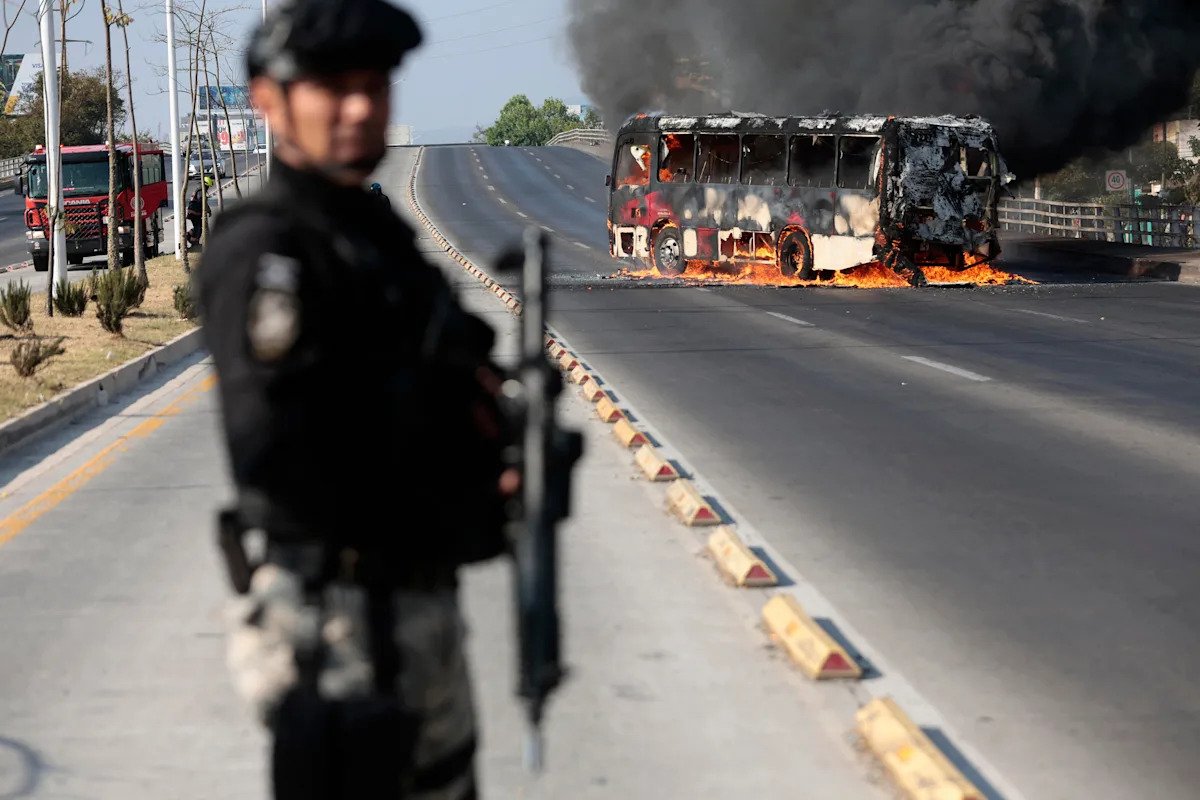
Violent clashes erupted in parts of western Mexico on Sunday amid a military operation that led to the death of the Jalisco New Generation Cartel leader, triggering widespread security concerns throughout the region.
Mexican security forces killed Nemesio Rubén Oseguera Cervantes, also known as “El Mencho,” during an operation in the western state of Jalisco, Mexico’s Ministry of Defense said in a statement on X. It said he was wounded during the raid in the town of Tapalpa and died while being flown to Mexico City.
The state of Jalisco is the base of the cartel known for trafficking huge quantities of fentanyl and other drugs to the United States.
U.S. Deputy Secretary of State Christopher Landau, who also confirmed the cartel leader’s death, described him as “one of the bloodiest and most ruthless drug kingpins.”
“This is a great development for Mexico, the US, Latin America, and the world. The good guys are stronger than the bad guys,” he said on X.
A U.S. defense official told CBS News that the U.S. military played a role in the operation via the Joint Interagency Task Force-Counter Cartel, which regularly works with the Mexican military through the U.S. Northern Command. The official emphasized that “this was a Mexican military operation, so the success is theirs.”
Mike Vigil, former DEA Chief of International Operations, told CBS News that the military operation was “one of the most significant actions undertaken in the history of drug trafficking.”
“Because we’re talking about someone that is almost at the same level as (Joaquin) “El Chapo” Guzman and (Ismael) “El Mayo” Zambada,” he added. “(Oseguera Cervantes) is one of the biggest drug capos in the history of drug trafficking around the globe.”
During the operation, troops came under fire and killed four people at the location. Three more people, including Oseguera Cervantes, were wounded and later died, the Ministry of Defense’s statement said. Two others were arrested and armored vehicles, rocket launchers and other arms were seized. Three members of the armed forces were wounded and are receiving medical treatment.
The killing of the powerful drug lord triggered several hours of roadblocks with burning vehicles in Jalisco and other states. Such tactics are commonly used by the cartels to block military operations.

A member of the Prosecutor’s Office stands guard near a burning bus set on fire by organized crime groups in response to an operation in Jalisco to arrest a high-priority security target, at one of the main avenues in Zapopan, state of Jalisco, Mexico, on Feb. 22, 2026. / Credit: Ulises Ruiz /AFP via Getty Images
(Ulises Ruiz /AFP via Getty Images)
Jalisco Gov. Pablo Lemus Navarro activated a “code red,” which is a protocol for a state of emergency or security crisis, in response to the clashes. In a post on X, he said public transportation was suspended across Jalisco and urged people in the area to remain in their homes until the situation was under control.
Mexican President Claudia Sheinbaum Pardo on social media acknowledged the roadblocks but stressed, “In the vast majority of the national territory, activities are proceeding with complete normality.”
Videos circulating on social media showed plumes of smoke billowing over the city of Puerto Vallarta, a major city in Jalisco, and sprinting through the airport of the state’s capital in panic.
“They are burning buses, they’re shutting down roads, not only in Jalisco, but Michoacan, Colima, Tamaulipas, Guanajuato, and then also Aguas Calientes,” Vigil said. “And what they’re trying to do is show that they are still a force to be reckoned with, that this was not a lethal blow to them.
In Guadalajara, Jalisco’s capital and Mexico’s second-largest city where the World Cup is scheduled to host matches this summer, burning vehicles blocked roads.
A similar situation unfolded at the airport in Reynosa, a Mexican border city in the state of Tamaulipas, sources on the ground and family members in the city told CBS News’ Nidia Cavazos. They said roads to and from the airport had been blocked off by cartel members. Reynosa borders McAllen, Texas, and is typically packed with Americans traveling back and forth. While international bridges remained open, key streets to get to the bridges were blocked off.
The U.S. State Department has released a security alert advising American citizens in several Mexican states, including Jalisco, Tamaulipas, Michoacan, Guerrero and Nuevo Leon, to shelter in place until further notice.
Air Canada temporarily suspended operations at the Puerto Vallarta Airport because of what it described as “an ongoing security situation in Puerto Vallarta” that impacted the airport.
“We are monitoring the situation and in contact with local authorities who are working to resolve the issue,” the airline said.

A man extinguishes a burning truck set on fire by organised crime groups in Zapopan, state of Jalisco, Mexico, on Feb. 22, 2026. / Credit: Ulises RUIZ /AFP via Getty Images
Southwest and Alaska Airlines confirmed they canceled flights to and from Puerto Vallarta on Sunday, while Delta Air Lines issued travel waivers to customers with flights into or out of the airport in Puerto Vallarta as well as Guadalajara.
“The safety of our customers and crew always comes first and we are closely monitoring the situation in the region. We have taken steps to adjust our operation accordingly and are working to communicate with our impacted customers,” Delta said in a statement.
The Jalisco New Generation Cartel, known as CJNG, is one of the most powerful and fastest-growing criminal organizations in Mexico. Oseguera Cervantes, 59, was originally from Aguililla in the neighboring state of Michoacán. He had been significantly involved in drug trafficking activities since the 1990s. He helped co-found the Jalisco New Generation Cartel with Érick Valencia Salazar, alias “El 85,” around 2007.
Valencia Salazar was among 29 wanted cartel leaders taken into U.S. custody last February, according to the Justice Department.
The Jalisco cartel has been one of the most aggressive cartels in its attacks on the military — including on helicopters — and is a pioneer in launching explosives from drones and installing mines. In 2020, it carried out a spectacular assassination attempt with grenades and high-powered rifles in the heart of Mexico City against the then head of the capital’s police force and now federal security secretary.
The DEA considers the cartel to be as powerful as the Sinaloa cartel, one of Mexico’s most infamous criminal groups, with a presence in all 50 U.S. states.
Since 2017, Oseguera Cervantes has been indicted several times in the United States District Court for the District of Columbia. The U.S. State Department had offered a reward of up to $15 million for information leading to the arrest of El Mencho.

A U.S. wanted poster for
In February 2025, the Trump administration designated the cartel as a foreign terrorist organization, saying that in addition to trafficking fentanyl, the group “engages in extortion, migrant smuggling, oil and mineral theft, as well as weapons trade.”
Trump threatens strikes on Iran as more warships enter Mediterranean
How safe is America from polio?
Team USA sets record for its most gold medals won at a Winter Olympics