
Breaking News
Trump’s 36% approval, MAGA’s $304 million

Big numbers and high stakes are riding on the ballot in November: 435 House seats, 35 Senate seats, 39 governorships − and the country’s course for the final two years of President Donald Trump’s term.
Who will win?
In the math of the midterms, a handful of statistics can signal the odds of a squeaker or a tsunami, of a Democratic sweep or the resilience of the Republican status quo.
“If we lose the midterms, you’ll lose so many of the things that we’re talking about, so many of the assets that we’re talking about, so many of the tax cuts that we’re talking about, and it would lead to very bad things,” Trump told supporters at a rally in Iowa that kicked off his election-year campaigning. “We have got to win the midterms.”
Contrast the president’s warning with the confidence of House Democratic leader Hakeem Jeffries of New York.
“We only need to net three” seats, he told reporters on Capitol Hill. “It’s happening. Democrats are going to take back control of the House, and the only question is, what’s the margin?”
Nine months before Election Day − time enough for things to change − here are three key statistics that carry clues about November’s outcome.
More: Older women are spooked by the economy. Their vote is up for grabs.
Start with Trump’s approval: 36%
That was the president’s rating in the Associated Press/NORC survey taken Feb. 5-8, the latest of the public polls considered most credible.
The tepid measure of his political temperature was consistent with other respected pollsters, including a 37% approval rating in the Quinnipiac University poll Jan. 29-Feb. 2 and the 36% rating in the Gallup Poll Dec. 1-15.
That level of support, if it persists, would be a seven-decade low for a president at a midterm and a red alarm for the GOP.
Trump won’t be on the ballot, of course, but a president’s popularity has consistently forecast how his party’s candidates are going to fare. Midterms are not only elections but also referenda on the White House, the prime opportunity for voters to weigh in on how they think the commander in chief is doing.
At a retreat of House Republicans, Trump said the consequences could be personal for him. “You got to win the midterms because if we don’t win the midterms, it’s just going to be − I mean, they’ll find a reason to impeach me. I’ll get impeached,” he lamented.
He speaks with experience. When Democrats regained control of the House during his first term, in 2018, they did impeach him. Twice.
Some of those GOP representatives see their own peril ahead. Thirty of them have already announced they won’t run for reelection, some to retire and others to run for other offices. That’s 14% of the GOP caucus, with more likely to follow.

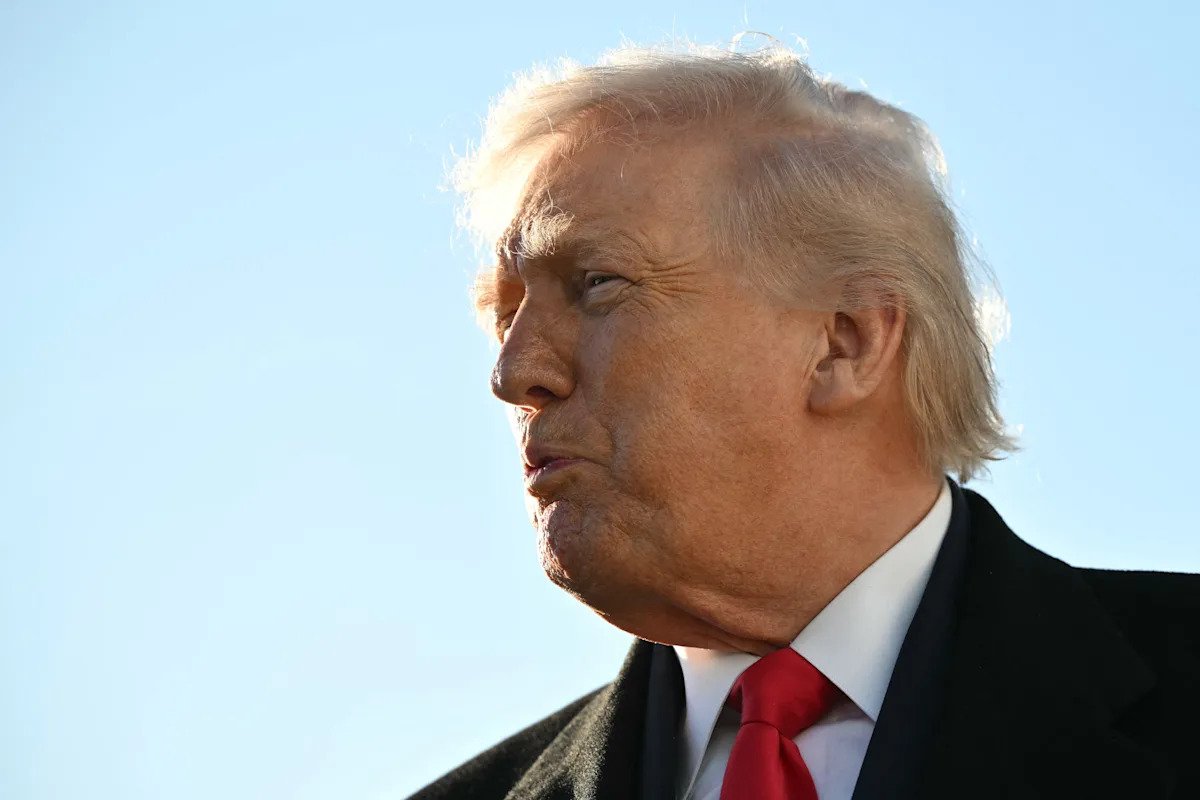
President Donald Trump speaks to the press before boarding Air Force One at Pope Army Airfield at Fort Bragg, North Carolina. on February 13, 2026, on his way to Palm Beach, Florida, to spend the weekend.
In comparison, 21 Democrats have said they won’t run again.
Since World War II, the president’s party has lost an average of 25 seats in the midterms. Only twice has the party in power gained ground, in 1998 and 2002. In both cases, the president’s approval was soaring into the 60s.
But the only president with a midterm rating lower than Trump’s current standing was Harry Truman in 1946, at 33%. That fall, the returns were brutal for his fellow Democrats: 55 lost their House seats. In 2006, when George W. Bush was at a dismal 38%, 30 fellow Republicans lost their seats.
In Trump’s first term, when his rating was 41%, the GOP lost 40 seats.
That said, the swing of dozens of seats has become increasingly difficult as the number of competitive districts has declined and political divisions have sharpened. The nonpartisan Cook Political Report with Amy Walter lists only 18 House seats as toss-ups − with Republicans in more peril than Democrats − and another 18 seats as “leaning” in one direction or the other.
By the way, the flurry of redistricting schemes in Texas, California and elsewhere to gerrymander congressional lines now looks as if it will end in a wash.
That net number: close to zero.
Watch economic angst: 57.3
That’s the preliminary read for February from the University of Michigan’s authoritative consumer sentiment survey.
The benchmark of how consumers are feeling has sunk 20% since Trump took office again a year ago, reflecting continued concern about the economy now and pessimism about what’s ahead.
Created in the 1950s, the number typically rises during good economic times and bottoms out during recessions. Over the past half-century, it hit an optimistic high of 111.3 in February 2000 − near the peak of the longest economic expansion on record − and a low of 50 in June 2022, when inflation was spiking.
The current measure is actually lower than that now among people who don’t have stock portfolios. A bit of a bump in the rating this month was fueled by more affluent Americans with money in the markets. Lower-income workers have seen slower wage growth, and more households are falling behind on their debts.
Nearly 3 out of 4 Americans now describe economic conditions as only fair or poor. Assessments of Trump’s handling of the economy, once a strength, is now a liability. Disapproval hit a record 59% in an NPR/PBS News/Marist poll taken Jan. 27-30. Most said Trump’s signature tariffs had hurt.
To the president’s annoyance, surprisingly solid economic statistics have failed to persuade many Americans to adopt a rosier outlook. Last month, job growth was stronger than expected and inflation was lower.

Morton and Barbara Mandel Recreation Center is a polling venue for the Florida House District 87 Special Primary Election January 13, 2026 in Palm Beach.
“I think we have the greatest economy actually ever in history,” Trump declared with some hyperbole to Fox Business host Larry Kudlow. But he acknowledged that voters remain stubbornly skeptical: “I guess we have to sell that because we should win in a landslide, and we’ll do everything we can to do it.”
Trump has mocked the issue of “affordability” as a “Democratic hoax” and “a con job.” Some anxious Republicans have urged him to show more public displays of empathy.
He’s not the first president to discover that economic statistics don’t always determine how Americans feel. Ask George H.W. Bush, whose argument that the economy had turned the corner failed to win him a second term in 1992. He was defeated by Bill Clinton, running on a mantra that has become a political adage: “It’s the economy, stupid.”
Or Joe Biden, whose insistence that data showed the economy was strong despite a downbeat national mood reinforced a sense that he was out of touch.
MAGA money: $304 million
For the GOP, cold cash is an encouraging number in a discouraging year.
Begin with some basics: The Republican National Committee reported having $95 million in the bank in January, while the Democratic National Committee now owes more money in loans than it has in the bank. The main GOP super PAC for Senate races, the Republican Senate Leadership Fund, has $100 million, close to triple the $36 million reported by the Democrats’ Senate Majority PAC.
Looming over it all is MAGA Inc., the leading pro-Trump super PAC, with a stunning $304 million on hand. There is no clear Democratic counterpart to that.
“I am pleased to report that I have raised, since the Great Presidential Election of 2024, in various forms and political entities, in excess of 1.5 Billion Dollars,” Trump announced without details in an after-midnight post on Truth Social last August. That huge war chest would be especially remarkable amassed by a lame-duck president.

FILE PHOTO: A shopper walks past a partially empty dairy section at a grocery store in Washington, D.C., U.S., January 24, 2026. REUTERS/Nathan Howard/File Photo
In the past, Trump hasn’t always been willing to spend his money on other people’s races, though. In the midterms during his first White House term, in 2018, his super PAC America First Action spent less than $30 million. This time, he may want to save his financial firepower to play a role in the 2028 presidential election.
But he could choose to deploy millions of dollars to defend vulnerable Republican incumbents, attack promising Democratic challengers and finance ads that promote his leadership and warn of disastrous consequences if his opponents prevail.
Would that be enough to counter his sagging approval and voters’ economic angst?
We may be about to find out.
This article originally appeared on USA TODAY: Trump’s 36% approval, MAGA’s $304 million and the midterm math