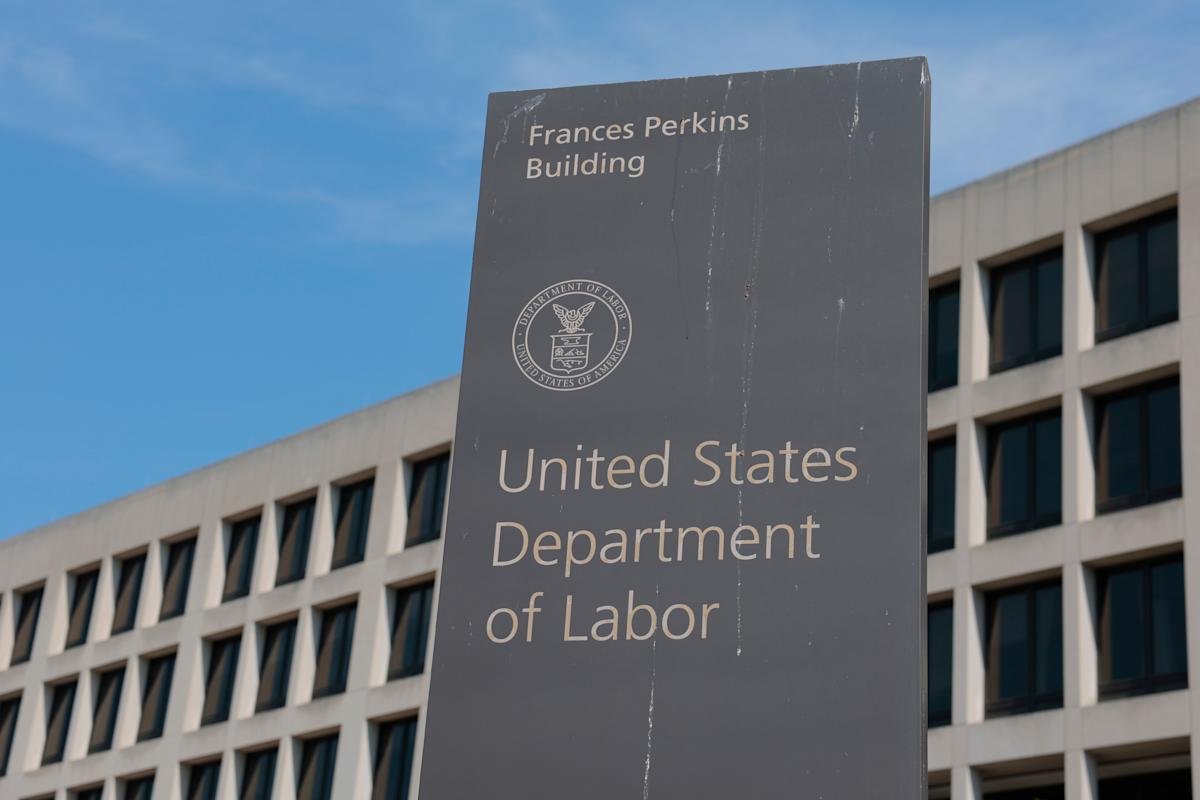
Recent data on the health of the nation’s job market cost Erika McEntarfer, the commissioner of the Bureau of Labor Statistics, her own employment after President Trump lashed out when revisions to earlier months’ numbers suggested the economy could be in worse shape than previously thought.
“Last weeks Job’s Report was RIGGED,” Trump wrote on Truth Social Monday.
The July employment numbers, released last week, showed the US added 258,000 fewer jobs in May and June than what was reported previously. Economists were quick to note the changes, while larger than normal, are routine, factoring in survey data from employers that’s slower to arrive, while Trump’s actions risk politicizing a crucial economic indicator.
Here’s how the jobs report is pieced together and why data within it is regularly updated.
Every month, the Bureau of Labor Statistics publishes an “employment situation” report that includes employment, hours, and wage data for workers on nonfarm payrolls from an “establishment survey” of businesses representing varied sectors of the economy. The report also includes data from a separate “household survey” on the labor force, employment, and unemployment. The report is closely watched by economists, traders, and businesspeople because it can move markets, influence monetary policy, and reflect the overall health of the economy.
The revisions that upset Trump were from the establishment survey, which relies on a survey of about 121,000 businesses and government agencies across the week or pay period that includes the 12th of the month, according to the Bureau of Labor Statistics.
Estimated data from this survey is always revised twice in the succeeding two months after it’s initially published “to incorporate additional sample receipts from respondents in the survey and recalculated seasonal adjustment factors,” the BLS says in a “frequently asked questions” page. Put simply, some businesses are slow to respond, so their survey answers are added as they’re received, leading to revisions — up or down — in the estimates of new jobs.
Importantly, the most recent revisions were within the BLS’s confidence interval — the measure of uncertainty in its own estimates — of “plus or minus 136,000” for the monthly change in total nonfarm employment, said Ryan Sweet, chief US economist at Oxford Economics. May payroll data was revised down by 125,000 jobs to 19,000 jobs gained, while June was revised down by 133,000 to 14,000 jobs gained.
Sweet noted that “if you look at the size of the revisions relative to total employment, they’re not significantly larger than what we’ve seen historically.”
In a blog post earlier this year, Michael Madowitz, principal economist for the Roosevelt Institute, wrote that while revisions can lead to some confusion, it’s worth reflecting on “why incurring some temporary confusion, in this case, contributes to the universally respected economic statistics that are central to the long-term stability of the US financial system.”
The BLS is showing its work, he noted, which is a good thing.
The payroll estimates from establishment surveys are also revised annually to account for wage and employment data from state unemployment insurance tax records. One of these revisions made waves last August when the BLS announced the economy had 818,000 fewer positions in the 12 months ending in March 2024 than initially reported, though that revision itself was also revised earlier this year to 598,000 fewer jobs. Trump has referenced the 818,000 data point as another example of what he perceives as data manipulation to favor Democrats, though it wasn’t exactly great news for the Biden administration.
“We were pretty devastated that in August of 2024 in an election year — right kind of in the home stretch there when people were starting to pay attention — BLS did its annual benchmark revision and found that we had added 800,000 fewer jobs than we had thought at that point,” said Alex Jacquez, a former Biden official and the chief of policy and advocacy at the Groundwork Collaborative, a progressive group.
A bigger likely problem than data manipulation is fewer businesses answering the survey.
Response rates for the establishment survey have declined sharply in recent years, leading to some worries that the data is becoming more vulnerable to errors. Still, researchers from the Federal Reserve Bank of San Francisco wrote in March of the monthly employment gains through 2024 that “despite the substantial decline in response rates, the incoming data are reassuringly not subject to greater noise, and thus greater uncertainty, than in the past.”
But “it’s becoming less of a clear picture of how the labor market is doing in the first estimate” due to the lower survey responses, Sweet said. That’s not a knock on the BLS, he added.
“These revisions are normal,” Sweet said. “It’s the nature of the beast of trying to measure a $30 trillion economy.”
Additionally, big revisions have occurred in other times of economic weirdness, including the 2008 financial crisis and the COVID-19 pandemic. “This is why we had massive upwards revisions in the early months of the Biden administration, when a ton of people were coming back into the labor force after COVID lockdowns,” Jacquez said.
The US indeed has some weirdness right now, including tariffs, business uncertainty, and immigrant workers leaving the labor force.
“(Major revisions) tend to coincide with idiosyncratic times in the labor market, which would make sense. If there’s a big recession, there’s a bunch of churn and a bunch of things happening in the labor market that wouldn’t normally be captured by the standard analysis and regressions that you pull out of the data,” he added.
That’s not to say the revisions aren’t worth examining, though: the two-month revision was the biggest since 1968 when excluding recessions, economists at Goldman Sachs have said, and could point to some strain in the economy.
Even before the most recent jobs report, economists had been watching for recession risks and a slowing job market, making reliable data all the more crucial.
In a video appearance on Yahoo Finance, William Beach, McEntarfer’s predecessor, said the BLS commissioner has nothing to do with the estimation or preparation of the jobs data, but “the damage is done” — people who don’t follow the BLS that closely may struggle to trust the numbers.
“We’re going to take a long time to recover from this,” Beach said.
Emma Ockerman is a reporter covering the economy and labor for Yahoo Finance. You can reach her at emma.ockerman@yahooinc.com.
Sign up for the Mind Your Money newsletter
Click here for the latest personal finance news to help you with investing, paying off debt, buying a home, retirement, and more
Read the latest financial and business news from Yahoo Finance