
President
Trump issues new threats to Iran over Strait of Hormuz closure

TEHRAN, Iran (AP) — U.S. President Donald Trump on Sunday made expletive-laden new threats to escalate strikes on Iran and its infrastructure if it doesn’t open the Strait of Hormuz by his deadline, after American forces rescued an aviator whose Iran-downed plane fell behind enemy lines.
A defiant Iran struck infrastructure targets in neighboring Gulf Arab countries, challenged the U.S. account of the rescue and threatened to restrict another heavily used waterway in the region, the Bab el-Mandeb Strait off the Arabian Peninsula.
In a social media post, Trump vowed to hit Iran’s power plants and bridges and said the country would be “living in Hell” if the Strait of Hormuz, crucial for global trade, isn’t opened by Tuesday. He ended with “Praise be to Allah.”
Trump has issued such deadlines before but extended them when mediators have claimed progress toward ending the war, which has killed thousands, shaken global markets and spiked fuel prices in just over five weeks.
“It seems Trump has become a phenomenon that neither Iranians nor Americans are able to fully analyze,” Iranian Culture Minister Sayed Reza Salihi-Amiri told visiting Associated Press journalists in an interview in Tehran, adding that the president “constantly shifts between contradictory positions.”
Both sides have threatened and hit civilian targets like oil fields and desalination plants critical for drinking water. Iran’s U.N. mission called Trump’s threat “clear evidence of intent to commit war crime.”
Iran’s military joint command warned of stepped-up attacks on regional oil and civilian infrastructure if the U.S. and Israel attack such targets there, according to state television.
The laws of armed conflict allow attacks on civilian infrastructure only if the military advantage outweighs the civilian harm, legal scholars say. It’s considered a high bar to clear, and causing excessive suffering to civilians can constitute a war crime.
U.S. describes a dramatic rescue
An intense search followed Friday’s crash of the F-15E Strike Eagle, while Iran promised a reward for the “enemy pilot.” It was the first known American aircraft to crash in Iranian territory since the U.S. and Israel launched the war on Feb. 28.
Trump said that the service member was “seriously wounded and really brave” and rescued from “deep inside the mountains” in an operation involving dozens of armed aircraft. He said a second crew member was rescued in “broad daylight” within hours of the crash.
A senior U.S. administration official said that prior to locating the pilot, the CIA spread word inside Iran that U.S. forces had found him and were moving him for exfiltration, confusing Iranian officials. The official spoke on the condition of anonymity to discuss details not yet made public.
Iran also shot down another U.S. military plane, demonstrating both the perils of the bombing campaign and the ability of Iran’s degraded military to hit back. Neither the status of the A-10 attack aircraft’s crew nor where it crashed is known.
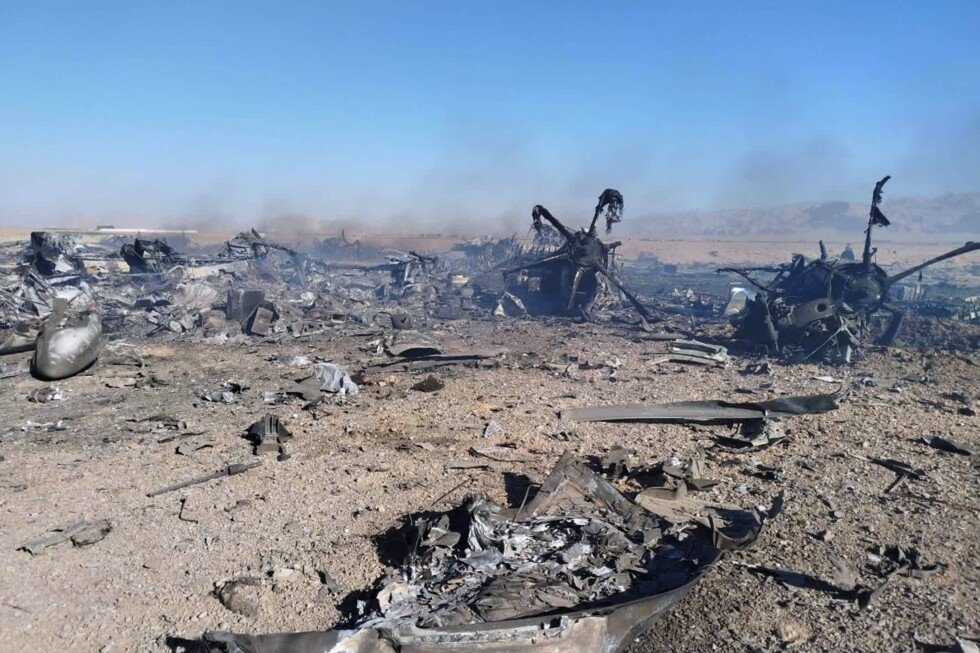
On Sunday, Iran’s state television aired a video showing what it claimed were parts of U.S. aircraft — a transport plane and two helicopters — shot down by Iranian forces during the rescue operation.
However, a regional intelligence official briefed on the mission told the AP that the U.S. military blew up two transport planes because of a technical malfunction and brought in additional aircraft to complete the rescue. The official spoke on condition of anonymity to discuss the covert mission.
Two Black Hawk helicopters were hit but navigated to safe airspace, according to a person familiar with the situation who spoke on condition of anonymity to discuss the sensitive information.
Diplomatic efforts continue
Trump’s deadline centers on growing alarm over Iran’s grip on the Strait of Hormuz, critical for shipments of oil and gas from the Persian Gulf to Europe and Asia as well as humanitarian supplies. Some ships have paid Iran for passage.
An Iranian presidential spokesperson, Seyyed Mohammad Mehdi Tabatabaei, said on social media that the strait can reopen only if some transit revenues compensate Iran for war damages.
A top Iranian adviser, Ali Akbar Velayati, warned on social media that Tehran also could disrupt trade on the Bab el-Mandeb, a key waterway to and from the Suez Canal.
Diplomatic efforts continued. Oman’s Foreign Ministry said that deputy foreign ministers and experts from Iran and Oman met to discuss proposals to ensure “smooth transit” through the strait. Oman has often served as a mediator between the U.S. and Iran.
Egypt said that Foreign Minister Badr Abdelatty had spoken with U.S. envoy Steve Witkoff and Iranian Foreign Minister Abbas Araghchi, and with Turkish and Pakistani counterparts. Russia said that Araghchi also spoke with Russian Foreign Minister Sergey Lavrov.
Iran strikes Gulf targets
In the United Arab Emirates, authorities said that four people — one Nepali and three Pakistani — were hurt in fires caused by debris from the interception of an Iranian projectile at Khor Fakkan port, and intercepted debris caused fires at a petrochemical plant in Ruwais, halting operations.
In Kuwait, Iranian drone attacks caused significant damage to power plants and a petrochemical plant. They also put a water desalination station out of service, according to the Ministry of Electricity.
In Bahrain, a drone attack caused a fire at one of the national oil company’s storage facilities and a state-run petrochemical plant, the kingdom’s official news agency said.
In Israel, rescue authorities said that they were searching for three people in the northern city of Haifa after an apartment building was hit. It wasn’t immediately clear what struck it.
Meanwhile, more than 1,900 people have been killed in Iran since the war began.
In Gulf Arab states and the occupied West Bank, more than two dozen people have died, while 19 have been reported dead in Israel and 13 U.S. service members have been killed. In Lebanon, more than 1,400 people have been killed and more than 1 million people have been displaced. Eleven Israeli soldiers have died there.
___
Bassem Mroue reported from Tehran, Iran, Sam Metz from Jerusalem and Samy Magdy from Cairo. Jon Gambrell in Dubai, United Arab Emirates; Lisa Mascaro and Seung Min Kim in Washington; Munir Ahmed in Islamabad; and Farnoush Amiri in New York; contributed to this report.