
Breaking News
Trump admin. keeps Gabbard whistleblower complaint from Congress on executive privilege

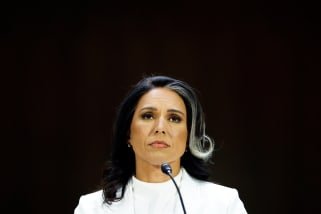
When key members of Congress finally had an overdue opportunity to review a whistleblower complaint against Director of National Intelligence Tulsi Gabbard, they quickly noticed a problem: The document was heavily redacted, making it clear that her office hadn’t exactly embraced full transparency, despite laws related to her office and congressional disclosures.
Any chance lawmakers will get the whole story from the administration? Evidently not. The Wall Street Journal reported Wednesday, based on its review of an email sent to Democratic congressional staffers:
The Trump administration told Congress it won’t share with lawmakers the classified intelligence that led to a whistleblower complaint against U.S. spy chief Tulsi Gabbard, citing presidential claims of executive privilege.
In an email to Democratic congressional staffers sent on Feb. 13 and reviewed by The Wall Street Journal, Gabbard’s office said it was unable to provide the unredacted intelligence that underpinned the complaint ‘due to the assertion of executive privilege to portions’ of the intelligence itself.
Though the Journal’s reporting hasn’t been independently verified by MS NOW, Sen. Mark Warner of Virginia and Rep. Jim Himes of Connecticut, the top Democrats on the congressional intelligence committees, effectively confirmed the story by writing to the DNI this week, asking who asserted privilege over the intelligence report and on what basis.
For those who might benefit from a recap, it was earlier this month when the public first learned that an unnamed U.S. intelligence official accused Gabbard of wrongdoing in a highly sensitive whistleblower complaint that was supposed to be shared with Congress.
The details, not surprisingly, were murky, but according to the available information, the complaint was filed in May, and Gabbard was legally required to share it with key lawmakers within 21 days. It nevertheless took roughly eight months before select members finally gained access to the allegations, albeit in redacted form.
Two weeks ago, the story advanced in an unexpected way: U.S. intelligence agencies reportedly learned about a sensitive phone conversation between two foreign nationals involving someone close to Donald Trump. According to Andrew Bakaj, the whistleblower’s attorney, Gabbard then took that information directly to White House chief of staff Susie Wiles, while restricting access among the nation’s spy agencies.
In other words, the unnamed whistleblower effectively accused the DNI of participating in something resembling a cover-up.
Soon after, MS NOW confirmed that the phone conversation in question related to Jared Kushner, the president’s son-in-law, and a private citizen who’s currently representing the U.S. in sensitive international talks.
Not surprisingly, all kinds of denials soon followed. The administration insisted that Gabbard had done nothing wrong, and while a senior U.S. official conceded to MS NOW that an intelligence agency intercepted a conversation between two foreign nationals talking about the president’s son-in-law, the same official said the intercepted comments were little more than “gossip.”
I’m not in a position to know how credible those denials are, though the latest reporting necessarily raises a rather obvious question: If the intercepted comments about Kushner really were just “gossip” and whatever the foreign nationals were saying wasn’t true, why is the administration asserting executive privilege to keep the relevant details from Congress?
The Journal’s report quoted Glenn Gerstell, the former general counsel at the National Security Agency, who said, “Executive privilege is rarely used as a reason to not give information to the Gang of Eight.” (The “Gang of Eight,” which has special access to sensitive intelligence that other members of Congress do not, includes the House speaker, the House minority leader, the Senate majority leader, the Senate minority leader and the top members of the intelligence committees in both chambers. Its members are evenly split between the parties.)
The White House did not respond to the Journal’s request for comment, and Gabbard’s office referred the Journal to previous communication to Congress that Gabbard had followed the rules for disclosure. It’s notable that the administration remains reluctant to address new developments in the controversy, which just became even more interesting. Watch this space.
This post updates our related earlier coverage.
The post Trump admin. keeps Gabbard whistleblower complaint from Congress on executive privilege appeared first on MS NOW.
This article was originally published on ms.now