
Lifestyle
The Internet Is Discussing “Boomer Panic,” Or How Older People Freak Out Over Minor Things — Experts Are Sharing Why It Happens

Known for being hard workers, ambitious and influential in driving social and political change, baby boomers have also gained a reputation among their younger peers for being know-it-alls, stuck in their ways and easily frustrated, with outsized reactions to smaller issues.

Nenad Cavoski / Getty Images
“Boomer panic” was a phrase coined in 2023 by TikTok user @myexistentialdread in a now-deleted video (though it’s still available via stitches).
In the original video, the TikToker recounted an interaction with an older customer who was annoyed about trying to buy an item that didn’t have a price tag, and the user questioned why boomers (people between the ages of 60 and 78) often appear to get loudly frustrated over minor inconveniences — such as figuring out how to use some form of technology, waiting in a long line or, in this case, a customer service snafu that’s fairly easy to resolve.

Lordhenrivoton / Getty Images
“Can someone please explain to me this phenomenon I’m gonna call ‘boomer panic,’ which is when you’re in an interaction with anyone who is a boomer, and immediately, any time something is going slightly frustrating or like south, they immediately resort to that screaming and screeching and panic?” the user asked.
In subsequent stitches and videos, other users (particularly people who work in customer service roles) shared similar anecdotes and theories about why these behaviors seem so prevalent.
myexistentialdread / Via tiktok.com, radioguyty / Via tiktok.com
Like many millennials, I can definitely relate to these sentiments. I have two boomer parents who tend to overreact to almost everything. But is so-called boomer panic an actual phenomenon? We talked to some experts to better understand what is actually going on.
Is ‘Boomer’ Panic Actually A Thing?
“Boomer panic” isn’t a clinical term, but some data suggest that boomers are feeling overwhelmed and frustrated by technology or pessimistic about their standard of living, Ashwini Nadkarni, an assistant professor of psychiatry at Harvard Medical School, told HuffPost.

Willie B. Thomas / Getty Images
For example, a Consumer Affairs article reported that 91% of boomers and Gen Xers felt overwhelmed by technology. A survey of 2,000 individuals found that boomers’ reasons for feeling burnt out stem from health decline and loss of independence.
These stats suggest that, yes, boomers can get irritated over many things. But it might not be any more or less than younger generations, according to Patti M. Simone, a professor of psychology at Santa Clara University.
“While some individuals of any age may become frustrated by new technology, changes in routines, or unexpected inconveniences, this is not unique to older people, nor is it a defining feature of aging,” Simone told Huffpost.
It’s Not Necessarily ‘Panic’ — It’s Dysregulation

Miljan Živković / Getty Images
According to Nadkarni, many factors could contribute to what others perceive as boomer outbursts, including having to adapt to new technologies, being part of the “sandwich generation” and managing retirement during challenging financial times.
Anyone can feel frustrated over Facebook changing its layout again or having to use a QR code to open a menu (I know I’ve been there). Technology is also developing at a much faster pace than it did when boomers were younger. Not to mention, the world is a lot different, too — thanks to the rise of social media, high-octane politics, a 24-hour news cycle and a questionable economy. It’s not like seemingly “big” reactions are entirely unwarranted.

Andriy Onufriyenko / Getty Images
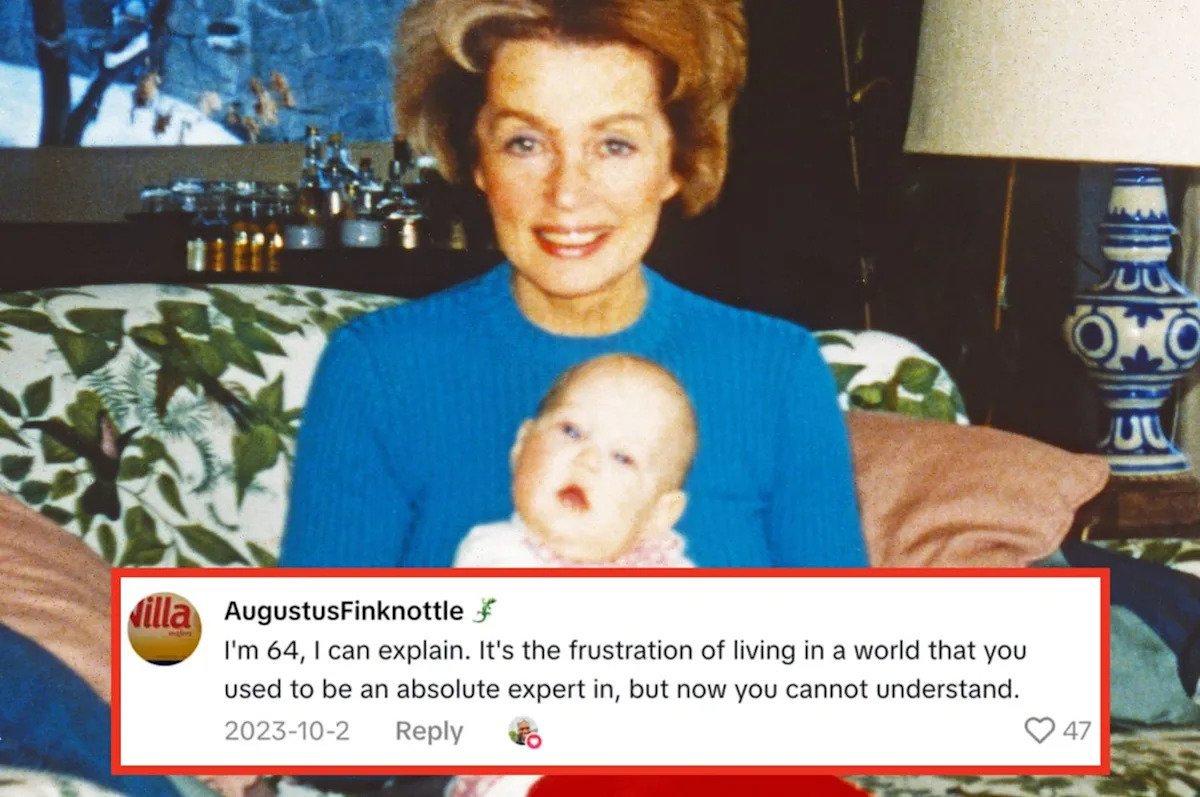
As one self-identified boomer commented on a “boomer panic” TikTok: “I’m 64, I can explain. It’s the frustration of living in a world that you used to be an absolute expert in, but now you cannot understand.”

Nadkarni also suggests that the pressures of caring for children (or grandchildren), aging parents, and managing retirement can contribute to these outbursts. Now, couple those factors with an upbringing that didn’t emphasize developing the skills to process or regulate emotion, and it might explain why these incidents happen.
“Younger generations have been raised to prioritize emotional well-being and mental health, prompting more open communication, emotional validation, and reduced suppression,” said Nakardi.
In the case of boomers, there was “an emphasis on stricter parenting and greater stigma toward mental health concerns,” which may have prompted them to bottle up their emotions and lose their tolerance for frustration over time, added Nakardi.

Stockbyte / Getty Images
Poking Holes In The Stereotype
However, despite boomers receiving criticism for not being able to process their emotions in real time, Simone noted that research indicates that older adults can often be better at reframing events, focusing on the positive, and managing stress.
“So while ‘boomer panic’ exists as a meme or stereotype, it should not be confused with an accurate description of how most older adults actually respond to everyday challenges,” she added.

Momo Productions / Getty Images
And, ultimately, Nadkarni said, in situations where someone is clearly dysregulated or stressed out, approaching them with empathy is key to helping them calm down.
“When anyone is overreacting,” Nadkarni added, “the individual’s nervous system is responding as if a stimulus is a true threat, even if it isn’t.”
This article originally appeared on HuffPost.