
Economy
Section 301 trade probes put China in U.S. crosshairs ahead of Xi-Trump meeting

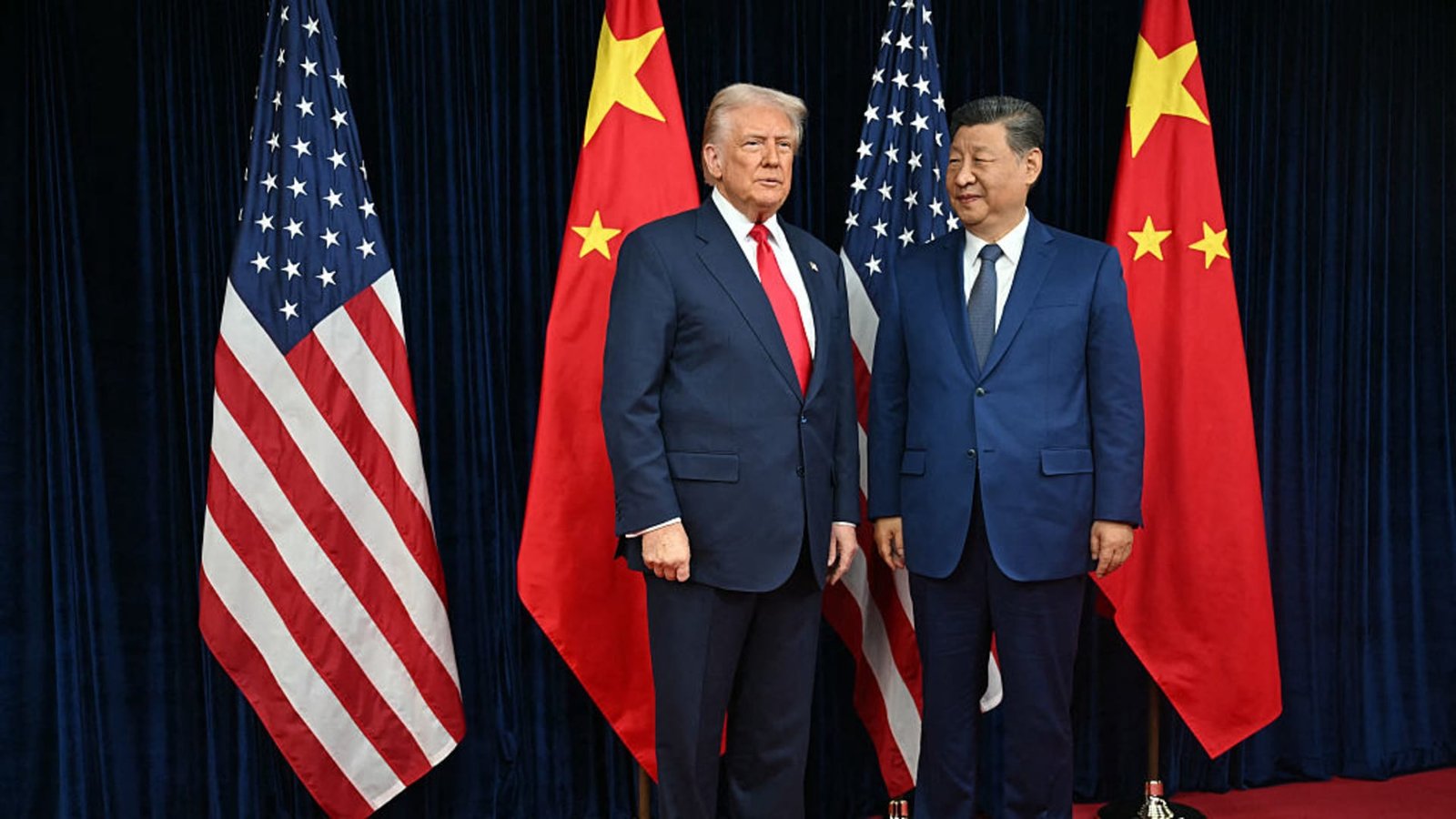
TOPSHOT – US President Donald Trump (L) and China’s President Xi Jinping arrive for talks at the Gimhae Air Base, located next to the Gimhae International Airport in Busan on October 30, 2025. Donald Trump and Chinese leader Xi Jinping will seek a truce in their bruising trade war on October 30, with the US president predicting a “great meeting” but Beijing being more circumspect. (Photo by ANDREW CABALLERO-REYNOLDS / AFP) (Photo by ANDREW CABALLERO-REYNOLDS/AFP via Getty Images)
Andrew Caballero-reynolds | Afp | Getty Images
With a high-stakes summit in Beijing less than three weeks away, the U.S. has launched sweeping trade investigations that put China squarely in its crosshairs, adding a new layer of friction to an already complicated relationship.
The probes, which will be conducted under Section 301 of the Trade Act of 1974, aim to identify unfair trade practices, particularly structural excess capacity and production in manufacturing sectors.
The 301 investigation, while casting a wide net over a dozen trading partners, takes a clear aim at China, given its well-documented issues such as overcapacity and forced labor, said Dan Wang, China director at the political consultancy Eurasia Group.
As Trump’s negotiating position has been weakened by the military aggression in Iran, “U.S. needs to establish credible threat on tariffs as it remains Trump’s top pressure tool,” Wang said, although Beijing was likely unsurprised by the escalation.
“Maximizing leverage before major bilateral meetings seems to be a standard move now,” she said.
The probes followed the U.S. Supreme Court’s decision last month to strike down Trump’s “reciprocal” tariffs, which curtailed his ability to deploy tariffs at will, giving China a boost in leverage ahead of the summit.
The Trump administration is “pivoting to its other tools to continue its tariff agenda … [tariff] is clearly a card that Trump wishes to have in his pocket for negotiations,” said Lynn Song, chief economist at ING Bank.
Section 301 permits the president to impose levies on countries found to have engaged in unfair trade practices without congressional approval. Trump has repeatedly charged China with indulging in unfair trade practices going back to his first term as president when he invoked Section 301 as well to levy tariffs.
Meanwhile, despite criticism from global trading partners including the U.S. against its over-reliance on external demand, China’s export machine has continued to run full throttle. Chinese exports surged 21.8% in the first two months from a year earlier, boosting its trade surplus to a record high of $213.6 billion.
The trade probes are now adding fresh uncertainty to an already-complicated diplomatic backdrop and a fragile trade truce between the world’s top two economies, with the gap between both sides’ agendas for the summit widening.

“It is unclear what is even on the table for discussion by both sides, and the summit is coming up quickly,” said Deborah Elms, head of trade policy at Hinrich Foundation.
“If additional investigations targeting forced labor practices are launched and China is named … Beijing will be even more aggravated and unlikely to want to engage in deal-making with an administration that … is at least less than stable,” she told CNBC’s “The China Connection” on Thursday.
The investigation comes at a time when U.S. actions against Iran have risked China’s energy supplies, further complicating Beijing’s calculus for the bilateral talks.
While China is temporarily insulated by strategic oil and gas reserves, it is not immune to prolonged supply chain disruptions emanating from the Strait of Hormuz, said Alfredo Montufar-Helu, managing director at Ankura Consulting in Beijing.
“A volatile external environment is the exact opposite of what policymakers in Beijing need right now,” Montufar-Helu said.
U.S. and Israeli strikes that killed Iranian Supreme Leader Ayatollah Ali Khamenei have drawn sweeping retaliation from Tehran, which has moved to choke off the Strait of Hormuz — a waterway that carries roughly one-fifth of the world’s oil supply.
As a major buyer of Iranian crude, China has sent a special envoy to the region to mediate, urging an immediate ceasefire and a return to diplomatic negotiations.

Limited breakthrough?
Trump will be in China from March 31 to April 2 for a meeting with his Chinese counterpart Xi Jinping, the first trip by an American president since Trump’s last visit in 2017. Trade negotiators from both sides are reportedly slated to meet in mid-March to lay the groundwork for the leaders’ summit.
The meeting is expected to yield limited breakthroughs though, with both sides seeking to maintain the stability that has characterized the bilateral relations since late last year.
“We should not expect a fundamental reframing of the bilateral relationship,” said Montufar-Helu. “Maintaining the stability achieved in Busan is, in itself, an excellent result.”
Chinese Foreign Minister Wang Yi struck a conciliatory tone during a press briefing Sunday, saying that both sides needed to “create a suitable environment” for the summit and “remove unnecessary disruptions.”
Washington is likely to push for extended commitments on agricultural purchases, including soybeans and aircraft, as well as assurances that China will not restrict its rare earth exports, according to analysts.
Deliverables have likely narrowed to commercial purchases such as soybeans rather than any grand bargain, with the two leaders expected to frame the meeting as the opening of a longer conversation set to unfold across the rest of 2026, said Elms.
China, for its part, will likely seek clarity on the trajectory of U.S. technology export restrictions. “Beijing will essentially be asking how high the fence will get and how big the yard will be,” Montufar-Helu added.
The possibility of American executives accompanying Trump on his trip to Beijing appears to be fading as well, signaling how expectations for the summit have been scaled back.
“With each passing day, the chances of a formal CEO delegation joining the president’s trip are fading,” Han Lin, China Country Director at The Asia Group, told CNBC on Thursday. “Few CEOs have been invited, and even fewer have likely agreed to come given how little time remains.”

Subscribe now