
Breaking News
Oil prices soar after strikes on energy sites, Pentagon seeks $200 billion and more key events that got us here

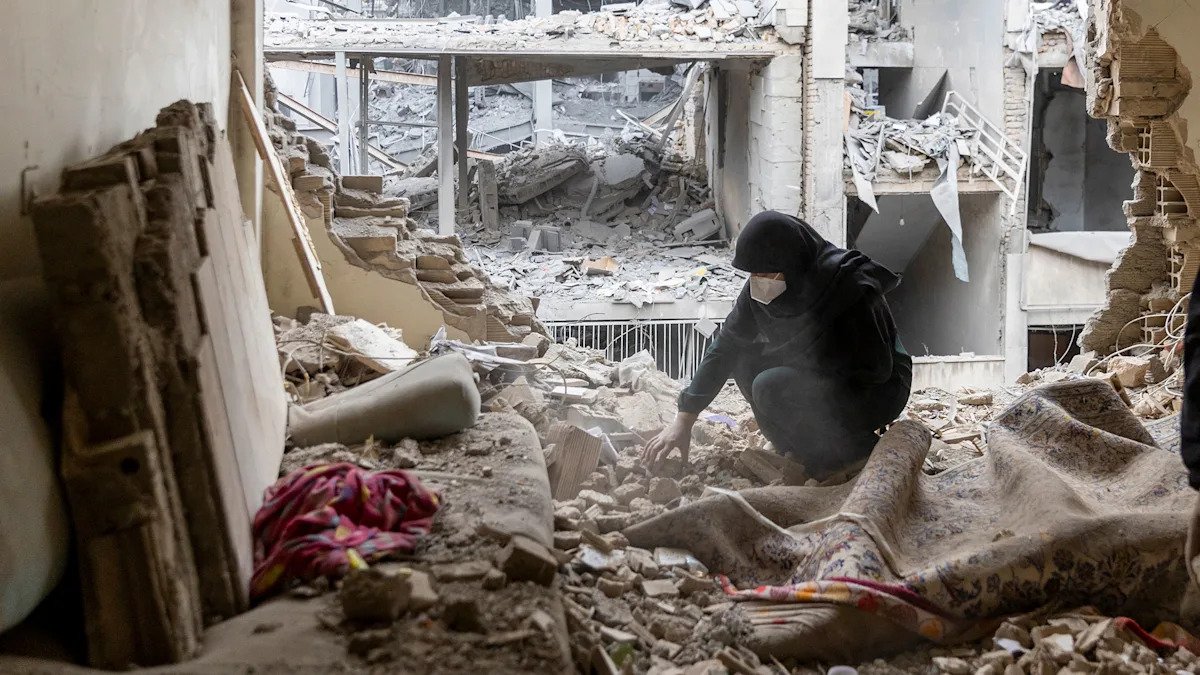
Now in its third week, the Iran war has engulfed the Middle East, killed more than 2,000 people and sent oil prices skyrocketing worldwide. The United States and Israel continue to strike Iran daily. Israel is also fighting the Iranian-backed militant group Hezbollah in Lebanon.
In response, the Iranian regime — now led by Mojtaba Khamenei, son of the slain Ayatollah Ali Khamenei — has launched hundreds of drones and missiles at Israel and at U.S. military targets in Bahrain, Jordan, Kuwait, Qatar, Saudi Arabia, Turkey and the United Arab Emirates. By threatening to bomb ships, Tehran has forced the Strait of Hormuz to close, blocking one-fifth of the world’s oil supply.
There is no sign the widening conflict will end anytime soon. President Trump has repeatedly touted American military success, claiming on Monday that U.S. strikes have “literally obliterated” Iran. But he has also said that the war will be over only “when I feel it — when I feel it in my bones.”
Likewise, Iran’s foreign minister had rejected reports that his country is seeking a peace deal. “We never asked for a ceasefire, and we have never asked even for negotiation,” Abbas Araghchi told CBS on Sunday. “This is what we have done so far, and we continue to do that until President Trump comes to the point that this is an illegal war with no victory.”
Here’s a quick recap of the latest developments in the Iran war — and how we got to this point over the last 20 days.
Latest updates
Oil prices soar after strikes on energy sites: Iranian state media reported on Wednesday that airstrikes had hit its giant South Pars natural gas field — as well as nearby oil and petrochemical facilities — in the southern city of Asaluyeh. International oil prices jumped more than 6% to nearly $110 a barrel following the news. Natural gas prices also shot up. Most of the energy from South Pars is used domestically in Iran. Qatar blamed Israel for the strike.
In response, Iran launched retaliatory strikes on energy sites in Qatar, Kuwait, Saudi Arabia and the United Arab Emirates. Qatar’s Ras Laffan terminal, the largest liquefied natural gas facility in the world, was seriously damaged. Oil prices briefly topped $115 a barrel.
On social media, Trump said the U.S. and Qatar were not involved in the South Pars strike — which he also attributed to Israel — but threatened to “massively blow up” the gas field if Iran retaliated again.
“I do not want to authorize this level of violence and destruction because of the long term [sic] implications that it will have on the future of Iran,” Trump wrote, “but if Qatar’s LNG is again attacked, I will not hesitate to do so.”
Three Israeli officials briefed on the South Pars strike told the New York Times that the U.S. was informed before the attack. When asked about the Times report, Trump said on Thursday that he “told [Israeli Prime Minister Benjamin Netanyahu]: ‘Don’t do that.’
“We’re independent,” Trump added. “We get along great. It’s coordinated.”
Araghchi, Iran’s foreign minister, said on social media that his country would show “ZERO restraint” if its energy infrastructure were struck again.
Pentagon seeks $200 billion to fund Iran war: Citing a senior administration official, the Washington Post reported on Wednesday that “the Pentagon has asked the White House to approve a more than $200 billion request to Congress to fund the war in Iran.” Lawmakers opposed to the conflict are likely to oppose the funding request, which accounts for nearly a quarter of America’s annual defense budget. “Obviously, it takes money to kill bad guys,” Defense Secretary Pete Hegseth said during a Thursday news conference. “As far as the $200 billion, I think that number could move.” Shortly after, Trump confirmed that he would be asking for hundreds of billions of dollars to fund the war.
Top U.S. intelligence officials contradict Trump on Iran’s missile threat: At a Senate hearing on Wednesday, two top intelligence officials — Tulsi Gabbard, the director of national intelligence, and John Ratcliffe, the CIA director — confirmed the intelligence community’s earlier conclusion that Iran was years away from developing missiles capable of hitting the U.S. Trump has repeatedly claimed that the U.S. had to attack Iran because it was on the verge of building such missiles, but neither Gabbard nor Ratcliffe would second that assertion. “The only person who can determine what is and is not an imminent threat is the president,” Gabbard said during questioning.
Israel kills key Iranian leaders: Israel announced on Wednesday that its overnight airstrikes had killed Iranian intelligence chief Esmaeil Khatib. In a statement, the Israeli military said Khatib had overseen espionage and covert operations against Iranians as well as Israeli and American targets around the world. Iranian President Masoud Pezeshkian confirmed the killing on social media, calling it “a cowardly assassination.”
Khatib is the third high-level Iranian official killed by Israel this week. On Tuesday, Israeli airstrikes near Tehran killed Ali Larijani, the head of Iran’s Supreme National Security Council and de facto leader of the country after the death of Ayatollah Ali Khamenei. Israel also said it had killed Gholamreza Soleimani, the head of the Basij, Iran’s powerful plainclothes militia.

Ali Larijani, Secretary of Iran’s Supreme National Security Council, on Sept. 27, 2025.
(Courtney Bonneau/Middle East Images/AFP via Getty Images)
In a video statement posted on social media, Israeli Prime Minister Benjamin Netanyahu framed the killing of Larijani and Soleimani as a step toward regime change. “We’re undermining this regime in the hope of giving the Iranian people a chance to oust it,” Netanyahu said. “It won’t happen all at once, it won’t happen easily. But if we persist in this, we’ll give them the opportunity to take their fate into their own hands.”
But according to a New York Times analysis, Larijani “had a reputation for being able to bridge the country’s hard-line military elements and more moderate political factions.” As a result, his death “could open the way for the military to tighten its grip over the ruling system,” the Times said.
Trump’s top counterterrorism official resigns: Trump administration official Joe Kent resigned from his post as director of the National Counterterrorism Center on Tuesday because of his opposition to the war, writing in a letter that Iran “posed no imminent threat to our nation” before the U.S. and Israel launched joint airstrikes on Feb. 28. Citing his own combat experience, Kent wrote that he could not “in good conscience” support “sending the next generation off to fight and die in a war that serves no benefit to the American people nor justifies the cost of American lives.” Kent claimed that Israel “deceived” Trump into attacking Iran.

Joe Kent, director of the National Counterterrorism Center, on Dec. 11, 2025.
(Tom Williams/CQ-Roll Call, Inc via Getty Images)
Trump rebuffed by NATO: Posting on Tuesday to his Truth Social network, Trump wrote that “the United States has been informed by most of our NATO ‘Allies’ that they don’t want to get involved with our Military Operation against the Terrorist Regime of Iran.” For days, the president has been asking U.S. allies for help in securing the Strait of Hormuz and complaining about their reticence. But unlike previous Republican presidents such as George H.W. Bush and George W. Bush, Trump did not assemble an international coalition before starting a war in the Middle East. “We have had such Military Success, we no longer ‘need,’ or desire, the NATO Countries’ assistance,” Trump wrote on Truth Social. “WE DO NOT NEED THE HELP OF ANYONE!”

President Trump on March 17.
(Yuri Gripas/Abaca/Bloomberg via Getty Images)
20 days of strikes on Iran
The U.S. and Israel first struck Iran around 9:45 a.m. local time on Feb. 28. Before the attacks, the Trump administration had been negotiating with the Iranian regime over the future of its nuclear program — while simultaneously ordering the largest buildup of U.S. military forces in the Middle East since the 2003 invasion of Iraq.

People watch as smoke rises along the skyline after an explosion in Tehran on Feb. 28.
(AP)
The initial wave of U.S.-Israeli airstrikes killed Ayatollah Ali Khamenei and about 40 of Iran’s top military and intelligence officials. A missile also struck the Shajarah Tayyebeh elementary school for girls in Minab, near the Strait of Hormuz. At least 175 people died, according to Iranian officials. Most of them were children.
An ongoing U.S. military investigation has determined that the school was destroyed by an American Tomahawk cruise missile as the “result of a targeting mistake.” If confirmed, this would make the school strike “one of the most devastating single military errors in recent decades,” according to the New York Times. On Friday, Hegseth said that U.S. Central Command had designated a general officer “from outside CENTCOM” to further investigate the attack.
Over the last two-plus weeks, the U.S. and Israel have continued to hit Iranian targets — naval sites, missile infrastructure, nuclear facilities — with missiles, drones and fighter jets. According to CENTCOM, the goal is to dismantle “Iran’s defense industrial base” in order to “prevent threats to the region into the future.” Hegseth said on March 13 that more than 15,000 Iranian targets have been struck so far — including more than a hundred warships.
The latest major operation occurred on March 13 when the U.S. bombed more than 90 missile storage sites and mine facilities on Kharg Island, a small outpost that serves as Iran’s main oil export terminal. Trump said U.S. forces “totally obliterated every MILITARY target” but left the island’s oil infrastructure intact. He threatened to reverse that decision if Iran does not reopen the Strait of Hormuz to commercial shipping.

Iran’s Kharg Island is seen on Feb. 26.
(Planet Labs PBC via AP)
About 50,000 U.S. troops have been deployed to the region, along with the world’s largest aircraft carrier, the USS Gerald R. Ford. Another 2,500 Marines are now reportedly heading to the Middle East from the Pacific.
Israel fights Hezbollah in Lebanon
Hostilities between Israel and Hezbollah have occurred intermittently since 1982, and the outbreak of the Gaza war in October 2023 led to another round of fighting. A ceasefire had been in place since November 2024, but Hezbollah launched several rockets into northern Israel after the U.S. and Israel struck Iran on Feb. 28. Israel has been conducting retaliatory strikes on Hezbollah targets in Lebanon ever since.
On Monday, Israel’s defense minister said that its forces had launched a “ground maneuver” in southern Lebanon, adding to fears that a broader invasion may be coming.
Iran retaliates
Within hours of the initial U.S.-Israeli strikes, Iran had launched its own barrage of ballistic missiles and Shahed drones at targets in Israel, Bahrain, Kuwait, Saudi Arabia, Kurdistan and the United Arab Emirates. Iran also reported striking U.S. military bases in Qatar, Kuwait, Bahrain and the UAE.
Over the weeks that have followed, Tehran has continued to launch attacks on regional targets, though many have been intercepted. One Iranian drone strike on a U.S. base in Kuwait killed six U.S. reserve soldiers and seriously injured dozens of others; the U.S. Embassy there shuttered after a separate attack. Several Israeli civilians have been killed by Iranian missiles. NATO defense systems have intercepted a ballistic missile launched from Iranian territory as it entered Turkish airspace; the United Kingdom’s Ministry of Defense confirmed that its forces intercepted an Iranian drone headed toward Iraq.
In recent days, U.S. officials have claimed that the rate at which Iran is launching missiles and drones has fallen dramatically — by 80% to 90% — since the start of the war.
On March 8, Iran’s Assembly of Experts — an elected body of 88 senior clerics tasked with naming Khamenei’s successor — chose the slain ayatollah’s son, Mojtaba Khamenei, to take over as supreme leader. Mojtaba Khamenei is known for his close ties to the Islamic Revolutionary Guard Corps; his selection signals that the “much more hard-line Revolutionary Guard side of the regime … is now in charge,” Vali Nasr, an expert on Iran and Shiite Islam at Johns Hopkins University, told the Times.

Iran’s Assembly of Experts appointed Mojtaba Khamenei, right, as the nation’s new supreme leader, succeeding his father, Ayatollah Ali Khamenei.
(Iranian President’s Press Office/Handout/Anadolu via Getty Images)
In his first statement on the war, Mojtaba Khamenei vowed that Tehran would keep the Strait of Hormuz closed while continuing to retaliate for U.S.-Israeli attacks. In his second, issued Monday, Khamenei said he would retain all the officials appointed by his father. Khamenei was reportedly injured in the first wave of strikes.
The human toll
In Iran, at least 1,444 people have been killed and 18,551 injured since the start of the war, according to the Iranian Health Ministry. In Lebanon, officials said that more than 1,000 people have been killed; at least 2,400 others have been wounded. In Israel, at least 14 people have been killed, according to authorities. The Pentagon has said that 13 American service members have died so far; six were killed when a refueling plane crashed in Iraq. About 200 Americans have been wounded.
On Monday, Lebanon said that more than 1 million of its residents have been displaced in the latest outbreak of fighting between Israel and Hezbollah. Hundreds of thousands of people have been displaced in Iran as well.
Oil prices skyrocket
The Strait of Hormuz connects the Persian Gulf to the rest of the globe. One-fifth of the world’s oil flows through it. Iran has been threatening to attack ships there, and the country’s new leader has vowed to maintain the blockade. U.S. officials say Iran has also been booby-trapping the strait with mines.

A satellite view of the Strait of Hormuz.
(Gallo Images/Orbital Horizon/Copernicus Sentinel Data 2025)
As a result, global oil prices have shot up to more than $100 a barrel for the first time in years. The average price of gas in the U.S. is approaching $4 a gallon, up 80 cents from a month ago. Food and other goods that need to travel from one place to another could soon become more expensive as well.
Trump has tried to address the issue in various ways: lifting sanctions on some Russian oil to increase supply; striking Iran’s 30 mine-laying ships; and calling on U.S. allies to send warships to escort merchant vessels through the Strait of Hormuz.
“I’m demanding that these countries come in and protect their own territory — because it is their territory,” Trump said on Sunday. “You could make the case that maybe we shouldn’t even be there at all, because we don’t need it. We have a lot of oil.”
But top officials from Japan, Italy, Australia and Germany rebuffed Trump on Monday, saying their countries would not participate in efforts to reopen the strait.
“This is not our war,” said Germany’s defense minister. “We did not start it.”
The endgame?
Trump initially said the war would last four or five weeks. Since then, he vacillated between claiming that the war was “over” in “the first hour” — and “we won” — to insisting that the U.S. could continue attacking Iran “for as long as it takes.”
The president and those around him have also provided many different explanations for why the U.S. chose to attack Iran now: to ward off an imminent Iranian threat; to preempt Iranian retaliation against U.S. assets after an expected Israeli attack on Iran; to destroy Iran’s missile and military capabilities; to prevent Iran from obtaining a nuclear weapon; to achieve regime change by bringing the Iranian opposition to power.
It is unclear which of these goals the U.S. would have to achieve before declaring “victory.” Trump has said that he must “be involved in the appointment” of Ayatollah Ali Khamenei’s successor, dismissing Khamenei’s son as an “unacceptable” pick.
“We want someone that will bring harmony and peace to Iran,” he added. But Trump has also admitted that he doesn’t know who could succeed the slain Khamenei because so many key Iranian figures have already been killed.
Meanwhile, an Israeli military spokesman said on Monday that Israel is prepared for at least three more weeks of fighting — and “even more if we need to.”
During its first two weeks, the Iran war cost the U.S. an estimated $12 billion in direct military expenditures. Multiple polls have shown that most Americans oppose the initial U.S. strikes on Iran and believe the war is making America less safe.