
Breaking News
Much Of The Western Half Of The Country Had Its Warmest Winter On Record, Including Nine US States

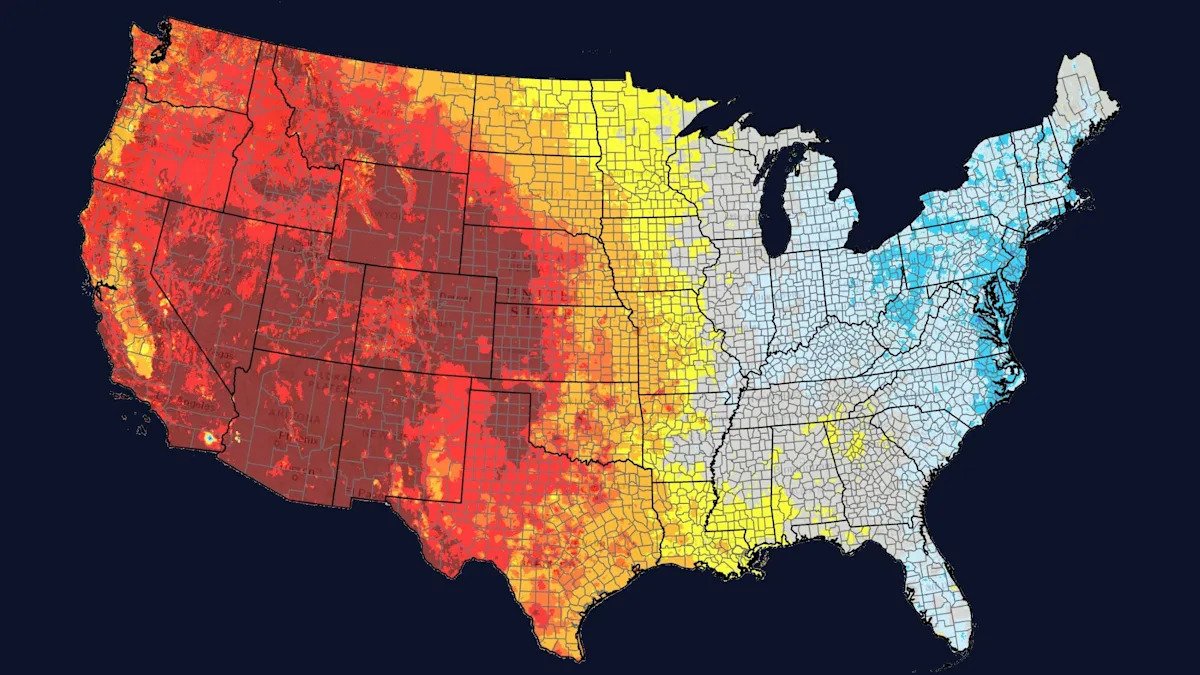
Winter 2025-26 was one for the record books, in the sense that there was record-breakingly little winter for much of the West and Plains.
A large swath of the western half of the U.S., from the West Coast to the Plains, had its warmest meteorological winter (December through February) on record – based on 131 years of climate data.
That includes nine states, from Texas to Oregon, shown in red in the map above, according to data released Monday from NOAA’s National Centers for Environmental Information.
The contiguous United States (every state except Hawaii and Alaska) as a whole measured its second-warmest meteorological winter on record. Eight states from Ohio to southern New England were categorized as cooler than average, according to NOAA, which kept the country from its record warmest winter overall.
(MORE: America’s Hottest Winter Temperature On Record Just Happened In South Texas, Preliminary Data Shows)
Several cities can now claim winter 2025-26 as their warmest on record, including locations with over a century of data, like Salt Lake City (152 years of data), Tucson (130 years of data) and Rapid City, South Dakota (114 years of data).
Phoenix, Arizona, obliterated its previous record (a record that was only a year old, mind you) by almost 3 degrees, a pummeling of a record in the realm of three-month temperature data.
Albuquerque, New Mexico, clobbered its previous record warmest winter by 3 degrees, according to the Southeast Regional Climate Center. Helena, Montana, Las Vegas and Lubbock, Texas, were among the other cities record warm this winter.
It’s Not Just Temperatures
When it comes to winter, temperatures are just part of the story when it comes to determining how mild it has been.
The Midwestern Regional Climate Center developed the Accumulated Winter Season Severity Index (AWSSI) as a measure of how impactful winter has been based on both temperature and snowfall, and monitoring sites across the western half of the country are experiencing record mild winter seasons.
The AWSSI isn’t limited to winter, but rather the period of time with weather that meets certain meteorological criteria. So “winter” can still be ongoing for some sites, even as March begins.
All of this to say, many locations across the West and Plains have had a record mild winter when combining temperatures, snowfall and snow cover.
Much of the Plains and East was also dry. Nineteen states from Nebraska, Oklahoma and Texas to Maine had one of their 10 driest winters on record, according to NOAA.

NOAA/NCEI
What Happened?
Remember how cold weather in the East is what kept the country as a whole from having its warmest winter on record?
Well, that’s a major clue to why the West was so warm.
A ridge of high pressure has dominated the western half of the country, allowing for consistent warmer weather to prevail as well as causing the jet stream to steer storms farther north, limiting snowfall for the mountains.
This trend is associated with the negative phase of the Arctic Oscillation (AO), a global circulation pattern in our atmosphere that indicates the strength of the polar vortex. When the AO is in a negative phase, the polar vortex is weaker, which allows for colder air to spill into the eastern half of the country while trapping the western half under warmer conditions.

Sara Tonks is a content meteorologist with weather.com and has a bachelor’s and a master’s degree from Georgia Tech in Earth and Atmospheric Sciences along with a master’s degree from Unity Environmental University in Marine Science.