
Breaking News
Moon fly-by sees astronauts regain contact with Earth and head for home

Four astronauts on Nasa’s Artemis II mission are on their way back home after a dramatic lunar fly-by that saw them travel further from Earth than any other humans.
The crew lost contact with the Earth, as expected, for 40 minutes as they travelled behind the Moon.
With communications re-established, astronaut Christina Koch said: “It’s so great to hear the Earth again.”
Soon afterwards the spacecraft dipped to within a few thousand miles of the lunar surface and the crew witnessed a total eclipse of the Sun as the Moon blocked out its light.
The Artemis II mission’s spacecraft, Orion, broke the record for human travel at about 13:56 EDT (18:56 BST) on Monday, beating a record of 248,655 miles (400,000km) held since 1970 by the Apollo 13 mission.
Canadian astronaut Jeremey Hansen acknowledged the achievement with humility.
“As we surpass the furthest distance humans have ever traveled from planet Earth, we do so in honoring the extraordinary efforts and feats of our predecessors in human space exploration,” he said.
As the spacecraft approached and the Moon swelled in its windows, the astronauts began working through a checklist of things to record on its surface, taking images with an array of digital cameras and, as Nasa had briefed, making sketches and recording their own audio descriptions of what they saw.
The spacecraft was not planning to land on the Moon but fly around its far side, the side which is never visible from Earth. Satellites have photographed the far side before, but the astronauts were the first human eyes to see some parts of the far side’s surface and its vast craters and lava plains.
After the flyby President Trump spoke with the Orion team and congratulated them: “Today, you’ve made history and made all America really proud, incredibly proud.”
He went on to ask the four astronauts what the most unforgettable part of their day had been.
Commander Reid Wiseman told the President: “We saw sights that no human has ever seen, not even Apollo, and that was amazing for us.”
Fellow astronaut Jeremy Hansen made a request to Nasa mission control to name two craters they observed on the Moon “both with our naked eye and with our long lens”.
One they asked to be called Integrity – the name the astronauts gave to the Orion capsule they are travelling in.
The other request was to commemorate Wiseman’s late wife Carroll, who died in 2020 of cancer.
“A number of years ago we started this journey.. and we lost a loved one and there’s a feature on a really neat place on the moon… at certain times of the Moon’s transit around Earth we will be able to see this from Earth,” he said in a visibly emotional tribute.
The four astronauts were seen hugging on the live feed from their capsule after the request.

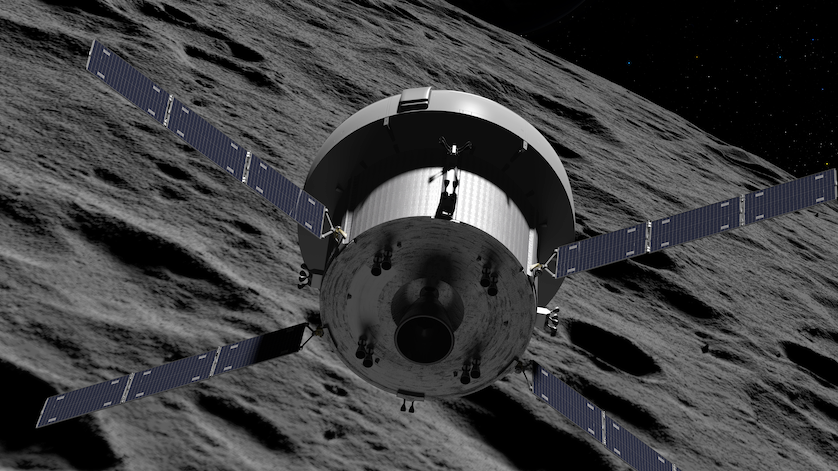
Artwork: Orion emerges from the Moon’s far side to a solar eclipse in space [NASA]
The crew’s kit included two professional digital SLR cameras – one fitted with a wide‑angle lens to capture the whole scene, another with a powerful zoom to pick out fine detail on the lunar surface – plus a mirrorless camera with a standard‑view lens designed to produce images with a perspective close to that of the human eye.
Small, rugged video cameras mounted on the tips of each of Orion’s four solar array wings recorded smooth, continuous views as the spacecraft swept over the Moon’s cratered landscape, while each astronaut also carried a smartphone to film and photograph everyday life inside the capsule.
Nasa says it plans to share much of the imagery, either later in the mission or when the spacecraft returns to Earth.
During the six hour flyby, the crew dimmed Orion’s internal lights to reduce reflections on the windows and improve their view.
Nasa’s science team say the audio will matter as much as the imagery: as the astronauts “say what they see” while looking out, trained human eyes can sometimes pick out subtle colours, contrasts and textures that do not stand out in spacecraft images alone.

Close up, the Moon stops being a shining disc and becomes a craggy world with varied features. [NASA]
Dr Kelsey Young, the agency’s lunar science lead, told BBC News that a well trained observer could detect faint shades in the landscape – the nuances of colour, texture and geological features on the far side – that became clearer the longer they stared at the Moon from close up.
“Human eyes and brains are highly sensitive to subtle changes in color, texture, and other surface characteristics,” she said.
The night’s most nerve-jangling phase came as the Orion craft slipped behind the bulk of the Moon. Its radio and laser connections to Earth were cut off, leaving the four astronauts alone on the lunar far side for about 40 minutes.
Just before this “loss of signal”, Pilot Victor Glover had a message for the people of Earth.
“As we prepare to go out of radio communication, we’re still going to feel your love from Earth. And to all of you down there on Earth and around Earth, we love you, from the Moon. We will see you on the other side.”
For the next 40 minutes, mission controllers, the astronauts’ friends and families, and those watching the live stream waited anxiously as the mission clock ticked down to the moment when contact should have been restored.

A view from Orion on Monday of the approaching Moon [NASA]
When the signal finally did flicker back into life there was a long silence before the voice of Christina Koch crackled back to mission control, evoking memories of the Apollo era.
“We will explore. We will build ships. We will visit again. We will construct science outposts. We will drive rovers, we will do radio astronomy, we will found companies. We will bolster industry, we will inspire.
“But ultimately, we will always choose Earth. We will always choose each other”.
From about 20:35 (01:35 BST Tuesday) the Sun as seen from the capsule began to change as the Moon moved to eclipse it. What was left was a portion of the Sun’s shimmering atmosphere, called the corona, poking out from the lower portion of the Moon. which is usually drowned in glare.
Glover was moved by what he saw: “It is amazing the brightness where the sunset is still bright and you still have a distinct Earth shine.”

The Sun’s shimmering atmosphere poking out from behind the Moon’s shadow [NASA]
For Nasa, “Moon Day” was not just theatre. It was about putting the Orion spacecraft through its paces and to see if it could cope for future missions.
Artemis II is a test flight ahead of more ambitious goals, including landing humans on the Moon for the first time since 1972, and ultimately sending humans to Mars.
Sensors on Orion recorded how its power and thermal systems coped for nearly an hour without direct sunlight and with rapid swings in heating and cooling as it moved through the eclipse.
Orion had made its closest sweep past the Moon, endured its spell of isolation, watched an eclipse in the black and then let lunar gravity bend its path back towards Earth.
The crew now face several quieter days of checks and experiments before a final ordeal: a fiery plunge through the atmosphere at nearly 25,000mph and a parachute splashdown into the Pacific that will test the capsule’s heatshield and recovery systems.