
Breaking News
Making sense of what the Supreme Court’s ruling will mean for the economy — and your wallet.

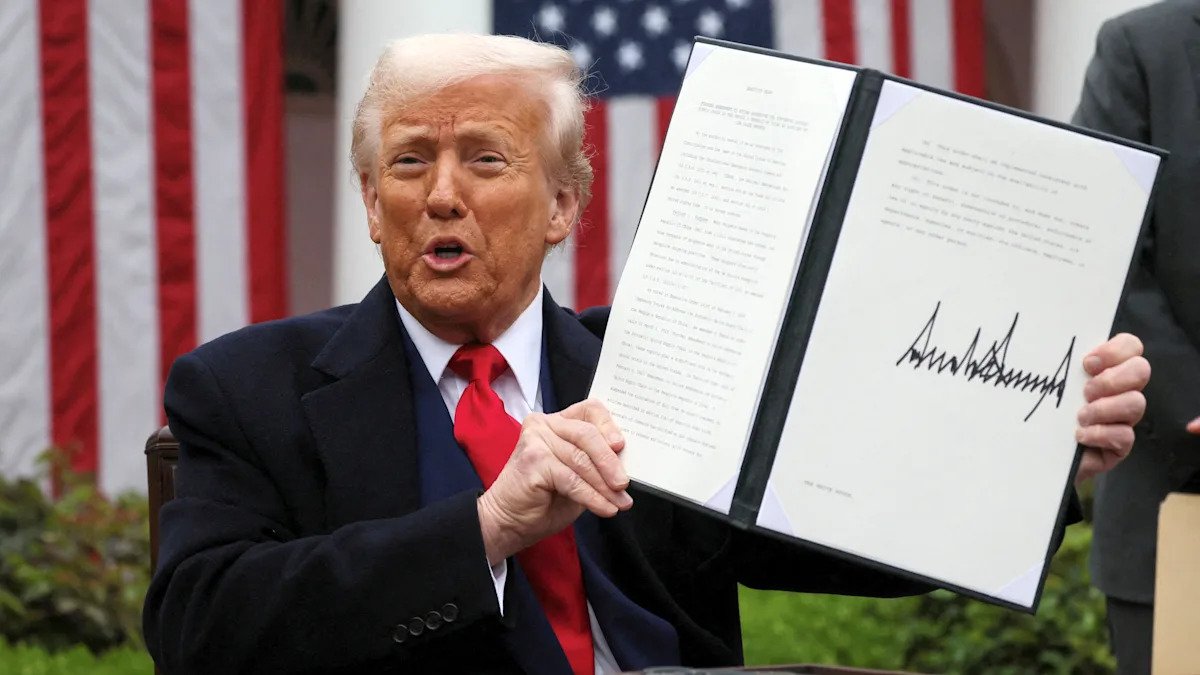
The Supreme Court struck down President Trump’s sweeping global tariffs on Friday, dealing a major blow to his signature economic policy.
In a 6–3 decision, the justices found that Trump overstepped his authority when he imposed far-reaching “reciprocal” tariffs on hundreds of other nations. The court found that, despite Trump’s claim that he had broad emergency powers to impose tariffs, he could not do so without express permission from Congress.
In a press conference on Friday, Trump said he was “absolutely ashamed” at the justices who ruled against him — calling them a “disgrace to our nation.” He also asserted that he has many other “methods, practices, statutes and authorities” to replace the tariffs that had been blocked by the court.
To that end, the president used an existing 1974 law to announce a new global 10% tariff that will remain in place for “five months” while his administration investigates different ways to “put fair tariffs — or tariffs period — on other countries.”
Here’s a rundown of what led to the Supreme Court’s decision, how it was decided and what the ruling might mean for the economy — and your wallet.
How did we get here?
Trump declared a national economic emergency last April, arguing that America’s trade deficit with other nations constitutes an “unusual and extraordinary threat to the national security and economy of the United States.”
He then used that emergency declaration as the legal ground for his “Liberation Day” tariffs by invoking a 1977 law called the International Emergency Economic Powers Act (IEEPA), which grants presidents power to respond to “unusual and extraordinary” threats during national emergencies. He announced the sweeping new tariffs in a Rose Garden ceremony on April 2, which sent global markets into chaos and left nations around the world reeling as they scrambled to respond
A flurry of lawsuits soon followed — including the one that led to Friday’s ruling, Learning Resources v. Trump.
In three separate rulings, lower courts determined that Trump overstepped his legal authority when he used IEEPA for tariffs. The administration appealed to the Supreme Court. During oral arguments in November, the justices gave strong signals that they were likely to shoot down the tariffs, which they ultimately did on Friday.
Why did SCOTUS overturn the tariffs?
In the simplest terms, the Supreme Court found that Trump lacked the authority to impose the tariffs in the first place.
The Constitution gives Congress the exclusive power to impose taxes under most circumstances. Trump had argued that America’s trade deficit with other nations, which he had declared a national emergency, created a unique situation that allowed him to unilaterally impose tariffs under the 1977 law, IEEPA.
But the justices ruled that the IEEPA does not in any way grant presidents the ability to usurp Congress’s exclusive taxing authority, whether there’s a legitimate national emergency or not.
“The President must ‘point to clear congressional authorization’ to justify his extraordinary assertion of that power … He cannot,” Chief Justice John Roberts wrote in the majority opinion, quoting his own words from a previous Supreme Court decision.
How much tariff money was collected?
The exact number isn’t known. The best estimates available found that, by the end of 2025, the government had collected between $129 and $164 billion from the tariffs Trump put in place through the IEEPA. He has pursued different legal avenues to impose other tariffs that are not affected by the Supreme Court’s decision. But about 60% of the total tariff revenue the U.S. brought in last year came from tariffs that are impacted, according to an analysis by the CATO Institute.
Will the U.S. have to give the money back?
It’s too early to know. The Supreme Court’s majority ruling does not address the question of refunds at all. But experts have argued that a logical next step to the tariffs being deemed illegal would be for the entities that were forced to pay them to get their money back.
Although everyday Americans bore the overwhelming share of the cost from the tariffs, in the form of higher prices, they would not be the ones receiving that money. Any actual refunds would go to the companies that paid the tariffs directly.
How the process of paying back up to $175 billion in tariff revenues might play out is unknown, but it would undoubtedly be incredibly complex. An estimated 34 million separate payments were made by 300,000 individual companies. Sorting through all of that would pose an enormous logistical challenge for both those firms and the government.
“The Court says nothing today about whether, and if so how, the Government should go about returning the billions of dollars that it has collected from importers. But that process is likely to be a mess,” Justice Brett Kavanaugh wrote in his dissenting opinion to Friday’s ruling.
On Friday, Trump said he has no plans to refund any of the revenue that has been collected until the courts provide a firm decision on whether it’s necessary.
“We’ll end up being in court for the next five years,” he said.
Treasury Secretary Scott Bessent shared a similar sentiment later on Friday.
“I’ve got a feeling the American people won’t see it,” he said of the tariff revenue.
Does this mean prices will go down?
Again, it’s unclear. Trump’s tariffs have undoubtedly had a substantial impact on the economy, but it will take a while for the impact of this decision — which only applies to some of the tariffs — to become clear.
While it may make logical sense that prices would go down once one of the biggest factors that was driving them up is eliminated, that may not happen. Periods of deflation, when prices across the U.S. decline, are very rare and typically only happen in the midst of a major financial crisis. “Generally, prices don’t go down once they’ve gone up,” one retail industry expert told the Washington Post on Friday.
The decision could still affect affordability, however, if it inspires the Federal Reserve to lower interest rates more quickly than it would have otherwise. Tariffs have been one of the “inflationary pressures” that the Fed has cited in its decision to take it slow with rate cuts. If that pressure is relieved, it could create room for the central bank to be more aggressive.
Of course, all of that depends on whether Trump finds other legal avenues to impose new tariffs to replace those just overturned, which could allow him to effectively maintain the status quo.
What will Trump do now?
Before Friday’s decision, Trump and members of his administration repeatedly said they would keep taxing imports even if the Supreme Court struck down his sweeping IEEPA tariffs.
They would just have to rely on different legal pathways to do it.
“The reality is the president is going to have tariffs as part of his trade policy going forward,” Jamieson Greer, Trump’s top trade negotiator, told the New York Times in January. In the case of an adverse Supreme Court ruling, Greer insisted the administration would start working to replace them “the next day” by invoking other aspects of U.S. trade law.
That process is already underway.
“The Supreme Court did not overrule tariffs; they merely overruled a particular use of tariffs,” Trump said on Friday. “Now I’m going to go in a different direction, probably the direction I should have gone the first time.”
Congress has given the White House the power to impose tariffs — with certain limitations. Section 301 of the Trade Act of 1974 allows the president to tax imports from countries engaging in “unjustifiable,” “unreasonable” or “discriminatory” trade practices.
Trump used Section 301 during his first term to counter China, and on Friday said he would be “initiating several Section 301 and other investigations to protect our country from unfair trading practices.”
Section 122 of the same 1974 law enables the president to impose tariffs as high as 15% for up to 150 days in response to unbalanced trade.
On Friday, Trump said he would “impose a 10% global tariff under Section 122 over and above the normal tariffs already being charged.”
Section 232 of the Trade Expansion Act of 1962 permits the president to impose tariffs on certain sectors if he deems them a threat to national security. Trump used this provision in September when he slapped new taxes on imported kitchen cabinets, bathroom vanities and upholstered furniture.
And, finally, Section 338 of the Depression-era Tariff Act of 1930 authorizes the president to impose tariffs as high as 50% on imports from countries that “uniquely discriminate” against U.S. businesses. Treasury Secretary Scott Bessent has already indicated that Section 338 would be part of the administration’s Plan B.
The problem for Trump — who claimed boundless tariff power under IEEPA — is that all of these provisions involve some degree of checks and balances. Each individual Section 232 or Section 301 tariff requires its own investigation to prove that the countries in question are, in fact, threatening U.S. security or acting unfairly. Section 122 has a time limit. And Section 338 has never been used for tariffs before — meaning it’s likely to face legal challenges.
“It’s a little more complicated; the process takes a little more time,” Trump admitted on Friday. “I wanted to make things simple, but they didn’t let us do that.”
What about those tariff rebate checks?
For months, Trump has mused about sending every American a “rebate” from what he has described as the “trillions of dollars” in tariff revenue his administration has collected since imposing broad new import levies.
The idea again took center stage shortly after the GOP suffered big losses on Election Day 2025 — at which point White House press secretary Karoline Leavitt told reporters that the administration was “exploring all legal options to get that done.”
“I can confirm for you that the president made it clear he wants to make it happen, and so his team of economic advisers are looking into it,” Leavitt said in November.
But now that Trump’s IEEPA tariffs have been deemed illegal, his critics are arguing that consumers should be compensated.
“These tariffs were nothing more than an illegal cash grab that drove up prices and hurt working families, so you could wreck longstanding alliances and extort them,” California’s Democratic Gov. Gavin Newsom said in a statement. “Every dollar unlawfully taken must be refunded immediately — with interest. Cough up!”
Experts say that Trump’s tariffs have cost U.S. households anywhere from $1,600 to $2,600 per year in the form of higher prices, according to independent estimates.
Likewise, a recent study published by the New York Fed found that nearly 90% of the economic costs associated with tariffs have fallen on U.S. businesses and their customers.