US Politics
Is Starmer’s ‘stand up to Trump the bully’ act getting him anywhere?

This is a moment of “profound national seriousness”, said Kemi Badenoch at Prime Minister’s Questions. Never mind that she had just made a joke about a Labour MP bringing sex toys into parliament, she is right.
Keir Starmer, who thinks of himself as a serious person for serious times, is being undermined by an American president who is shockingly unserious but doing things that have really serious consequences.
Badenoch wanted to ask about one of those consequences, which is that European countries have to spend more on their own defence because they cannot rely on the United States any more. She devoted all six of her questions to quoting George Robertson, the Labour former defence secretary and head of Nato, whose devastating speech yesterday is still sending secondary shock waves through Westminster.
Lord Robertson, who is, as she said, “Labour through and through”, accused Starmer of putting the nation “in peril” by spending too much on welfare instead of defence.
Starmer was indignant. He and the chancellor have increased defence spending, he said, although he didn’t remind his own MPs that they had raided the foreign aid budget to pay for it. He dwelt instead on having inherited armed forces cut right down by the government of which she was a member. And he pointed out that welfare spending went up under the Conservatives, too.
In the end, though, Starmer’s answer to Robertson’s demand, as relayed by Badenoch, was “No”. He said, “I don’t agree with him.” That gave Badenoch the appearance of victory, but I suspect that public opinion is divided over this. Starmer has already put up defence spending by switching money from the most unpopular budget, foreign aid, and if he could squeeze any more from the second-most unpopular budget, welfare, people might prefer to have the money back in the form of tax cuts rather than spend even more on defence.
It was left to the minor parties to ask about the other serious consequence of President Trump, namely that he is plunging the world into a recession by waging what Ed Davey, the Liberal Democrat leader, called an “idiotic war” against Iran. Davey again demanded that the King’s state visit to America be called off, after Trump threatened to rip up the UK’s trade deal in a phone call with Sky News last night.
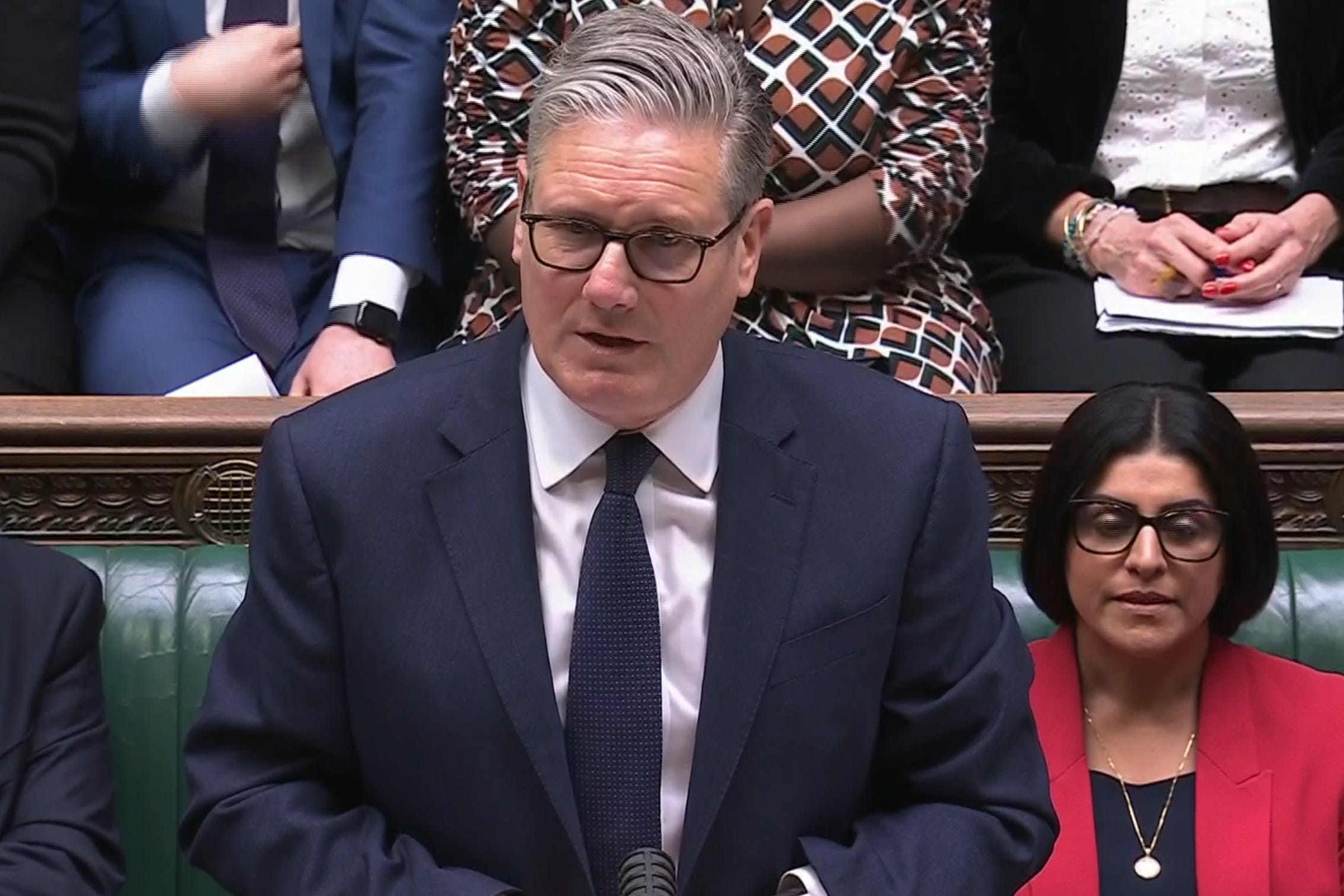
This gave Starmer the chance to do his “standing up to the bully president” act, saying he had come under a lot of pressure to back the war, pressure that “included what happened last night”, but “I’m not going to change my mind”.

The effects of the “idiotic war” have not been felt yet, except in diesel prices, but everyone can see it coming. Sorcha Eastwood, of the non-sectarian Alliance party of Northern Ireland, was quite immoderate about it, demanding that the PM do something about “the worst cost of living crisis”. Starmer looked a bit taken aback and said mildly: “Wages are going up.”
He will need a better line, and he will need it soon. He has done his best to try to put himself on the right side of anti-Trump opinion in Britain, while trying to preserve some kind of working relationship with a president who describes British policies as “tragic mistakes” and “insane”.
Starmer must look around the world and wonder whether the curse of Trump is coming for him – or for his opponents. So far, the Trump effect has destroyed Pierre Poilievre, the Canadian conservative leader who was poised on the brink of power when Trump was inaugurated, and Victor Orban, the Hungarian leader endorsed by JD Vance; just as it has saved Mark Carney and Peter Magyar.
Starmer’s opposition to the Iran war has given him some cover, although it hasn’t moved the headline poll figures for him or for Labour. It gives him a line of attack against Badenoch and Nigel Farage, both of whom supported the initial American-Israeli attack on Tehran, but there has been no practical difference between government and opposition since.
The row over defence spending will probably be inconclusive. But the decisive issue may be the oil price crisis. It may not matter to British voters whether Starmer is pro-Trump or anti-Trump, or for or against the Iran war, but incumbent governments tend to suffer in recessions even if they are not to blame.