
Breaking News
ICE is hiring dozens of health workers as lawsuits, deaths in custody mount

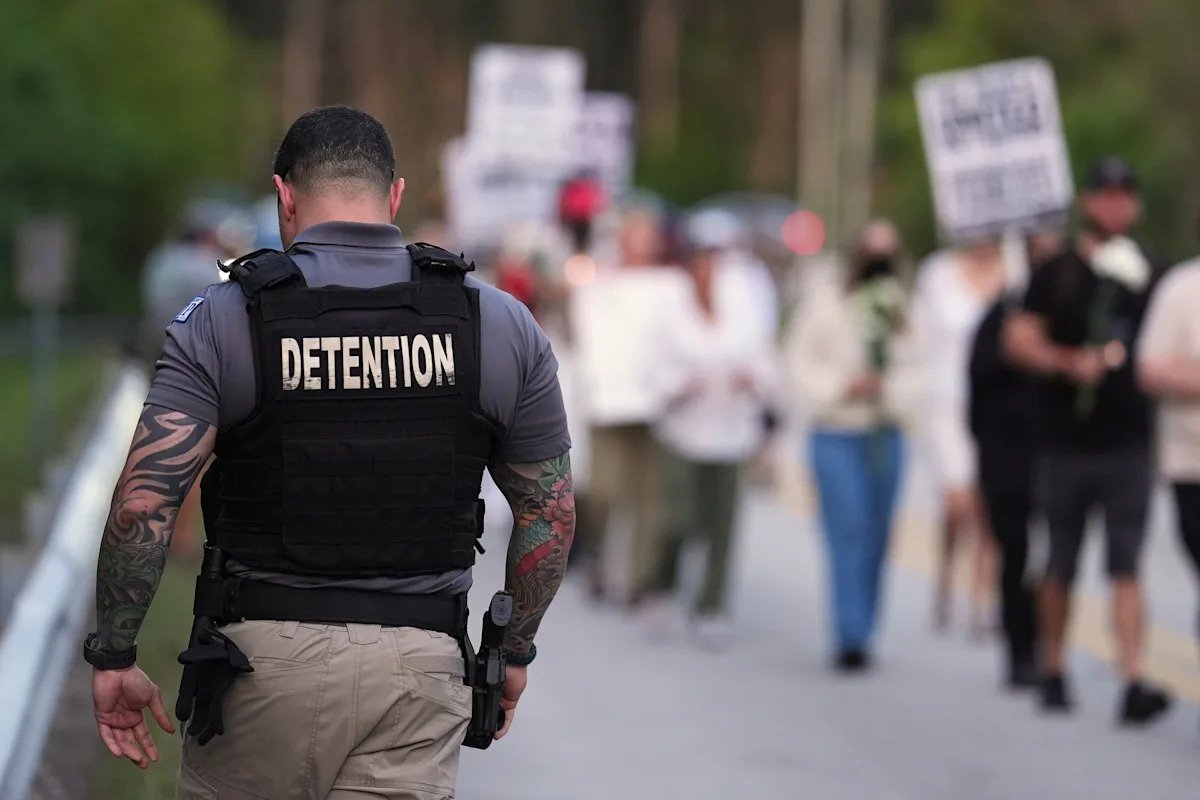
The Trump administration is expanding its ranks of health care providers who work in immigration detention centers around the country as deaths in custody mount and federal oversight is weakened by layoffs.
The push by the Department of Homeland Security to hire more than 40 doctors, nurses, psychiatrists, pharmacists and health administrators follows the revelation that nearly as many immigrants have died in custody so far this year than over the course of the Biden administration, according to government records.
U.S. Immigration and Customs Enforcement has reported 20 detainee deaths in custody since President Donald Trump took office — the most in a single year in decades — compared to 24 deaths in the Biden administration. The 2025 figure was provided by the office of Rep. Pramila Jayapal (D-Wash.), the ranking member on the House subcommittee overseeing DHS. The overall death rate is lower given that the number of detained immigrants is at a record high.
The detention centers — which currently hold more than 60,000 people — are overcrowded and the use of hastily constructed facilities like tent cities makes it easier, public health officials said, for communicable diseases to spread and more difficult to manage chronic illnesses. At the same time, oversight of the centers has eroded, as layoffs hit the Homeland Security offices investigating allegations of abuse and neglect, and lawmakers attempting to visit facilities in their districts are turned away.
Frequent transfers of migrants between states have also disrupted medical treatments and allowed prescriptions and other records to be lost in transit. Migrants have died in recent months of infections, Covid-19, injuries, uncontrolled diabetes and suicide — according to government reports.
The Department of Homeland Security did not respond to several questions about staffing plans, deaths in detention and accusations of medical neglect. In a recent New York court filing responding to a lawsuit by the ACLU, the agency argued that it “provide[s] adequate food, clothing, shelter, and medical care to individuals in custody” and that “all medication, whether brought by the detainee or later, is received by [the ICE Health Service Corps] and administered according to proper medical procedures.”
Independent watchdog groups that track health care access for detained migrants dispute those claims but say increasing the health care workforce could help prevent further deaths by reducing delays in the dispensing of medications and ensuring a more thorough intake process that gathers detainees’ medical histories to avoid future emergencies.
Yet Jonathan White, a retired commander in the U.S. Public Health Service Corps who oversaw the detention of undocumented, unaccompanied minors during the first Trump administration, said that without more fundamental policy changes, people will continue to get sick and die.
“The larger problem is that this is a system to abduct and detain people without meaningful due process,” he said. “That is inherently harmful and cannot be made humane or healthy or safe no matter how many people you throw at it.”
More detainees, less oversight
Earlier this year, the Department of Homeland Security tried to to eliminate its offices that investigate complaints of discrimination, neglect and mistreatment of detainees — the Office for Civil Rights and Civil Liberties, the Citizenship and Immigration Services Ombudsman and the Immigration Detention Ombudsman — calling them “internal adversaries that slow down operations.” DHS accused the oversight staff of “adding bureaucratic hurdles and undermining [the department’s] mission.”
After human rights groups sued, the offices were restored in May, but hundreds of their staff were laid off a few months later as part of a government-wide reduction in force, hobbling oversight efforts. An ongoing lawsuit seeks to bring the fired workers back.
Trump also fired the independent inspectors general that investigated claims regarding the conditions of detention centers.
Rebekah Wolf, staff attorney with the Immigration Justice Campaign and Policy Department of the American Immigration Council, which represents immigrants in detention, said health care in ICE detention centers has always had problems. But now, she said, there’s less transparency and accountability.
“I have a client right now who has untreated diabetes — they just stopped giving her medicine,” she said. “And so we’re like, ‘Hey, detention center, why’d you stop giving this medicine?’ And there’s just no response.”
The ACLU and Detention Watch Network, two advocacy groups that focus on conditions for migrants, report that medical neglect is the most common complaint they hear from clients in ICE custody. Immigrants at the Louisiana State Penitentiary and California City Detention Facility launched hunger strikes in September, in part to protest poor access to medical care and mental health care, including difficulty accessing diabetes medication and receiving treatment for injuries. In August, in response to a class-action lawsuit in New York City, a judge ordered ICE to allow migrants to keep prescription medications they had on them when they were detained or that family members brought to detention centers. And in early October, a detainee in Michigan with chronic myeloid leukemia sued the Trump administration, saying his chemotherapy was suspended for several weeks after being detained, risking serious complications.
Some Democratic lawmakers are introducing legislation to address the deaths in custody. Jayapal partly attributes the reports of poor medical care to Trump tapping private prison companies to handle immigration detention centers while eroding government oversight. She plans to introduce a bill to mandate that all ICE facilities are run by federal employees, arguing that would help curb self-dealing and profit seeking at the expense of detainees’ quality of care.
“Now, with the massive increases in money that are going out, the firing of all the inspector generals and the corruption within the system,” she said. “I mean, you’ve got Tom Homan accepting bags of cash,” she added, referring to allegations that Trump’s border czar took a $50,000 bribe from undercover FBI agents last year.
Homan has denied that he took a bribe from federal agents, and the Justice Department reportedly shut down the investigation into the incident. “I didn’t take $50,000 from anybody,” Homan said in a Wednesday night appearance on NewsNation’s “Cuomo” town hall.
Staffing up
The health care-related job openings include posts at some of the detention centers where deaths have been reported and where watchdog groups have alleged unsafe conditions and medical neglect, including the facility in Jena, Louisiana, where multiple foreign students have been detained, as well as centers in Eloy and Florence, Arizona.
Most of the people providing health services to ICE detainees are private contractors, but the new jobs are open only to current members of the U.S. Public Health Service Corps — one of the country’s eight uniformed services made up of roughly 6,000 public health and medical professionals. These commissioned officers frequently work jobs that are difficult to fill with civilian health care providers — including at rural Indian Health Service clinics, prisons, and ICE detention facilities.
If ICE doesn’t get enough applications for the jobs, said White, public health officers could be ordered to deploy there temporarily or permanently. But he said avoidable deaths are likely to continue even with a few dozen more medical personnel because the detainee population is swelling by the tens of thousands and is being held in worse conditions with less oversight. He voiced particular concern about an uptick in self-harm and suicide.
“Compared to the population that is traditionally seen in the immigration system, the level of trauma and psychological distress of those caught up in this new abduction machine will be much greater,” he said. “These people are proportionally much more likely to have the most severe psychological reaction to being removed, because they have many years in this country, roots in their communities, and U.S. national children who they’re being separated from.”
A 2024 report by the ACLU, Physicians for Human Rights, and American Oversight, based on thousands of pages of government documents obtained through the Freedom of Information Act, argued that more than 90 percent of deaths in ICE custody could have been prevented with better medical care. The report documents several instances of ICE health workers giving incorrect diagnoses, prescribing medication to people with contraindications, and delaying treatment during heart attacks, suicide attempts and other emergencies. The report examined the deaths of 52 people in ICE custody from 2017 to 2021, covering Trump’s first term and the first year of Biden’s presidency.
“The lack of medical staffing is a consistent theme,” but far from the only issue, said Eunice Cho, a senior counsel for the ACLU who has worked on several lawsuits related to conditions in ICE detention. “Specialist care is denied. People are transferred from place to place before they’re able to actually get their care. People are not given medication.”
Human rights groups are also concerned that deaths may be undercounted. “There is no standardized way in which ICE reports on deaths. It is quite possible that people have died and no one knows,” said Anthony Enriquez, vice president of U.S. advocacy and litigation at Robert F. Kennedy Human Rights, which is suing DHS alongside the Immigration Council and the ACLU, among other groups.
Enriquez said that families of migrants who died in detention have spoken out about a death before ICE has publicly accounted for it.
As ICE works to fill the new medical jobs, the agency’s surge in detentions is far outpacing its expansion of detention capacity. The administration aims to hold up to 100,000 people per day, and as the federal government increasingly houses migrants in tents and converted local jails heading into flu season, advocates and investigators are worried.
“My greatest fear is that we’re going to continue to see the number of people who unfortunately die as a result of being held in immigration detention grow,” Cho said.