
Breaking News
How the US executed a ‘miracle rescue mission’ behind enemy lines

“WE GOT HIM!” Donald Trump announced triumphantly, early on Sunday morning.
“Over the past several hours, the United States military pulled off one of the most daring search and rescue operations in US history … I am thrilled to let you know [our missing airman] is now SAFE and SOUND!”
The president’s Truth Social post marked the end of a 36-hour drama that will stand proud in the annals of United States military history.
After a US air force F-15E Strike Eagle fighter jet was shot down over Kohgiluyeh and Boyer-Ahmad province on Friday, the pilot was rescued almost immediately. But the weapons officer remained missing.
What followed was a race against time between the US and Iran to recover the stranded colonel. At stake was not just the life of the airman and the dozens of special forces troops who risked everything to save him, but the reputation of the US military.
Mr Trump said: “This type of raid is seldom attempted because of the danger to ‘man and equipment’. It just doesn’t happen!”
Video footage from the site showed the mountainous region deep in southern Iran where the aviator landed after pulling the yellow side lever on his ejection seat.
The seat’s ejection system, which uses a solid CKU-5 rocket propellant to blast through a jet’s canopy at a speed of about 200 metres per second, is one of the most sophisticated, but carries a high probability of spinal fractures and other injuries.
The US president confirmed on Sunday afternoon that the airman had been “seriously wounded”. Earlier he had said the colonel had “sustained injuries, but he will be just fine”.
“This brave warrior was behind enemy lines in the treacherous mountains of Iran, being hunted down by our enemies, who were getting closer and closer by the hour,” said Mr Trump, who later described the airman’s rescue as “a miracle”.

Iranian media shared this unverified image on Saturday of an ejector seat, which is consistent with the model used in the F-15E fighter

Iranian media show off part of an F-15 that Tehran claims it shot down
The airman will have had his survival, evasion, resistance, and escape (Sere) instructions playing through his head.
But armed only with a pistol, beacon and secure communications device, everything depended on the US special forces reaching him before Iranian forces closed in.
He could not use the beacon because Iranian forces could have detected it. But the use of his encrypted communication device caused confusion.
Mr Trump told Israeli television that the rescue had been delayed because the colonel had sent a message saying “God is good.”
The US was concerned the Iranians had taken its downed navigator hostage, and were forcing him to try to lure American rescue forces into an ambush, Mr Trump told Channel 12.
He added that it took several hours for the US to determine that the colonel, who holds a religious belief, was speaking of his own volition.
Every moment lost could have been fatal.
Iran had offered a reward for anyone who found the officer, and a video shared on social media on Friday showed dozens of armed locals combing the countryside, rising to the challenge.
It was not an academic risk. The Black Hawk helicopters involved in extracting the first of the two airmen – the pilot – immediately after the F-15E crashed on Friday were fired upon from the ground. Video footage showed one of the two choppers trailing smoke as it beat a retreat into Iraq.
It was the Naval Special Warfare Development Group or “Seal Team 6”, as it is known, that was charged with rescuing the remaining airman.
A specialist commando unit tasked with performing complex and especially dangerous missions, it is used by the US for counterterrorism, reconnaissance and short-duration offensive operations as well as rescue missions.
It was established shortly after Operation Eagle Claw, the failed US military attempt to rescue 53 embassy staff held captive by Iran in 1980 – something that will have made its success on Saturday night especially sweet.
In the event, extracting the second airman proved a close call, and not everything ran to plan.
The extraction operation was launched after the Central Intelligence Agency (CIA) pinpointed the airman’s location and ran a “deception operation” to cause the Iranians to believe he had already been located elsewhere and that they were trying to get him out of the country via a port.
The agency used fabricated radio transmissions to trick the IRGC [Islamic Revolutionary Guard Corps] into believing the pilot was being moved to various decoy locations, effectively steering search parties away from the mountains where he was actually hiding and giving the extraction team more time.
Some reports suggested they used distress beacons as decoys to further distract Iranian forces during the first hours that the airman was missing.
The actual rescue mission involved over 100 special forces commandos being flown in on specialist MC-130J troop carriers, landing on a makeshift agricultural runway normally used by crop-sprayers and other light planes. That runway was just 30 miles from Isfahan, one of Iran’s most important nuclear facilities.
MQ-9 Reaper drones and fast jets provided air cover, striking any military-aged males believed to be a threat in a three-kilometre radius.
The injured colonel was reported to have climbed a ridge line 7,000ft above sea level while US forces dropped bombs and opened fire on approaching Iranian fighters.
He only broke cover in the final moments and performed a “daring move to meet his rescue team” The Wall Street Journal reported.
The feint worked, but a final drama occurred when two of the MC-130Js – which cost $100m (£75.6m) each – became bogged down on the unpaved runway and had to be destroyed to stop them falling into enemy hands.
“One Little Bird [an MH-6 helicopter] flew to that mountain top area and rescued the WSO [weapon systems officer] and brought him back to the landing strip. And of course the two C-130s’ nose gears got stuck in the dirt. So after a few hours they had to bring in three AFSOC [Air Force Special Operations Command] Dash-8s to fly out the rescued WSO and the 100 or so personnel involved in the op,” a US military official told Michael Weiss, an American journalist and author.
‘The US suffered no casualties’
“The op basically cost $300m because they had to abandon the two AFSOC C-130s and the four MH-6 Little Birds. Then the US air force had to use multiple bombs to blow up all the aircraft they abandoned at that airstrip. And the Iranians shot down two MQ-9s [Reaper drones that were providing cover]”.
The official added: “Luckily the US suffered no casualties and we had to use multiple bombs and missiles to blow up IRGC vehicles that tried to drive up the mountain and also those that tried to drive to the airstrip.”
Once the airman was extracted he was said to have been immediately flown to a hospital in Kuwait for treatment.
Iran’s Tasnim news agency initially claimed that “several enemy American aircraft in the southern Isfahan region were destroyed by the warriors of Islam, and the pilot rescue operation failed,” citing unnamed sources at Iran’s military headquarters.
The White House and the Pentagon were uncharacteristically silent in the 36 hours after the F-15E went down. But in the background, they were working overtime.
The President remained in the Oval Office throughout the drama, receiving constant updates from Pete Hegseth, the US defence secretary, according to Karoline Leavitt, the White House press secretary.
Mr Trump is expected to hold a formal press conference on the rescue on Monday.
On Sunday, sources close to the Israeli military claimed Israel had played an unspecified role in the rescue operation, something Mr Trump partially confirmed later, telling Channel 12 that they had helped “a little”.
Benjamin Netanyahu, the Israeli prime minister, said the rescue operation “proves that when free societies muster their courage and their resolve, they can confront seemingly insurmountable odds”.
Facing a general election in October, he added: “As a nation that repeatedly carried out daring rescue operations, and as someone who was wounded in such a mission and lost a brother in the Entebbe rescue, Israelis and I, we know what a bold decision you took”.
The operation denied Iran a potentially pivotal propaganda victory, but the regime was making the best of a bad lot, noting that Mr Trump had been wrong when he claimed on Wednesday last week that Iran’s had “no anti-aircraft equipment” and that their “their radar is 100 per cent annihilated”.
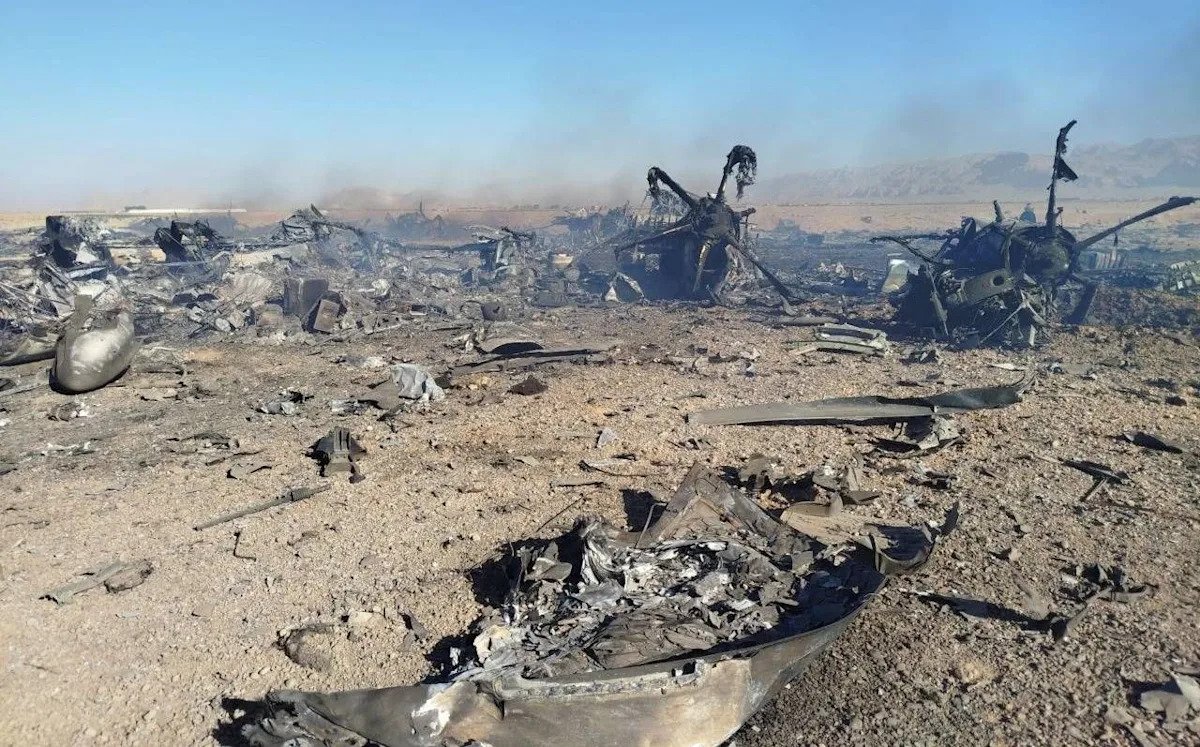
In an effort to salvage what little victory they could, Iranian officials also posted images on Sunday of the charred remains of one of the two torched MC-130Js.
Mohammad-Bagher Ghalibaf, the speaker of the Iranian parliament, wrote in a social-media post: “If the United States gets three more victories like this it will be utterly ruined.”
Yet Mr Trump hailed the mission as one for the ages. He wrote: “This is the first time in military memory that two US pilots have been rescued, separately, deep in Enemy Territory. WE WILL NEVER LEAVE AN AMERICAN WARFIGHTER BEHIND!”
The Iranians had simply “got lucky” in shooting down the F-15E fighter jet, he added, telling the Axios newswire they had used nothing more than a “shoulder-fired missile”.
The rescue, Mr Trump said, was “an AMAZING show of bravery and talent by all!”
Try full access to The Telegraph free today. Unlock their award-winning website and essential news app, plus useful tools and expert guides for your money, health and holidays.