
Breaking News
Historic Heat Wave Set March US High, May Set Monthly Records In Over 140 Cities, From California To Missouri

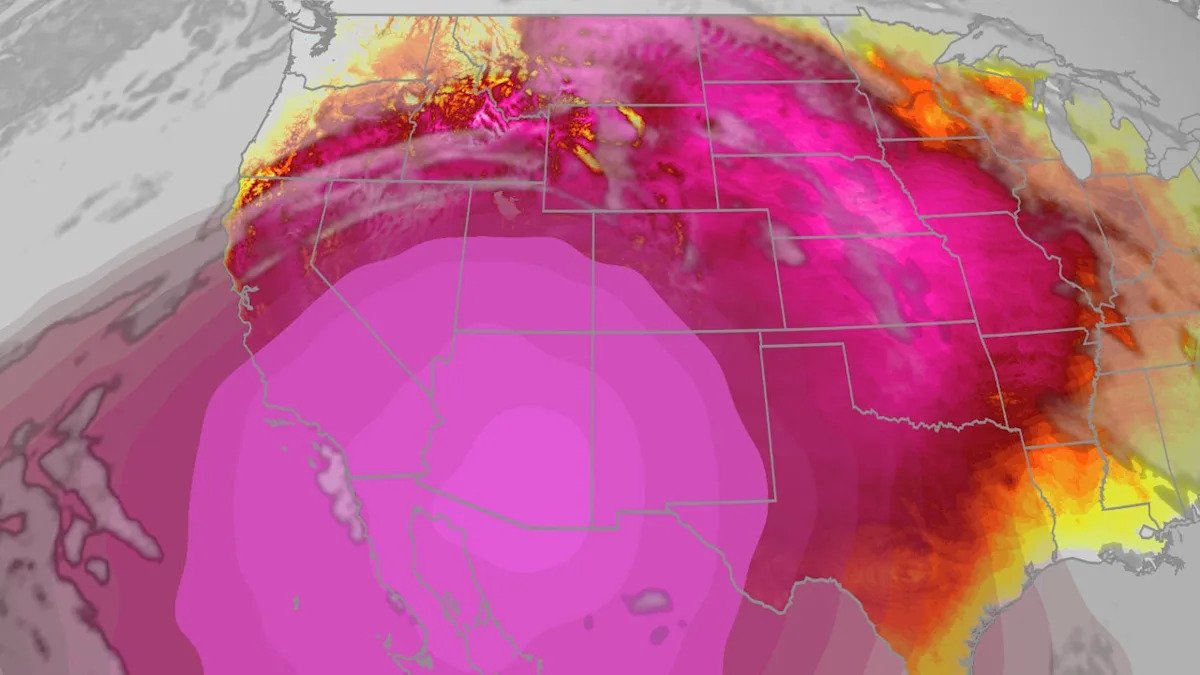
A historic March heat wave has already smashed monthly records in dozens of cities in the West. This unusually early heat has spread into parts of the Plains and will have staying power in the Southwest into next week.
It’s so warm some male skiers and snowboarders were seen shirtless carving the slopes at Breckenridge, Colorado, Wednesday.

Michael Ciaglo/Getty Images
(MAP: Temperatures Right Now)
National March Record Set…Again
We started this heatwave with an impressive Thursday, when Martinez Lake, Arizona, recorded a high of 110 degrees.
This had broken the nation’s hottest March temperature record of 108 degrees, previously tied on Wednesday in North Shore, California. This record was initially set in Rio Grande City, Texas, on March 30, 1954, and on March 14, 1902.
But it was short-lived.
Not only did Marzinez Lake break the record again by hitting 112 degrees Friday, three other stations joined them. Yuma, New Mexico, as well as Ogilby and Winterhaven, California, hit 112 on Friday. And yes, Winterhaven is an ironic name for this record.

March Records Already Set In West
So far, at least 125 cities have already tied or set new March record highs from this heatwave. Let’s hit some of the most notable.
Phoenix set its all-time record high for March on Thursday with a temperature of 105 degrees, and they hit it again on Friday. They have only seen a 100-degree high in March four times, with three of them occurring this year. On Wednesday, the city saw its earliest triple-digit high at 102 degrees, eight days earlier than the previous record earliest triple-digit high (March 26, 1988).
Las Vegas broke its all-time hottest March high when they hit 97 on Friday. They set the previous record of 95 degrees on Thursday.
Death Valley broke their hottest March as well with a high of 105 degrees. The previous record was 104 degrees set on March 26, 2022 and March 19, 2026.
Downtown Sacramento hit 88 degrees, which tied their all time hottest March high, which was set back on March 26 1988.
Redwood City, California, hit 90 degrees multiple days this week, when they hadn’t previously reached 90 in March in 96 years of records. The city broke its monthy high again on Friday when they hit 94, which broke its previous monthly record set just a few days ago.
San Francisco Airport broke their all-time March high when it hit 89 on Friday, breaking their previous of 85 set on March 25, 1953, and twice earlier this week.
Heat Wave’s Peak Is Still Ahead
There’s still more ahead in this heat wave.
The National Weather Service has issued extreme heat warnings and heat advisories in the Southwest, including Phoenix and Las Vegas.
(MORE: Heat Safety And Preparation)

It will not only remain in the Southwest but has also spread throughout much of the West into parts of the Plains and South, eventually reaching parts of the Southeast.

While some cooler air will slide into the northern and central U.S. beginning Sunday, record heat will persist in the Southwest into at least the first half of next week.
How hot are we talking about? Think mid-summer heat as we’re turning the page officially to spring in mid-late March.
Triple-digit highs: The Desert Southwest, including Phoenix, Tucson, possibly as far north as Las Vegas, and parts of the L.A. Basin, are forecast to see 100-degree-plus highs for multiple days. This weekend, a few of the hottest locations in the Southern Plains could also reach the century mark.
90s: California’s Central Valley, even parts of the Bay Area, will rise into the 90s for multiple days. This weekend, 90s are possible as far north as Nebraska, Colorado and Kansas. And that could reach as far east as Omaha and Kansas City.
Perhaps most impressive is some all-time March records for additional entire states could be in jeopardy. According to weather historian Christopher Burt, 13 additional states from Nevada to Iowa to Oklahoma could threaten their all-time state March records, including:
Nevada: 100 at Laughlin on March 17, 2007
Colorado: 96 at Holly on March 19, 1907
Iowa: 93 at multiple locations in 1986, 1910 and 1907
Missouri: 95 at Belle on March 21, 1907
Oklahoma: 104 at Frederick on March 27, 1971
(MAPS: 10-Day US Forecast Highs, Lows)

Why So Hot So Soon?
The reason for this heat wave in particular has to do with the ridge of high pressure, also known as a heat dome, that is parked over the West.
This heat dome is record-breaking for March, comparable in strength to ones we see in June. You can see the general position of the high pressure on the graphic below.

Record high pressure? Record temperatures. Temperatures we are seeing this week… in March… are comparable to what we should be seeing in summer.
This heat dome will eventually weaken and flatten a bit later next week.
Historic Notables
Again, we’re not just talking about records set for a specific calendar day. This heat wave could set records for any March day in over 140 cities from California to Montana to South Dakota to Texas.
Phoenix could see triple-digit highs every day into at least this weekend, if not into much of next week. In an average year, they typically don’t reach 100 degrees until May 2.
Both Las Vegas and downtown Los Angeles have never hit 100 degrees in March. They have a low chance of doing that in this heat wave.
In parts of the Plains, highs this weekend could be as much as 45 degrees warmer than average.
Put simply, this may be the most significant, long-lived March heat wave the nation has experienced since the March 2012 heat wave rewrote the record books in the central U.S. and Canada.

Other Records
Here are some other records and stats for this heatwave.
Downtown Los Angeles hit 95 degrees, which was a daily record. The previous daily record was 93 degrees set in 1997.
Lancaster, California, hit 95 degrees, which broke the all-time March high for the city again. The previous record? March 18, 2026.

(Photo by Kevin Carter/Getty Images)
Tieing their March record is Rosewell, New Mexico, which hit 95 degrees. Albuquerque’s high of 89 degrees broke their hottest March high temperature.
Palm Springs, California, hit 108 degrees, which beat their March temperatures of 107 degrees, which was set just the day before. Riverside, California, hit 102 degrees, which tied their highest March temperature set back on March 10, 1916.
Elko and Ely Airports in Nevada both broke monthly March records on Friday when they hit 82 and 83, respectively.
Grand Junction, Colorado, broke its March temperature record when it hit 85 degrees. The previous record was 81 set in 2004. Pueblo’s 89 degrees was also a monthly record. Colorado Springs also tied their monthly record when they hit 81 degrees.
Even Montana’s Bozeman Yellowstone Airport rebroke their March high temperatures when they hit 79 degrees. The previous record was 78, which they hit the day before. Billings’ 83 degrees high was the earliest 80 degree day for the city and was also a daily record.
And it isn’t just the West that has seen the record heat, the Central Plains and even the Southeast have seen records fall.
El Paso, Texas, broke their monthly high temperature by reaching 94 degrees on Friday. The previous record was 93 degrees set in 1907.
Numerous cities saw daily records fall Friday including Boise, Idaho (83), Buffalo, Wyoming, (80), Denver (85), Cedar City, Utah (86), Klamath Falls, Oregon (76), Concordia, Kansas (91), Rapid City, South Dakota (85), Little Rock AFB (86), Des Moines (79), Carbondale, Illinois (85), Omaha, Nebraska (87), Childress, Texas (101) and Fort Smith, Arkasas (92), among many, many more.

These are locations that could tie or set new all-time March heat records in this heat wave.
Snow Drought, Climate Change
The warmest winter on record in much of the West has already left snowpack at its lowest levels in at least two decades from the Rockies of Colorado to the Oregon Cascades.
As the graph below shows, Colorado’s snowpack is at its lowest for any mid-March in the last 40 years, according to the USDA’s National Water and Climate Center.

NRCS/USDA
After feet of snowfall in early February, California’s Sierra snowpack has since dwindled to only 42% of average for this time of year, according to the California Department of Water Resources. Melting snow in spring and summer typically supplies 30% of the state’s water. Fortunately, the state’s reservoirs are higher than average due to recent wet years.
This heat wave will further deplete the already paltry snowpack in the West. That could lead to an expansion of drought in the Southwest and higher fire danger early this summer before the summer monsoon kicks in, according to outlooks by NOAA and the National Interagency Fire Center.
And this heat wave appears to have climate change’s fingerprints on it.
According to an analysis by Climate Central, the magnitude of this heat wave by March standards has been made at least five times more likely by climate change.
Jonathan Erdman is a senior meteorologist at weather.com and has been covering national and international weather since 1996. Extreme and bizarre weather are his favorite topics. Reach out to him on Bluesky, X (formerly Twitter) and Facebook.