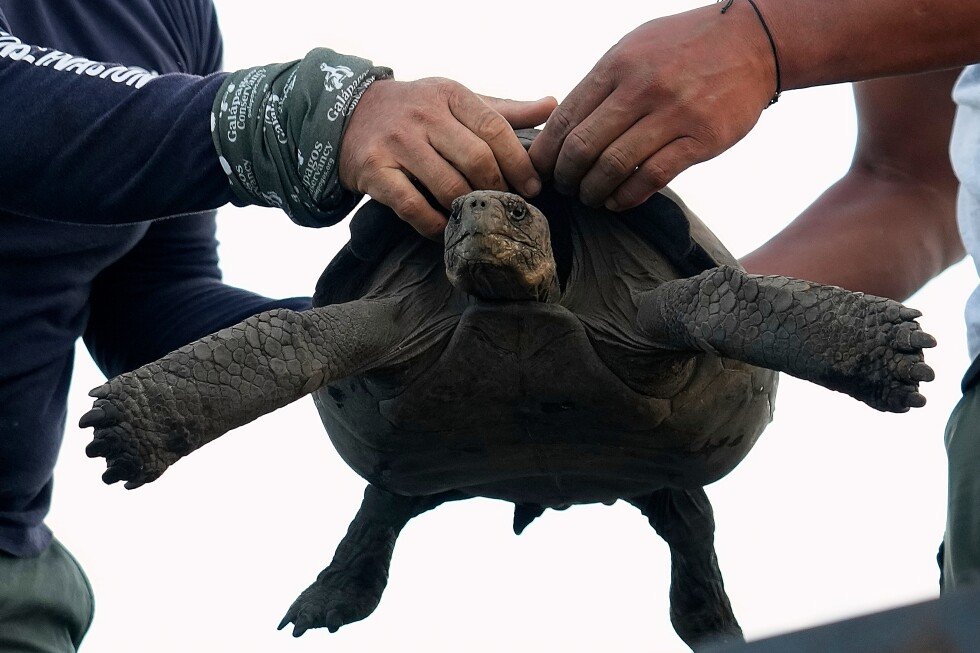
FLOREANA ISLAND, Galapagos (AP) — Juvenile tortoises with Floreana ancestry were brought to their native island from the Galápagos National Park’s breeding center on Santa Cruz Island, as part of a project to restore the species to its native habitat
The original Floreana giant tortoise was driven to extinction in the 19th century largely after sailors and whalers took tortoises for food. Later, introduced animals such as rats and feral cats preyed on eggs and hatchlings, while other invasive species degraded habitat and food sources.
Scientists later found tortoises with Floreana ancestry on other islands and began selectively breeding hybrids for reintroduction once juveniles are large enough to survive.
Juvenile giant tortoises are released on Floreana Island as part of a project to reintroduce the species to its native habitat in the Galapagos Islands, Ecuador, Friday, Feb. 20, 2026. (AP Photo/Dolores Ochoa)
Juvenile giant tortoises are released on Floreana Island as part of a project to reintroduce the species to its native habitat in the Galapagos Islands, Ecuador, Friday, Feb. 20, 2026. (AP Photo/Dolores Ochoa)
Add AP News on Google
Add AP News as your preferred source to see more of our stories on Google.
Share
Read More
Galapagos National Park rangers unload juvenile giant tortoises on Floreana Island after transporting them from a breeding center in Santa Cruz as part of a project to reintroduce the Floreana giant tortoise to its native island in the Galapagos Islands, Ecuador, Thursday, Feb. 19, 2026. (AP Photo/Dolores Ochoa)
Galapagos National Park rangers unload juvenile giant tortoises on Floreana Island after transporting them from a breeding center in Santa Cruz as part of a project to reintroduce the Floreana giant tortoise to its native island in the Galapagos Islands, Ecuador, Thursday, Feb. 19, 2026. (AP Photo/Dolores Ochoa)
Add AP News on Google
Add AP News as your preferred source to see more of our stories on Google.
Share
Read More
Juvenile giant tortoises are loaded onto a boat on Santa Cruz for transport to Floreana Island for release as part of a project to reintroduce the Floreana giant tortoise to its native island in the Galapagos Islands, Ecuador, Thursday, Feb. 19, 2026. (AP Photo/Dolores Ochoa)
Juvenile giant tortoises are loaded onto a boat on Santa Cruz for transport to Floreana Island for release as part of a project to reintroduce the Floreana giant tortoise to its native island in the Galapagos Islands, Ecuador, Thursday, Feb. 19, 2026. (AP Photo/Dolores Ochoa)
Add AP News on Google
Add AP News as your preferred source to see more of our stories on Google.
Share
Read More
Juvenile giant tortoises are transported from a breeding center on Santa Cruz to Floreana Island for release as part of a project to reintroduce the giant tortoise to its native island in the Galapagos Islands, Ecuador, Thursday, Feb. 19, 2026. (AP Photo/Dolores Ochoa)
Juvenile giant tortoises are transported from a breeding center on Santa Cruz to Floreana Island for release as part of a project to reintroduce the giant tortoise to its native island in the Galapagos Islands, Ecuador, Thursday, Feb. 19, 2026. (AP Photo/Dolores Ochoa)
Add AP News on Google
Add AP News as your preferred source to see more of our stories on Google.
Share
Read More
Juvenile giant tortoises are loaded onto a boat on Santa Cruz Island for transport to Floreana Island for release as part of a project to reintroduce the Floreana giant tortoise to its native island in the Galapagos Islands, Ecuador, Thursday, Feb. 19, 2026. (AP Photo/Dolores Ochoa)
Juvenile giant tortoises are loaded onto a boat on Santa Cruz Island for transport to Floreana Island for release as part of a project to reintroduce the Floreana giant tortoise to its native island in the Galapagos Islands, Ecuador, Thursday, Feb. 19, 2026. (AP Photo/Dolores Ochoa)
Add AP News on Google
Add AP News as your preferred source to see more of our stories on Google.
Share
Read More
A juvenile giant tortoise sits in a box before its release on Floreana Island as part of a project to reintroduce the species to its native habitat in the Galapagos Islands, Ecuador, Friday, Feb. 20, 2026. (AP Photo/Dolores Ochoa)
A juvenile giant tortoise sits in a box before its release on Floreana Island as part of a project to reintroduce the species to its native habitat in the Galapagos Islands, Ecuador, Friday, Feb. 20, 2026. (AP Photo/Dolores Ochoa)
Add AP News on Google
Add AP News as your preferred source to see more of our stories on Google.
Share
Read More
Galapagos National Park rangers carry juvenile giant tortoises up a hill for release on Floreana Island as part of a project to reintroduce the species to its native habitat in the Galapagos Islands, Ecuador, Friday, Feb. 20, 2026. (AP Photo/Dolores Ochoa)
Galapagos National Park rangers carry juvenile giant tortoises up a hill for release on Floreana Island as part of a project to reintroduce the species to its native habitat in the Galapagos Islands, Ecuador, Friday, Feb. 20, 2026. (AP Photo/Dolores Ochoa)
Add AP News on Google
Add AP News as your preferred source to see more of our stories on Google.
Share
Read More
Galapagos National Park rangers unload juvenile giant tortoises on Floreana Island after transporting them from a breeding center in Santa Cruz Island, for release as part of a project to reintroduce the species to its native island in the Galapagos Islands, Ecuador, Thursday, Feb. 19, 2026. (AP Photo/Dolores Ochoa)
Galapagos National Park rangers unload juvenile giant tortoises on Floreana Island after transporting them from a breeding center in Santa Cruz Island, for release as part of a project to reintroduce the species to its native island in the Galapagos Islands, Ecuador, Thursday, Feb. 19, 2026. (AP Photo/Dolores Ochoa)
Add AP News on Google
Add AP News as your preferred source to see more of our stories on Google.
Share
Read More
Galapagos National Park rangers attach a tracking device to a juvenile giant tortoise before its release on Floreana Island as part of a project to reintroduce the species to its native habitat in the Galapagos Islands, Ecuador, Friday, Feb. 20, 2026. (AP Photo/Dolores Ochoa)
Galapagos National Park rangers attach a tracking device to a juvenile giant tortoise before its release on Floreana Island as part of a project to reintroduce the species to its native habitat in the Galapagos Islands, Ecuador, Friday, Feb. 20, 2026. (AP Photo/Dolores Ochoa)
Add AP News on Google
Add AP News as your preferred source to see more of our stories on Google.
Share
Read More
Juvenile giant tortoises walk on Floreana Island after being transported from a breeding center on Santa Cruz for release as part of a project to reintroduce the Floreana giant tortoise to its native island in the Galapagos Islands, Ecuador, Thursday, Feb. 19, 2026.(AP Photo/Dolores Ochoa)
Juvenile giant tortoises walk on Floreana Island after being transported from a breeding center on Santa Cruz for release as part of a project to reintroduce the Floreana giant tortoise to its native island in the Galapagos Islands, Ecuador, Thursday, Feb. 19, 2026.(AP Photo/Dolores Ochoa)
Add AP News on Google
Add AP News as your preferred source to see more of our stories on Google.
Share
Read More
A juvenile giant tortoise walks away after being released on Floreana Island as part of a project to reintroduce the Floreana giant tortoise to its native island in the Galapagos Islands, Ecuador, Friday, Feb. 20, 2026. (AP Photo/Dolores Ochoa)
A juvenile giant tortoise walks away after being released on Floreana Island as part of a project to reintroduce the Floreana giant tortoise to its native island in the Galapagos Islands, Ecuador, Friday, Feb. 20, 2026. (AP Photo/Dolores Ochoa)
Add AP News on Google
Add AP News as your preferred source to see more of our stories on Google.
Share
Read More
___
This is a photo gallery curated by AP photo editors.