
Breaking News
Could this weekend’s No Kings protests be the largest ever?

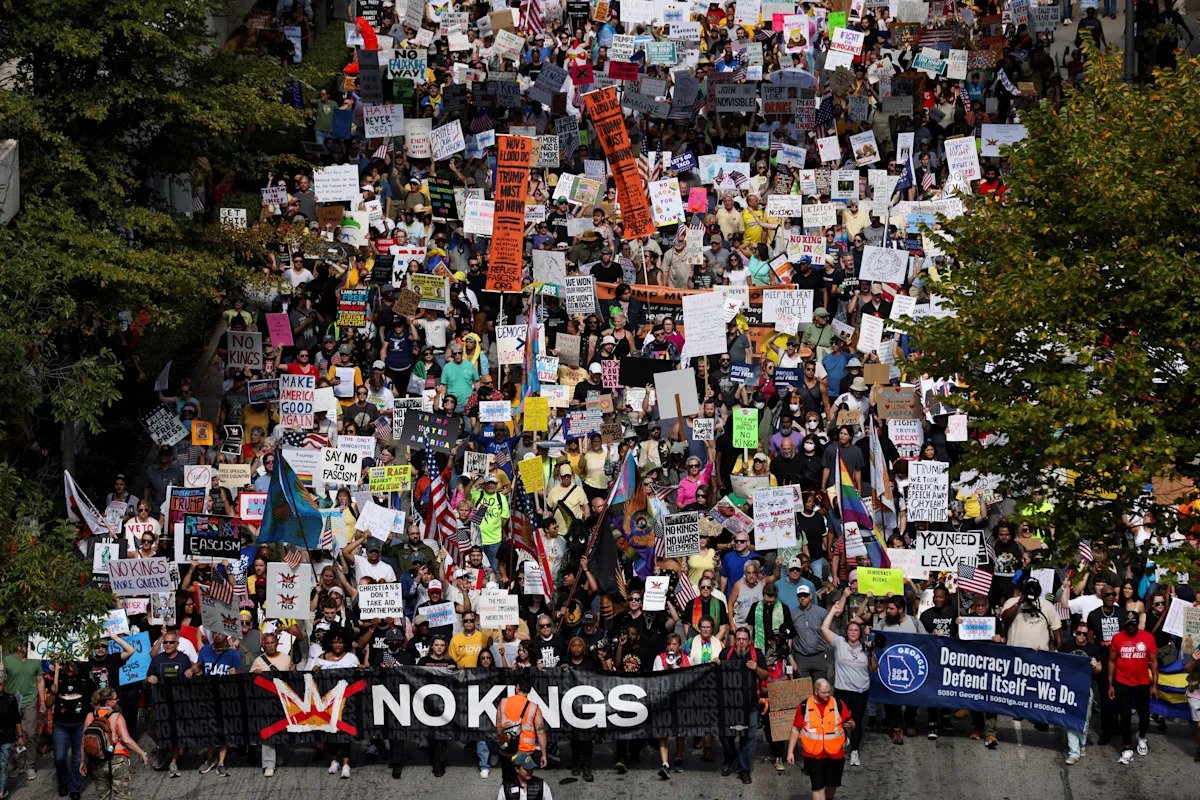
With more than 3,100 events planned nationwide to protest President Donald Trump’s actions and policies, organizers expect the No Kings protests to draw millions of Americans into the streets March 28.
Two earlier No Kings protests brought out huge crowds, and organizers hope this event will be among the largest days of protest in U.S. history.
The ACLU estimated that the No Kings protests in initial June 2025 drew about 5 million people to 1,800 events, and the October 2025 demonstrations drew 7 million to 2,500 events. The ACLU’s estimate for the June 2025 protests matched the findings of Harvard University’s Crowd Counting Consortium.
Indivisible cofounder Leah Greenberg said organizers expect people to protest for a variety of reasons − from immigration enforcement to calls for impeachment. The important thing is people come out and build connections, she said. Indivisible is one of the organizers.
“We have people who are going to come out because they are furious about what is being done to their neighbors and attacks on immigrants. We have people who are going to come out because they are deeply concerned about the Trump administration’s attacks on civil rights. We have people who are going to come out because they are horrified by the war,” Greenberg said. “Rather than trying to make a specific set of policy demands or a specific policy platform, we want to mass together.”
Public Citizen co-president Robert Weissman said that since the first mass protest of the second Trump presidency took place a year ago, the No Hands Protests, some Americans have refused to give in to what they say are the administration’s designs to sow fear.
“The public has really refused to give in to fear and has found the power in collective action and in solidarity,” he said.
The No Kings organizers have built a coalition spanning labor, progressive activists, civil rights groups and faith leaders. In addition to civic organizing groups like Indivisible and Public Citizen, hosting organizations include long-standing activism groups like MoveOn, the Human Rights Campaign, Women’s March and Working Families Power, along with multiple unions and grassroots groups like 50501 that have formed since Election Day 2024.
The name No Kings comes from the organizers’ belief that Trump is acting like a monarch rather than the leader of a democracy. The third day of protests was announced as immigration enforcement ratcheted to a peak in Minneapolis and immigration officers killed two U.S. citizens monitoring arrests, but organizers say people should come protest whatever about the Trump administration troubles them.

A flag flutters near a banner depicting U.S. President Donald Trump during a “No Kings” protest against U.S. President Donald Trump’s policies, in Washington, D.C., U.S., October 18, 2025.
When asked to comment on the protests, White House spokesperson Abigail Jackson responded: “The only people who care about these Trump Derangement Therapy Sessions are the reporters who are paid to cover them.”
Indivisible Kansas City founder Beverly Harvey told USA TODAY it doesn’t matter why people protest, but if they don’t like what the administration is doing, they can participate.
“It’s a laundry list of things he’s done. So just pick something, pick anything you want,” she said.
Protests are scheduled in big cities, suburbs and tiny towns across the nation. Organizers have focused since Trump’s second term began on having accessible protests rather than a handful of mass protests that people have to travel far to attend. They say it not only helps build a greater network of advocates, but it makes it harder to deny that people in all areas are upset enough to protest.
Greenberg said every new demonstration leads to more local organizing. She said 20 to 50 new Indivisible groups are created each week.
“Fundamentally we’re not going for the biggest one-day record. We are going for the ongoing engagement of as much of the population as possible in civic work,” she said. “We don’t think that we are going to get out of this mess unless we have a much bigger number of people in every place in this country collectively owning their home turf and building power.”
Twin Cities
After months at the center of increased immigration enforcement that drew thousands of people into the streets to challenge officers, Minnesota’s Twin Cities will host the main protest, featuring local politicians alongside musicians Bruce Springsteen, Maggie Rogers and Joan Baez; Vermont Sen. Bernie Sanders; and actress Jane Fonda.
Marches starting at three locations will convene at the state Capitol in St. Paul to hear the concert and speakers. Lisa Erbes, 69, co-leader of Indivisible Twin Cities, said organizers expect the march and protest at the Capitol to surge past the 150,000 attendees at the October No Kings demonstration.
Though there will be nationally recognizable speakers, the rally is about the locals who came out and tried to protect their neighbors, she said.
“We are really trying to focus on the people of the Twin Cities who really came through and did such an amazing job of coming together as a community during the surge, and so we are going to be highlighting several of those people who were on the ground every day doing the hard work,” she said.
The Twin Cities’ push back on the Trump administration’s mass immigration enforcement campaign included coordinating patrols to warn neighbors of ICE’s movements and widespread efforts to take care of families left behind or in hiding with things such as food deliveries and community drives to help pay rent. Two activists monitoring ICE activities were shot and killed in clashes with immigration officers.
Ezra Levin, cofounder of Indivisible, said one of the main reasons the Twin Cities is the flagship event is because the way people organized to take care of their neighbors was so inspiring.
“It’s a real demonstration of what we’re going to need to see all across this country, which is not primarily even political. It is simply neighborly. It is people linking arms across ideologies simply because what they see they don’t like and they want to be part of making it right.”
Involvement in local advocacy surged as the federal government sent 3,000 immigration officers into the area to conduct mass arrests of people illegally in the country, Erbes said.
“People were so motivated to become even more active that just showing up for a protest, it wasn’t enough. They wanted more than that,” she said.
In response, soon after the second No Kings protests, many local groups began training people on how to legally monitor immigration enforcement, expecting Minneapolis to be the next big target.
Even with the number of immigration agents dropping and enforcement shifted to rural areas and suburbs, people are still patrolling and monitoring arrests and detention facilities, she said.
Continuing to grow
Harvey, 69, said she expects more than 20,000 people to turn out for the rally and march in downtown Kansas City over a host of reasons, including immigration enforcement and the Iran war.
About 5,000 people attended Kansas City’s first No Kings rally, and the number was closer to 18,000 at No Kings in October, she said.
“People are tired of what’s happening,” she told USA TODAY. “It’s really energizing to have thousands of people that have the same mindset; they want to save democracy.”
And they’ve stayed engaged between protests, she said. Kansas City now has multiple Indivisible chapters that frequently hold pop-up protests, wave signs on overpasses and hold education meetings.

Maria Garcia of Jacksonville Immigrant Rights Alliance leads a protest march during a “No Kings” protest outside the Duval County Courthouse Saturday, June 14, 2025 in Jacksonville, Fla. People took part in one of nearly 2,000 nationwide rallies against Trump and his administration.
“A lot of it is really getting out there and educating people about what’s happening,” she said. “There’s still a lot of people that follow him and a lot of them are watching fake news; they’re seeing propaganda.”
‘Finding activist homes’
Marcia Schneider, 70, an organizer in Portland, Oregon, said more than 60,000 people are expected to attend the march and rally along the city’s waterfront.
In the past year, Portland and surrounding cities have pushed back on increased immigration enforcement and Trump’s plan to send in the National Guard over the state’s objections, she said. The number of Indivisible chapters in the county has tripled, Schneider said.
“People are finding activist homes. … The networks that we’ve built are starting to really kick in,” Schneider said. “That’s how we’re getting through it.”
Not alone
Two dozen people showed up to the first protest Kurt Reinhart, 53, organized in Miles City, Montana, last April. They were frustrated that Republican U.S. Sen. Tim Sheehy was speaking at the local high school but not holding public town hall meetings.
The group in the state’s 11th-largest city organized and grew in number. About 130 people attended the second No Kings rally in October 2025. Reinhart hopes for a similar number outside the Custer County Courthouse for March 28, if not a few more.
More than 20 protests were set for Montana, which Reinhart called “quite a bit of people for a red state.”
But it feels especially important in smaller places like Miles City, he said.
“Especially in communities like this, you can feel really isolated and alone, which can be depressing and like you don’t have a voice and maybe more stressful and negative,” Reinhart said. “So these events do offer chances to be reminded that you’re not alone, that there are other people that share your concerns, that are bold enough to come out and sit on the side of the road in their communities.”
Until last year, the town of about 8,400 people in deep-red Montana hadn’t seen a protest in the 20 years Reinhart had lived there.
“It is important to remember that even a single person out with a message is reminding people that things aren’t really right.”
Sarah D. Wire, a senior national political correspondent for USA TODAY, can be reached at swire@usatoday.com.
This article originally appeared on USA TODAY: No Kings protests target Trump on March 28. Could they break records?