
Breaking News
China urges US, Israel to stop military action in Middle East, warns of ‘vicious cycle’

By Xiuhao Chen and Liz Lee
BEIJING, March 23 (Reuters) – China on Monday urged all parties involved in the Middle East conflict, particularly the U.S. and Israel, to cease military operations, warning of a “vicious cycle” in a war that analysts say if prolonged, could undermine global growth and weaken demand for Chinese exports.
“The one who tied the bell must be the one to untie it,” said Chinese special envoy to the Middle East Zhai Jun at a briefing after his shuttle-diplomacy trip that included stops in Saudi Arabia, the United Arab Emirates and Kuwait.
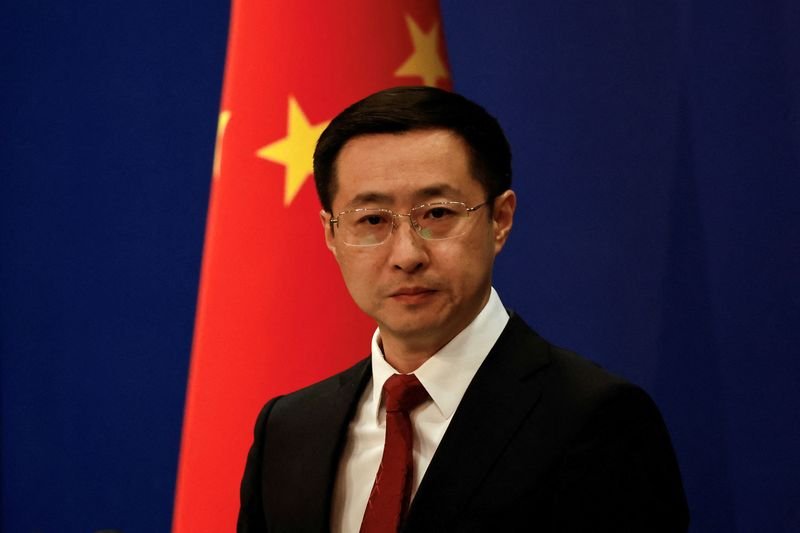
In a separate briefing, foreign ministry spokesperson Lin Jian cautioned that the use of force would only lead to a “vicious cycle” and that the war should not have been started.
“Should the hostilities continue to spread and intensify, the entire region will be plunged into chaos,” he said.
LESSONS FROM HISTORY
“The lessons of the past are not far behind us,” the Chinese foreign ministry said on Monday in a reply to Reuters seeking comment on Iraq War anniversary last week.
“The war 23 years ago brought profound suffering to the Iraqi people and had a serious impact on the Middle East,” the statement said.
Last Friday marked the 23rd anniversary of the Iraq War, in which U.S.-led forces invaded the country to oust Saddam Hussein, partly on claims that his government possessed weapons of mass destruction.
Though the regime fell quickly, Iraq sank into years of chaos and instability, in a war estimated to have killed more than 100,000 people, cost the U.S. trillions of dollars and created a power vacuum that saw the rise of the Islamic State terrorist group.
“The war 23 years later on Iran has caused severe losses to the Iranian people, and the spillover and spread of the conflict have also affected the entire region,” the ministry said.
CHINA’S EXPORTS
Trump on Saturday imposed a 48-hour deadline on Tehran to reopen the Strait of Hormuz to all shipping, threatening to destroy Iranian power plants otherwise.
Iranian attacks have effectively closed the key waterway which carries a fifth of global oil and liquefied natural gas, causing the worst oil crisis since the 1970s.
While Beijing did not detail its concerns, a prolonged conflict could weigh on China’s export outlook.
Emerging markets—key drivers of Chinese export growth—are particularly vulnerable due to limited oil reserves and sensitivity to rising energy costs.
“Weakening growth in China’s emerging market trading partners will likely weigh on Chinese exports to these countries in the coming quarters,” Goldman Sachs’s Hui Shan said in a report about the near-term risks to China’s economy.
China is relatively better positioned to absorb higher oil prices with coal accounting for about 60% of its energy mix, ample oil stockpiles and imports via the Strait of Hormuz, representing only around 5% of total energy consumption.
Still, rising oil and gas prices could lift inflation and end producer price deflation, according to the chief China economist.
The bank has cut its forecast for China’s second-quarter growth and raised its inflation outlook for 2026.
Asked whether China had pressed Iran to ensure safe passage for Chinese vessels and oil shipments through the strait, foreign ministry spokesperson Lin said Beijing remains in communication with all parties and is committed to easing tensions.
(Reporting by Xiuhao Chen and Liz Lee; Additional reporting by Samuel Shen; Additional writing by Jessie Pang; Editing by Jacqueline Wong and Arun Koyyur)