
Breaking News
As the 2026 midterm elections approach, just 23% of Americans are confident the vote will not be ‘rigged’

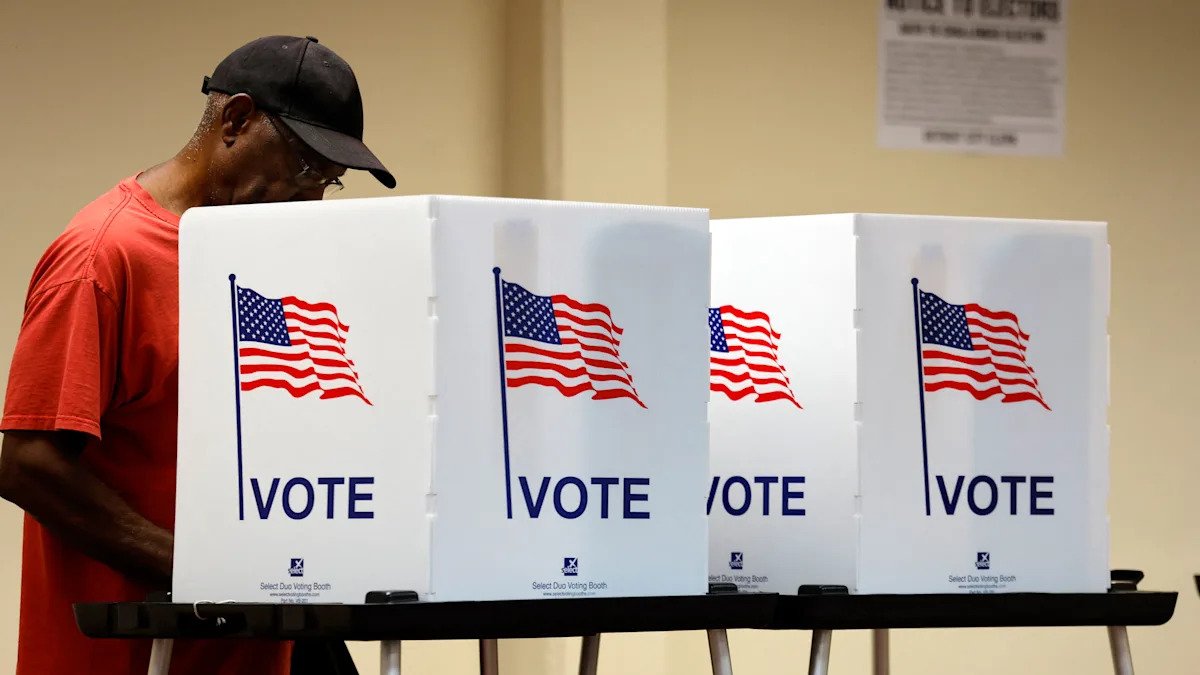
Nearly six in 10 Americans (59%) disagree with President Trump that Republicans should “take over the voting” in 15 states in order to “nationalize” the 2026 midterm elections, according to a new Yahoo/YouGov poll.
Just 19% say they would favor the idea.
“The Republicans should say, ‘We want to take over,’” Trump declared in a Feb. 2 interview with Dan Bongino, his former deputy FBI director. “We should take over the voting, the voting in at least many — 15 places. The Republicans ought to nationalize the voting.”
“The federal government should get involved,” the president added at an Oval Office event the following day — even though the U.S. Constitution explicitly says that “the times, places and manner of holding elections for senators and representatives shall be prescribed in each state by the legislature thereof.”
The new Yahoo/YouGov survey of 1,704 U.S. adults, which was conducted from Feb. 9 to 12, is a striking reminder of how Trump’s false claims of widespread election fraud — and his new talk of a federal election takeover by the GOP — have undermined faith in America’s democratic process.
As the administration raids county election offices, demands state voter files and tries to restrict voting via executive order, just 23% of Americans say they’re confident that November’s midterms will not be “rigged” in favor of certain candidates.
The other 77% either believe the voting will be rigged (33%) or say they’re not sure what to think (44%).
The loss of trust in U.S. democracy cuts both ways. For years, Yahoo and YouGov have asked Americans whether they think the next election will be “free and fair.” In December 2021 — 11 months after Trump’s supporters tried to stop Congress from certifying his 2020 election loss by violently attacking the U.S. Capitol — just 28% of Americans said the next presidential election would be free and fair. Another 28% said no; 45% said they were not sure.
Those numbers are eerily similar today: 27% yes, 27% no, 46% not sure.
But who is saying yes and who is saying no have changed. In 2021 — with Joe Biden in the White House, and with Trump falsely insisting that he had been cheated out of the presidency — Democrats (42%) were far more confident than Republicans (14%) that the next presidential election would be free and fair.
Today, with Trump back in the Oval Office, Republicans (37%) are significantly more confident than Democrats (24%). By the same token, 47% of Republicans and 45% of Democrats said in September 2022 they were very worried about the future of U.S. democracy. Now just 19% of Republicans say they’re very worried — compared to 66% of Democrats.
What are Americans worried about?
Democrats and Republicans tend to have different election concerns — but at the moment, Americans as a whole tend to side more with Democrats than Republicans.
Asked who is “more likely to try to rig November’s midterm elections,” for instance, U.S. adults who previously predicted that the elections would be rigged or expressed uncertainty choose Republicans (44%) over Democrats (33%) by an 11-point margin.
Likewise, 60% of Americans say Trump is “not likely to accept” a scenario in which Democrats “win enough seats in November to take control of the U.S. House or U.S. Senate” — while just 22% think he’d be likely to accept such a result. Notably, a majority of Republicans either agree that Trump is unlikely to accept a Democratic victory (34%) or say they’re not sure (24%).
What would Trump do if Democrats win the midterms? Very few Americans think he would “let it go and move on” (6%) — or succeed in overturning his party’s loss (7%). A greater number believe that Trump would “talk about it a lot but not take any real action to overturn the results” — and even more predict he would take “real action to overturn the results” but ultimately fall short (37%).
Remarkably, majorities of Democrats and independents believe the sitting U.S. president will take real action to overturn a midterm loss for his party. A full 62% of Democrats think Trump would try and fail; another 8% believe he would succeed. Among independents, those numbers are 44% and 6%, respectively.
On the flip side, Trump has claimed that the GOP must seize control of November’s elections because “people were brought to our country to vote, and they vote illegally.”
“We have states that are so crooked,” the president said earlier this month. “We have states that I won that show I didn’t win.”
All of Trump’s allegations of widespread, result-altering election fraud — claims he has been making since he lost the popular vote to Hillary Clinton in 2016 — have been conclusively debunked, both in court and by GOP election officials.
A 2024 audit by Georgia’s Republican secretary of state, for instance, found that just 20 of the 8.2 million people registered to vote there were not citizens. Only nine of them had ever cast ballots.
Even an ongoing review of the 2024 election by Trump’s Department of Homeland Security has so far “found little evidence of widespread voting fraud by noncitizens,” according to the New York Times. Allegations about fraudulent mail voting have also been debunked.
Yet the new Yahoo/YouGov poll found that Trump’s false claims have become pervasive, especially on the right:
52% of Americans believe Biden won the 2020 election “fair and square”; far fewer (28%) believe the election was “rigged and stolen from Trump.” Among Republicans, however, those numbers are 14% and 63%, respectively.
Far more Americans disagree (50%) than agree (34%) with the statement that “Democrats bring undocumented immigrants to our country to vote and help them vote illegally.” But Republicans agree (73%) rather than disagree (11%) by a 62-point margin.
Americans are more divided over the question of whether fraudulent voting by undocumented immigrants is “rare and it does not influence the outcome of elections” (42%) or “common and does influence the outcome of elections” (36%).
And they split right down the middle — 40% to 40% — when the same question is asked about fraudulent mail voting.
Possible reforms?
Last week, the Republican-controlled House passed the SAVE Act, a measure that would dramatically overhaul elections nationwide and potentially disenfranchise millions of voters.
The legislation now moves to the Senate, where Democrats have vowed to block it from moving forward.
The new Yahoo/YouGov poll asked about a key provision of the SAVE Act: its requirement that anyone registering to vote anywhere in the U.S. show “documentary proof of United States citizenship” in the form of a valid U.S. passport, military ID, tribal ID or birth certificate. Things like a driver’s license, Real ID or Social Security number would not be enough.
According to the survey, far more Americans say they would favor (62%) than oppose (23%) “requiring proof of citizenship — usually in the form of a passport or a birth certificate — in order to register to vote.” Nearly all Republicans (89%) favor the idea, while Democrats are divided (39% in favor, 45% opposed).
The question did not note that Congress already passed a law in 1996 prohibiting noncitizens from voting in federal elections; that all 50 states already require voters to attest that they are U.S. citizens when registering; that only half of all Americans have a passport; or that millions more either don’t have or can’t readily access their birth certificates.
As a result, the Brennan Center for Justice has estimated that requiring documentary proof of citizenship nationwide would block 21 million eligible voters from being able to cast ballots. When Kansas recently implemented its own version of the SAVE Act, it purged about 40 ineligible voters from its rolls — and prevented 31,000 eligible citizens (or about 12% of all applicants) from registering, according to the Bipartisan Policy Center.
In general, Americans tend to oppose new restrictions on voting:
Making it harder to vote by mail: 46% oppose, 38% favor
Making it harder to vote early (in person): 57% oppose, 21% favor
Banning or cutting back on mail ballot drop boxes: 42% oppose, 38% favor
Shortening the early or absentee voting period: 41% oppose, 35% favor
Giving more power to partisan observers to police polling places: 36% oppose, 27% favor
__________________
The Yahoo survey was conducted by YouGov using a nationally representative sample of 1,704 U.S. adults interviewed online from Feb. 9 to 12, 2026. The sample was weighted according to gender, age, race, education, 2024 election turnout and presidential vote, party identification and current voter registration status. Demographic weighting targets come from the 2019 American Community Survey. Party identification is weighted to the estimated distribution at the time of the election (31% Democratic, 32% Republican). Respondents were selected from YouGov’s opt-in panel to be representative of all U.S. adults. The margin of error is approximately 3%.