
Breaking News
5 takeaways from Trump’s birthright citizenship arguments

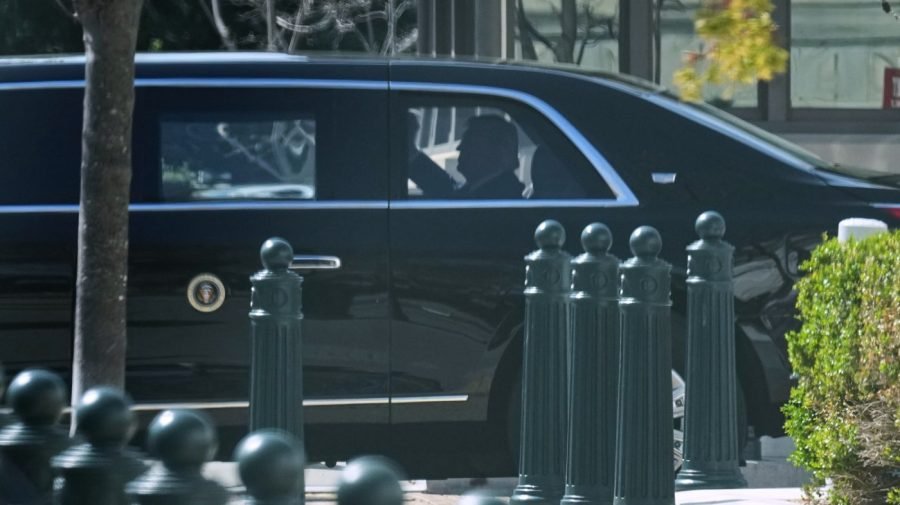
Oral arguments at the Supreme Court on Wednesday left the impression that key justices had misgivings about President Trump’s effort to limit birthright citizenship.
With one of the administration’s banner immigration policies on the line, Trump decided to attend, making him the first sitting president in recorded history to scrutinize the justices as a listener in the gallery during arguments over one of his own key policies.
Here are five takeaways from the justices’ questions and Trump’s attendance.
Trump stays steely
Chief Justice John Roberts did not verbally acknowledge Trump’s presence. The president was seated halfway back in the room toward Roberts’ left, but as the chief walked out to his seat, he gazed toward the right.
Several other justices appeared to look straight ahead. Justice Clarence Thomas looked toward where Trump was seated. Justice Ketanji Brown Jackson, meanwhile, maintained a tight-lipped smile until she took her seat.
As the argument got underway, the president remained stone-faced and silently listened to the proceedings with little expression.
It contrasted with Trump’s days in lower-level courtrooms, where he would typically sit at his trials alongside his lawyers and would frequently whisper to them, tap them on the arm to get their attention, pass them notes and even at times express visible frustration.
On Wednesday, the president sat in the grandiose Supreme Court courtroom. He was in the first row of the public gallery, where parties to a case often sit. The front half of the room is reserved for Supreme Court Bar members, the justices’ guests and press.
Trump entered shortly before the court gaveled in and watched all the questioning to his administration’s lawyer, Solicitor General D. John Sauer. After Sauer finished, Trump departed six minutes into the other side’s argument.
Before things kicked off, the president changed seats. Initially, he sat close to the side wall of the courtroom. A few minutes later, Commerce Secretary Howard Lutnick went to speak to someone in the back of the room.
Once he returned, Trump moved closer to the center, near an aisle that appeared to give him a better vantage point of the lectern.
The president sat near Lutnick, White House Counsel David Warrington and Attorney General Pam Bondi.
On the other side of the room was California Attorney General Rob Bonta (D). He has sued over Trump’s birthright citizenship order and challenged dozens of other administration actions.
One row behind him was John Eastman, who is arguably most known for his efforts to block certification of the 2020 presidential election but has long argued the Citizenship Clause has been misinterpreted. Eastman was seen frequently writing notes as he listened.
Broad skepticism of Trump order
Despite Trump’s presence in the courtroom, the justices cast significant doubt on his executive order limiting birthright citizenship.
Trump’s argument hinges on an interpretation of the 14th Amendment’s Citizenship Clause that departs from the way it has long been understood.
The 14th Amendment says that “all persons born or naturalized in the United States, and subject to the jurisdiction thereof, are citizens of the United States and of the State wherein they reside.”
The clause “subject to the jurisdiction thereof” has traditionally been thought to be an exception excluding certain groups from birthright citizenship, like the children of foreign diplomats or foreign enemies in a hostile occupation. But the Trump administration says it leaves out the children of immigrants in the country illegally, too.
The justices seemed unconvinced.
“The examples you give to support that strike me as very quirky,” Roberts said, questioning the Trump administration’s bid to expand the limits to a “whole class” of noncitizens.
“I’m not quite sure how you can get to that big group from such tiny and sort of idiosyncratic examples,” he added.
Justice Elena Kagan told Sauer that the text of the clause “does not support” the administration’s argument, saying the government seemed to be looking for a “technical, esoteric meaning.”
And even Justice Samuel Alito, one of the court’s foremost conservative justices, seemed to have potential reservations, suggesting the court faces an “unusual situation.”
“Our immigration laws have been ineffectively — and, in some instances, unenthusiastically — enforced by federal officials,” he said. “So, there are people who are subject to removal at any time if they are apprehended and they go through the proper procedures, but they have in their minds made a permanent home here and have established roots.
“And that raises a humanitarian problem,” he said.
Justices examine Trump’s immigration goals
Several of the justices asked policy questions about Trump’s birthright citizenship aims, only to later note those aims have no relevance to the court’s decision — with Trump in the room to hear it.
The Trump administration has defended its citizenship restrictions by pointing to “birth tourism,” referring to someone who travels to the U.S. specifically to give birth so their child can receive birthright citizenship.
“Do you have any information about how common that is or how significant a problem it is?” Chief Justice John Roberts opened the floor to the government.
“It’s a great question. No one knows for sure,” Sauer began, before detailing the various estimates and media reports.
After he finished, Roberts chimed back in.
He replied, “having said all that, you do agree that that has no impact on the legal analysis before us?”
Minutes later, a similar dynamic played out with Justice Brett Kavanaugh.
He conceded to Trump’s lawyer that the many examples of countries that don’t have birthright citizenship around the globe is a “very good point” as a policy matter.
“But, obviously, we try to interpret American law with American precedent based on American history,” Kavanaugh said.
“That’s certainly what I try to do and I think you try to do.”
As other justices probed, they brought up timely hypotheticals.
Justice Samuel Alito asked about a boy born on U.S. soil to an Iranian father who entered the country illegally. Alito did not directly reference Trump’s operations in Iran over the last month, but his country choice was striking.
“That boy is automatically an Iranian national at birth, and he has a duty to provide military service to the Iranian government,” Alito noted.
Wong Kim Ark to stay?
The justices repeatedly returned to its 1898 precedent called United States v. Wong Kim Ark, which affirmed U.S. citizenship for a man born to Chinese citizens in San Francisco.
The challengers say it bars Trump’s birthright citizenship restrictions. Trump says they’re overreading the precedent.
As several justices signaled they disagree with Trump, his attorney notably did not pivot to asking the court to overturn the 1898 decision. Sauer stood firm.
“No. First of all, we’re not asking you to overrule Wong Kim Ark,” Sauer told Justice Sonia Sotomayor after she suggested they would need to do so.
“But you are asking us to,” the liberal justice again insisted.
Justice Brett Kavanaugh seemed to indicate that a finding upholding Wong Kim Ark would mark an easy win for the mothers who sued over Trump’s order.
“If we did agree with you on Wong Kim Ark, that could be just a short opinion, right,” he asked, “that says the better reading is Respondents’ reading?
“Yes,” said Cecilia Wang, the mothers’ lawyer and the American Civil Liberties Union’s legal director, which drew laughter from the gallery.
Jackson eyes impact
Of all the justices, Justice Ketanji Brown Jackson appeared to be the one most interested in parsing the real-world impact of a ruling that favors Trump.
“How does this work?” she asked. “Are you suggesting that when a baby is born, people have to have documents, present documents? Is this happening in the delivery room?
“How are we determining when or whether a newborn child, a citizen of the United States under your rule?” she continued.
Sauer replied that the Social Security Administration had guidance regarding the matter and that Social Security numbers would continue to be generated based on the birth certificate, remaining in “the vast majority of instances completely transparent.”
But that didn’t answer Jackson’s question.
“So, are we bringing pregnant women in for depositions?” the most junior liberal justice asked. “What are we doing to figure this out?”
Sauer said parents would have the chance to dispute if their child was wrongly denied citizenship.
“After their baby has been denied citizenship,” Jackson pressed, “then we can go through the process?”
“Yes,” Sauer replied.
Copyright 2026 Nexstar Media, Inc. All rights reserved. This material may not be published, broadcast, rewritten, or redistributed.
For the latest news, weather, sports, and streaming video, head to The Hill.