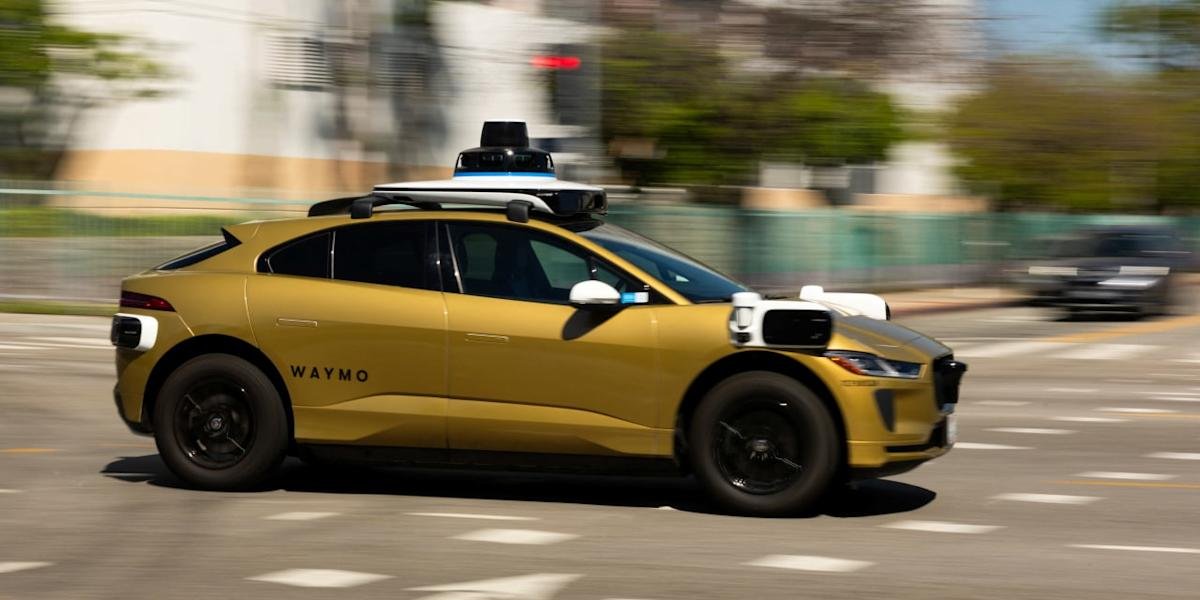
A Waymo driverless vehicle in Los Angeles. – Mike Blake/Reuters
After a recent spate of autonomous-vehicle deals, it’s feeling like 2016 all over again. Maybe this time the streets will really flow with robot cars.
The vibe shift could be felt in the past two weeks, in particular, as Uber Technologies detailed partnerships with several AV companies, including Amazon’s Zoox and Motional. The ride-hailing behemoth also announced on Thursday an agreement to possibly invest as much as $1.25 billion in electric-car maker Rivian for its planned autonomous vehicles.
Meanwhile, the Alphabet CEO’s new comp plan is now tied, in part, to Waymo, the self-driving car unit that grew out of Google and helped ignite the original excitement for the technology.
And the real tell that the AV hype cycle has begun anew? Travis Kalanick, Uber’s ousted founder, and Anthony Levandowski, the tarnished O.G. of the Google car project, returned to the scene in a dramatic way.
The two entrepreneurs came to epitomize a certain swagger of the first hype cycle roughly a decade ago when Silicon Valley was betting it could replace a world of human-driven cars with robots. That sent chills down the spines of Motor City executives who fretted—fairly perhaps—about safety and their pecking order in the world.
The two men drew headlines this past week. Kalanick revealed he has been the biggest investor in Levandowski’s latest self-driving startup, and the former Uber CEO was working to fold that company into his reimagined venture called Atoms, which aims to automate food, mining and transport industries.
“What a comeback,” Sarah Guo, a venture capitalist, posted on X, one of the many celebrating Kalanick’s return.
Anthony Levandowski was sentenced to prison in an autonomous-vehicle trade-secret theft case. He was later pardoned by President Trump. – Justin Sullivan/Getty Images
Travis Kalanick, Uber’s former chief executive. – Zak Bennett/Bloomberg News
Even as the swagger returns, a key question remains about the technology from the last go-round that fizzled out in late 2022: Can robot cars finally scale affordably into businesses?
“There’s a lot of buzz, a lot of hype, a lot of players back in the game…in a similar way that we saw in the last hype cycle,” Laura Major, chief executive of Motional, a self-driving joint venture between Hyundai and automotive supplier Aptiv, told me in an interview.
Since the first cycle, the hype had moved on. And, in the intervening years, excitement around AVs faded amid a general realization the technology wasn’t quite ready for mass adoption. Plus, the cost of the boring logistics behind the scenes to make robotaxis work was going to be expensive.
Story Continues
Such boom-bust cycles are familiar with emerging technologies and their adoptions. And, clearly, robot cars fell hard into what consulting firm Gartner called the “trough of disillusionment.”
That trough can be a brutal journey from the highs of inflated expectations where money and excitement are flowing into what might be possible. Those expectations were huge when Intel, Uber, General Motors and others were partnering and spending big to position themselves to jump on the self-driving future.
Many of those dreams ended in tears. Now, as Waymo is going city to city rolling out a robotaxi fleet, the promise of the technology increasingly feels real.
In my neighborhood in San Francisco, Waymo vehicles are becoming ubiquitous.
And it isn’t just in oddball places. They’re becoming mainstream enough to be name checked in comedian Conan O’Brien’s Academy Awards monologue.
That surely had the bosses in Mountain View happy.
Earlier this month, Alphabet reported a three-year comp plan for Chief Executive Sundar Pichai that includes, for the first time, pay tied to Waymo’s valuation. He could get shares worth up to $260 million, an incentive to see the valuation of Waymo continue to grow.
But it’s more than just valuations this time around. Companies are demonstrating how to connect users with the robot rides.
Under Uber Chief Executive Dara Khosrowshahi, the company has adopted an aggressive strategy of signing deals to connect robots with riders in several cities. That includes Waymo in Austin, Texas, where it competes with Tesla’s own efforts to roll out a robotaxi service.
“Seeing is believing,” Sarfraz Maredia, Uber president for autonomous mobility and delivery, told me of the new excitement. “We’ve clearly entered into this commercialization period, and it is clear to a lot of our key partners, and increasingly to some of the governments and regulatory bodies that we work with, that we’re exiting this trial and pilot period and starting to move to this place of real commercial deployments focused on safety and reliability at scale.”
Part of scaling is figuring out how to deploy in ways that are cost-effective. These vehicles, with their expensive sensors and computers, are still pricey, even if the costs are coming down from lofty levels.
Autonomous electric cars are a regular sight in Austin, Texas. – Bob Daemmrich/ZUMA Press
Practically, that means the vehicles need to be used more than a traditional car running in a ride-hailing fleet. It could be an expensive misstep to scale up a robot army to meet rush-hour demand in a city only to see many of those vehicles sit idle during nonpeak times. Uber is betting that a mixture of robots and humans can be the solution for now.
This past week, Uber announced a deal with Rivian. This involved an investment tied to the car company winning regulatory approval and meeting milestones tied to its R2 robotaxi being made for exclusive use in the ride-hailing app.
The deal calls for an initial 10,000 robotaxis, beginning in 2028. That is ambitious given the automaker hasn’t yet publicly deployed such technology.
If some of Uber’s enthusiasm sounds familiar, it should. In late 2017, a deal was announced for Volvo Cars to supply Uber with 24,000 sport-utility vehicles beginning in 2019 that were going to be modified with the tech company’s AV technology.
That never happened. A few months later, one of Uber’s test vehicles struck and killed a woman outside of Phoenix. This led to a halt of the company’s testing and, eventually, Uber ended its in-house efforts as it focused on becoming profitable.
Now that the swagger is back in the AV world, it is time to deliver on the visions made popular a decade ago.