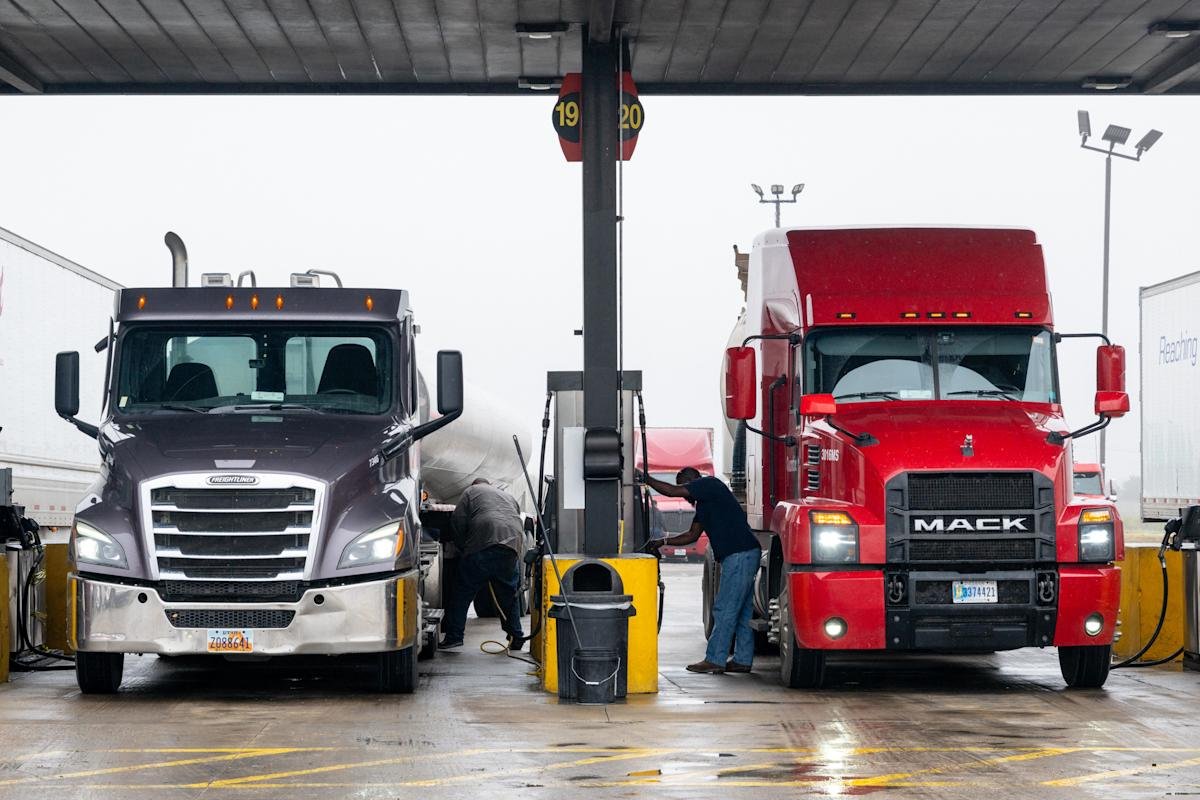
Trucker Heather Griffith saw the impact of the war in Iran on Tuesday on the fuel pump display at an AMPM convenience store in Lost Hills, California.
Putting 100 gallons of diesel into her blue Peterbilt 389 truck cost her $642. With Iranian threats having effectively closed the Strait of Hormuz to oil tanker traffic, the national average price of a gallon of diesel – already higher than regular gasoline – has jumped by nearly $1 in the past week.
Subscribe to The Post Most newsletter for the most important and interesting stories from The Washington Post.
If the war continues for much longer, diesel – now at $4.78 per gallon – could soon test its all-time high of $5.82 set in June 2022 following Russia’s invasion of Ukraine.
Griffith, 42, already knows of at least six drivers who have parked their rigs rather than run at a loss. She worries that she might have to join them.
“If it doesn’t go down, we’re not going to see any profit. It could end up making me close my doors,” she said.
Still in its early days, the Iran war has dashed truckers’ hopes for a business rebound after a three-year freight recession. Higher diesel prices, if sustained, also could have wider implications for the U.S. economy. Along with trucking, diesel powers the nation’s rail carriers and is a mainstay of farm tractors, harvesters and combines.
Making freight and food more expensive is a surefire formula for aggravating the affordability crisis that has bedeviled the White House for months. President Donald Trump on Monday sought to play down the impact of the gulf crisis, insisting that “it doesn’t really affect us; we have so much oil.”
But oil prices are determined in a global market, so disruption at a distant chokepoint is hitting American pocketbooks. Kathy Bostjancic, chief economist for Nationwide, said the war’s impact on energy costs will temporarily lift annual consumer price inflation to 3.5 percent by April or May, up from the current 2.4 percent rate.
Farmers will feel the pinch of pricier diesel over the next couple of months with the arrival of the spring planting season. If diesel keeps rising and stays high for 90 days, grocery prices will follow, said Joe Brusuelas, chief economist for RSM, a consultancy.
“That’s what I’m most worried about,” he said.
Griffith, a Marine veteran who deployed four times to Iraq and Afghanistan, has been driving for 12 years. Her husband, Daniel, is a veteran of 38 years behind the wheel. Operating from their home in Poteau, Oklahoma, they specialize in transporting heavy cargo, such as excavators, farm equipment, motor homes and electric transformers. It’s tough, tiring work, but the couple typically earns a combined $200,000 per year.
Large trucking companies such as JB Hunt and Schneider National are insulated against fuel price hikes. Their contracts include a fuel surcharge that automatically adjusts their prices based on weekly Energy Information Administration data.
Independent truckers like the Griffiths, however, enjoy no such protection. They must negotiate an “all-in” price with freight brokers every time they agree to carry a load. Inevitably, they struggle to wring higher prices from these intermediaries who represent shippers and often have plenty of truckers to choose from.
To help make her case, Griffith tracks her expenses in a day planner she bought at Walmart for $12. She lists the cost of each fill-up along with charges for mandatory government permits and vehicle escorts. But in the end, it comes down to persuasion.
“If you get the right broker, they’re willing to negotiate with the shipper to increase their budget. But most of the time, it’s a ‘no,’” she said.
The unforgiving market is forcing her to economize. She’s delaying repairs for a troublesome oil leak and an engine overhaul that could cost $30,000. Driving through Los Angeles recently, she passed a gas station advertising diesel at $8 a gallon.
“With these fuel prices now, it’s going to affect how we do our grocery shopping and whether we on occasion can get out to eat,” she said.
Fuel is one of the largest costs for owner-operators like the Griffiths, who make up about 11 percent of all truck drivers registered with the Federal Motor Carrier Safety Administration. The increase in diesel prices this year has yet to match the 2022 surge. But freight rates are lower now, so truckers have a thinner cushion to offset their rising costs. Truckers earned nearly $3 per mile in 2022 as diesel prices neared their peak, compared with about $2.25 today, according to DAT Freight & Analytics.
Small operators who are shrewd negotiators can recover perhaps 50 percent to 60 percent of their increased fuel costs, said Ken Adamo, DAT’s chief of analytics.
“With freight rates already low, a sharp increase in diesel can quickly eat up what little margin a small trucking business has left,” said George O’Connor, a spokesman for the Owner-Operator Independent Drivers Association in Washington, D.C.
The jump in diesel prices is also draining the Kane Group, a trucking and warehouse company in Jessup, Maryland, which serves customers between Richmond and New Jersey. The company’s contracts with shippers include a fuel surcharge that is based on a 90-day average, said CEO Richard Kane. That means a lag between the initial surge in prices and when his revenue catches up.
In January, the group was paying about $2.37 per gallon, excluding a 49 cent federal tax and a 71 cent Maryland state levy, to fill its 25 trucks with diesel.
“You might see [the increase] at the pump. But the shipper is still dealing with February numbers. I’m up 80 percent, but they’re not up 80 percent. On average, they’re still getting charged $3.25.”
Trump has offered conflicting statements in recent days about how long the war with Iran will go on. Brent crude, the global oil price benchmark, has oscillated wildly, topping $108 per barrel early Monday before dropping back to $86 on Tuesday.
Amid continued combat, commercial shipping through the critical Strait of Hormuz has virtually ceased. On Monday, the only vessel to transit the waterway, located along Iran’s southern coast, was Iranian-flagged, according to Windward, a maritime AI intelligence firm headquartered in London.
The prospect of higher fuel prices will raise freight carriers’ costs and probably dent shipping demand, as consumers paying more at the pump cut back on other expenses. Since the war began, the stocks of major national trucking companies and railroads have lagged the broader market, reflecting doubts about future volume.
The S&P 500 index dropped 1.4 percent over that period. But Union Pacific, the nation’s second-largest railroad, lost almost 6 percent of its value while Schneider National, a leading trucking company, surrendered 9 percent.
Motorists, meanwhile, may see evidence of industry cost-saving efforts on the road, as truckers slow their rigs in a bid for greater fuel efficiency, Adamo said. By driving 55 mph rather than 65 mph, truck drivers could recapture nearly half of their increased fuel costs.
“You’re going to see semitrucks driving slower right now,” he said.
Related Content