
Breaking News
President Trump urges college sports leaders to return to pre-NIL era: ‘I’d like to go exactly back to what we had and ram it through a court’

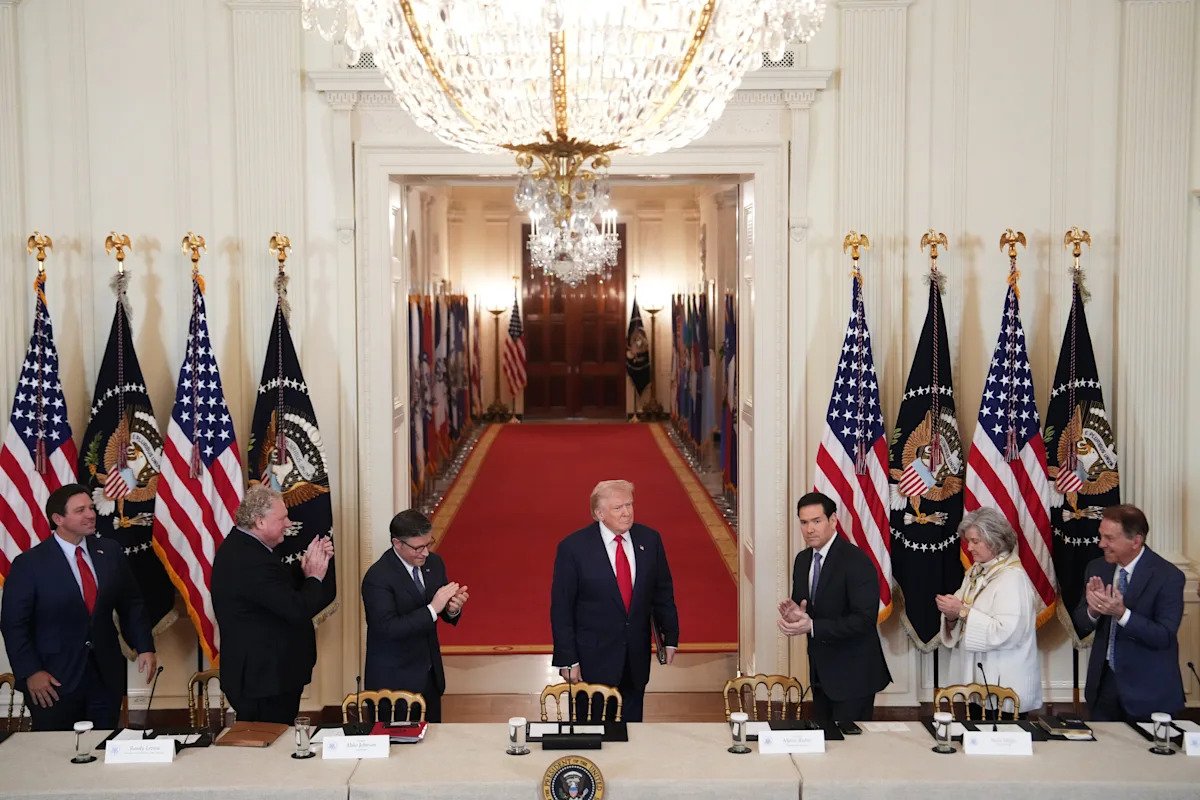
WASHINGTON, D.C. — Have you ever attempted to put toothpaste back into its tube?
There is a way to do it, actually. You can find videos online of some folks accomplishing this feat. The videos show a person using scissors to cut the wide bottom end of the tube’s plastic casing. From there, it’s quite easy. You just swipe that pesky paste back into the tube, close the end with staples or glue, and — voila! — you’ve put toothpaste back into its tube.
Advertisement
Of course, that tube is now maimed and probably not functionally useful.
But, hey, you did it!
On Friday here, as afternoon transitioned to evening, from within the gold-gilded and chandelier-adorned East Room of the White House, the United States President, in front of a nationally televised audience and before 50 sports and business dignitaries, announced to the world something altogether confounding.
He wants to put college sports’ proverbial toothpaste back into its collective tube.
Why can’t the industry “go back to the old system?” Trump asked a room of astonished and stoic faces. “I’d like to go exactly back to what we had and ram it through a court.”
Advertisement
In fact, Trump plans to attempt to do just that, he said during the 100-minute college sports roundtable event that left many in the room a bit mystified and those watching from afar somewhat stunned.
While disregarding and disparaging court decisions that have opened a path for athlete compensation, Trump announced plans to release a second executive order — this one “more comprehensive,” he said — that is intended, it appears, to reimplement unlawful policies of the pre-NIL era.
The executive order will be strong enough in its language that Trump expects it to invoke legal challenges. His hope is that the lawsuit and subsequent appeals find favorable judges, he says, that will rule differently than a host of judges who, he says, have “destroyed” college athletics with their deeming of NCAA rules to be in violation of antitrust. And that includes, he exclaimed, the Supreme Court, whose 9-0 decision in the NCAA v. Alston case, though not about compensation specifically, paved the path for the industry’s current unregulated market.
While writing this order — which is expected to be issued in a week, he said — Trump demands that lawmakers continue and expedite negotiations for federal legislation, despite the president himself believing that passage of a bill is virtually impossible because of “lunatics” in Congress, he told the room.
Advertisement
Friday’s meeting, scheduled for an hour, turned into a wild near-two-hour political meltdown of sorts — a president criticizing his enemies: the courts for “destroying” college sports, and congressional Democrats for preventing legislation to pass that might fix it.
Meanwhile, college athletics — its leaders resistant to collective bargaining — twists in the winds of soaring player salaries, unenforceable rules, mounting legal threats and budget deficits.

President Donald Trump (left) gestures as former Alabama football coach Nick Saban (right) speaks during a roundtable discussion on college sports at the White House on March 6. (Anna Moneymaker/Getty Images)
(Anna Moneymaker via Getty Images)
The industry is nearing the “point of no return,” Notre Dame athletic director Pete Bevacqua told the room, describing football as a “runaway financial train” that is gobbling up resources meant to fund Olympic and women’s sports.
Advertisement
“Lawsuits are killing us,” ACC commissioner Jim Phillips told the room. “You don’t like a rule, you just go to a local judge.”
Friday’s hearing included no current athletes, and though roundtable leaders say that athletes will be involved later in the process, Rep. Lori Trahan — one of the few Democrats in attendance — took exception to the lack of athlete representation and identified serious flaws in the SCORE Act, too. It was a brief but important moment emblematic of the divide in Congress.
In fact, as the more than 50 people conducted the roundtable on Friday — many of whom never even spoke — something else brewed, perhaps even more interesting, about a mile away. At the U.S. Capitol, a congressional compromise actually unfolded.
Two U.S. Senators, Maria Cantwell (D-Wash.) and Eric Schmitt (R-Mo.), agreed on a bipartisan bill to amend the Sports Broadcasting Act of 1961, permitting college conferences to consolidate and sell, presumably for more revenue, their media rights.
Advertisement
It was a landmark compromise between two sitting senators on either side of the aisle regarding one of the most divisive issues percolating across college athletics — a potentially groundbreaking endeavor (the pooling of rights) that could change the landscape of the industry.
The legislation, expected to be introduced in the Senate next week, offers leagues only the option to consolidate their rights. Amending the SBA — consolidating FBS conference TV rights — has caused a rift between the SEC and Big Ten and all other leagues, some of which, at the least, want to explore the concept to generate more revenue in a potential new distribution model for college sports.
Meetings are unfolding across college athletics related to the consolidation of rights. External forces are leading campaigns with the support of many from the Big 12, ACC and Group of Six conferences, including one that transpired just this week in Dallas. In fact, during Friday’s roundtable, American commissioner Tim Pernetti told the president that amending the SBA to provide consolidated rights is a revenue path that should be considered.
Schmitt and Cantwell’s bill is meant as a step to potentially reaching agreement on more of a sweeping bill to govern college athletics. But in six years, Congress has failed to agree on such a bill despite negotiations among Cantwell, Ted Cruz (R-Texas) and Chris Coons (D-Del.).
Advertisement
Will Cantwell and Schmitt’s proposal spur action? Will the White House roundtable spark more discussions?
Those questions remain unanswered, but they must be solved quickly if any legislation is to pass this year. Congressional work normally slows to a crawl in the summer ahead of November elections. The mid-terms are approaching.
Big 12 commissioner Brett Yormark urged lawmakers on the roundtable to act with a “sense of urgency” in passing a bill as soon as possible.
There are two tracks for potential legislation: the House of Representatives and the Senate.
Present in the room during Friday’s roundtable, House Republican leadership, Speaker Mike Johnson and majority leader Steve Scalise, told dignitaries that they have the necessary votes to pass the SCORE Act and that it should reach the floor for a third attempt at a vote this month. The SCORE Act, a Republican-backed college sports bill, would mostly grant the NCAA and conferences their antitrust protection to enforce rules, prevent athletes from being deemed employees and create a new governance model in college sports.
Advertisement
However, problems brew in the Senate. Even if SCORE passes the House, a long fight awaits in the other chamber, where a 60-vote margin for passage means seven Democrats must vote for legislation that, many of them believe, grants too much power to the conferences and unnecessarily prevents employment.
The issues in the Senate were identified during Friday’s roundtable by attendee Cody Campbell, the Texas Tech billionaire booster and acquaintance with Trump, and Cruz himself, who for months now has drafted a bill but failed in negotiations with Democrats.
Cruz pointed to Democrat-backed labor unions and Democrat leadership as preventing their members from reaching a deal on his legislation. He said “zero” Democrats in the Senate support the SCORE Act — a jarring and unsettling message for college sports stakeholders to hear.
Advertisement
After the roundtable, several college administrators told Yahoo Sports that their focus remains moving SCORE through the House and hoping for a negotiated compromise in the Senate.
Is this realistic?
The sitting president of the United States doesn’t think so. In fact, he’ll be slicing open the butt end of a toothpaste tube.