
Breaking News
5 takeaways from Trump’s marathon address

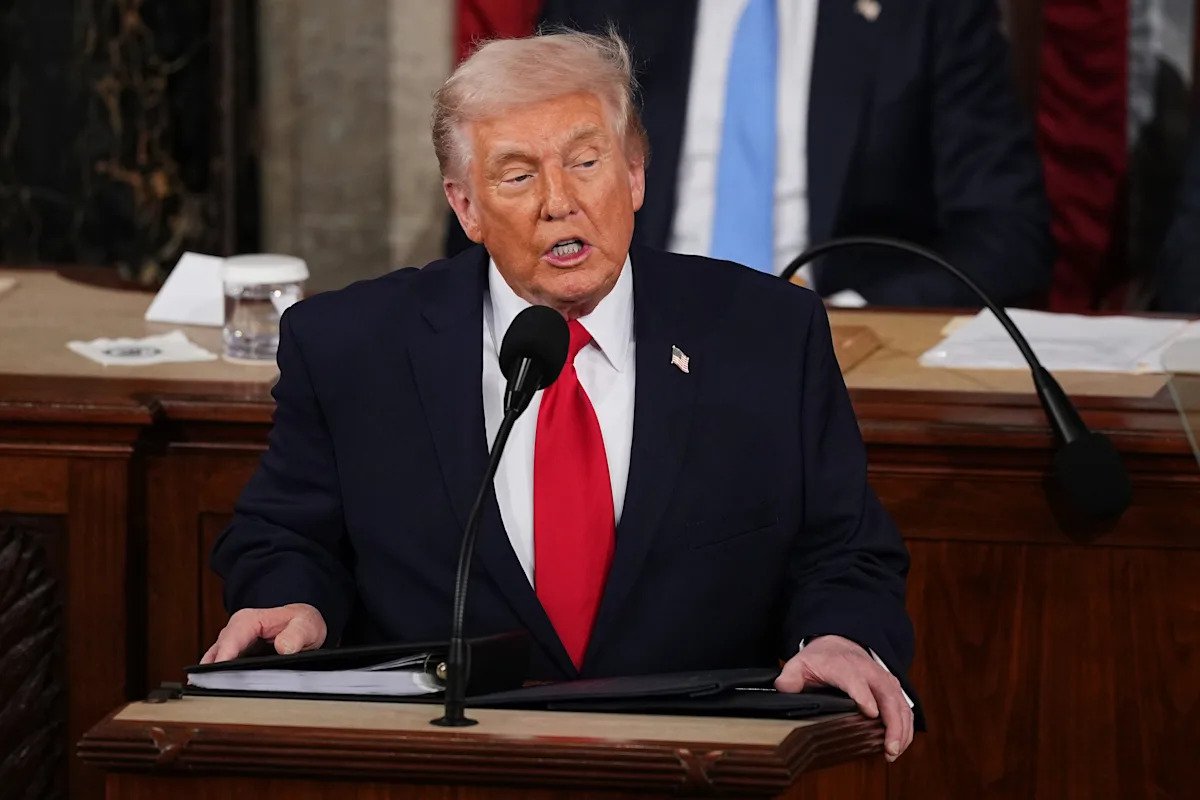
President Trump returned to Capitol Hill on Tuesday night to deliver his fourth State of the Union address — and his sixth formal speech to a joint session of Congress — since he first ascended to the Oval Office nearly a decade ago. The occasion, in other words, was familiar — as was much of what Trump said.
“Our nation is back: bigger, better, richer and stronger than ever before,” Trump declared at the start of his speech. “This is the golden age of America.”
But for a president who is always talking — who dominates the media, social or otherwise, by design — the challenge on Tuesday wasn’t to repeat the same old arguments or reach the same old audience.
Instead, with polls showing his job-approval rating at an all-time low, Trump’s imperative for this year’s State of the Union was to persuade: to soothe widespread concerns about the direction of his presidency and start wooing swing voters ahead of November’s pivotal midterm elections.
Trump has been a salesman longer than he’s been a politician. So did he make the sale? Here are five takeaways from his 2026 State of the Union address.
The state of our union is … long
Earlier this week, Trump told reporters that his State of the Union was “going to be a long speech because we have a lot to talk about.”
He wasn’t kidding.
In January 2025, Trump spoke to Congress for nearly one hour and 40 minutes. According to the American Presidency Project at the University of California, Santa Barbara, no president had ever uncorked a longer State of the Union or joint-session speech — until now.
By Yahoo’s unofficial count, Trump’s 2026 State of the Union clocked in at more than one hour and 48 minutes — roughly nine minutes longer than last year’s marathon address.
That makes it the longest such speech in modern presidential history.
The pre-Trump record holder was President Bill Clinton, whose final State of the Union in 2000 lasted one hour and 29 minutes. None of Trump’s first-term speeches to Congress were longer than one hour and 22 minutes.
As time goes on, Trump’s biggest speeches seem to be getting … bigger. At the 2016 Republican National Convention, he set the record for the longest acceptance speech for a U.S. presidential nomination (74 minutes). He proceeded to shatter that record eight years later, when his 2024 RNC speech went on for more than 92 minutes.
Most other modern presidents have averaged joint-session speeches of an hour or less — often much less.
Trump says he’s ‘won’ on affordability. Will voters buy it?

Vice President JD Vance, left, and House Speaker Mike Johnson look on as Trump delivers the State of the Union address.
(Tom Williams via Getty Images)
Trump was right about another thing: He did have a lot to talk about. And affordability came first.
A new Yahoo/YouGov poll conducted from Feb. 9 to 12 found that just 38% of Americans approve of the way Trump is handling his job as president. That number had slipped to 38% in only one previous Yahoo/YouGov poll — at the height of the COVID-19 pandemic in July 2020. It has never been lower.
Meanwhile, the president’s disapproval rating has risen to 58%. That’s also a new high.
The reason? 55% of Americans think Trump is focused on issues that aren’t very important rather than the issues that are most important to them (35%). And nothing is more important to them than the cost of living.
On Tuesday night, Trump touted what his administration views as his economic wins: lower inflation, gas prices and mortgage rates, plus a “stock market [that] has set 53 all-time record highs since the election,” as the president put it.
But former President Joe Biden did the same thing and voters weren’t convinced. In the final months of his term, inflation fell as low as 2.4% — the same as it is today. Real wages were growing then too. Unemployment was down. It didn’t matter. Americans reelected Trump in part because they felt prices were still too high.
And despite what Trump said on Tuesday, prices remain high today: Grocery prices as a whole are up about 2.1% over the past year, and interest rates remain stubbornly elevated as well.
Trump floated a few policy fixes: recent legislation that cuts taxes on tips and overtime in certain cases; tax-free “Trump accounts” for every American child; the TrumpRx web portal to find discounts on prescription drugs; an “executive order to ban large Wall Street investment firms from buying up in the thousands single family homes”; and a plan to match 401(k) contributions up to $1,000 per year.
But experts say such measures will have a relatively limited impact on everyday costs — and Trump seemed more animated when he was blaming Democrats for the problem than proposing solutions.
“They suddenly use the word ‘affordability” … [but] they caused and created the increased prices that all of our citizens had to endure,” Trump claimed. “They knew their statements were a dirty, rotten lie. Their policies created the high prices. Our policies are rapidly ending them.”
A confrontation over immigration

Trump looks toward Republican lawmakers as they applaud during his speech.
(Chip Somodevilla via Getty Images)
About an hour into his speech, Trump issued a calculated challenge to the legislators in attendance: Stand up if you agree that “the first duty of the American government is to protect American citizens, not illegal aliens.”
Senate Democrats, of course, have refused to keep funding the president’s immigration crackdown through the Department of Homeland Security unless major reforms are put in place. They have been critical of the administration’s policies, which last month led to federal agents shooting and killing two U.S. citizens in Minneapolis.
So Democrats sat motionless. Republicans, in contrast, stood en masse and cheered for more than a minute.
“These people are crazy,” Trump eventually said. “Boy oh boy, we’re lucky we have a country with people like this. Democrats are destroying our country.”
Trump went on to describe gory acts of violence perpetrated by “drug lords,” “murderers” and “rapists” who entered the country illegally, claiming that the opposition party is “blocking the removal of these people,” as Democrats shouted in response.
But according to an internal Department of Homeland Security document obtained by CBS News, less than 14% of the nearly 400,000 immigrants arrested by Immigration and Customs Enforcement in Trump’s first year back in the White House had charges or convictions for violent criminal offenses.
So while Republicans will probably promote the moment on social media and in campaign ads, a majority of the public disagrees with Trump’s position. The latest Yahoo/YouGov poll found that 58% of Americans now say the recent ICE raids in U.S. cities have gone too far — and majorities favor all of the major reforms that Democrats are proposing.
Tension over tariffs

Trump’s State of the Union address on Tuesday is the longest on record.
(Anadolu via Getty Images)
Last Friday, the U.S. Supreme Court struck down Trump’s sweeping global tariffs, dealing a major blow to his signature economic policy. In response, Trump said he was “absolutely ashamed” at the justices who ruled against him — calling them a “disgrace to our nation.”
Several of those same justices showed up to Tuesday’s State of the Union — even though, according to Trump, they were “barely invited” this year.
Would Trump confront them again? The answer, it turns out, was no. Instead, the president lamented what he described as “an unfortunate ruling” while vowing again that his tariffs would “remain in place” under “alternative legal statutes,” leading to “a solution that will be even stronger than before.”
But again, the question here is whether that’s what voters want.
Trump argued in his address that “everything was working well” before the court intervened, and that “factories, jobs, investment and trillions and trillions of dollars will continue pouring into America” because of his import taxes. He even predicted, falsely, that “tariffs, paid for by foreign countries, will, like in the past, substantially replace the modern-day system of income tax.”
According to independent estimates, Trump’s tariffs have cost U.S. households anywhere from $1,600 to $2,600 per year in the form of higher prices.
Likewise, a recent study published by the New York Fed found that nearly 90% of the economic costs associated with tariffs have fallen on U.S. businesses and their customers.
Polls regularly show that Americans oppose Trump’s tariffs by a nearly 2-to-1 margin. This week, a new ABC News/Washington Post/Ipsos poll found that 64% of Americans disapprove of Trump’s handling of tariffs, compared to 34% who approve.
Is Trump about to go to war with Iran?

Trump departs after delivering his speech on Tuesday.
(Anadolu via Getty Images)
The answer is still “we don’t know.”
In recent weeks, Trump has amassed what he’s described as an “armada” of destroyers, aircraft carriers, warships, submarines and attack planes within striking distance of Iran — a buildup that has “progressed to the point [where he] has the option to take military action” at any point, the New York Times reported last week.
Ahead of last-ditch talks scheduled for Thursday, multiple outlets have also reported that Trump is considering a limited strike on the Middle Eastern country — followed by a broader campaign later this year.
But Trump has largely declined to explain why — and what he hopes to accomplish.
On Tuesday night, the president made two big claims: that Iran is “working to build missiles that will soon be able to reach the United States of America” and that it has started pursuing a nuclear weapon “all over again” after coordinated U.S. and Israeli attacks last June severely damaged three of Iran’s nuclear facilities.
The 2015 nuclear deal negotiated by the Obama administration “dismantled much of [Iran’s] nuclear program and opened its facilities to more extensive international inspections in exchange for billions of dollars’ worth of sanctions relief,” according to the Council on Foreign Relations. But Trump withdrew from that deal during his first term, at which point Iran “resumed its nuclear activities.”
“My preference is to solve this problem through diplomacy, but one thing is certain,” Trump continued. “I will never allow the world’s No. 1 sponsor of terror — which they are, by far — to have a nuclear weapon.”
The president then claimed that “we haven’t heard those secret words: We will never have a nuclear weapon” from Iranian leaders. But while Iranian leaders have often said publicly they aren’t pursuing a nuclear weapon, the hard part is making sure their actions say the same.