
Breaking News
Republicans’ sweeping elections overhaul would impose strict new voting rules, potentially disenfranchising millions of voters

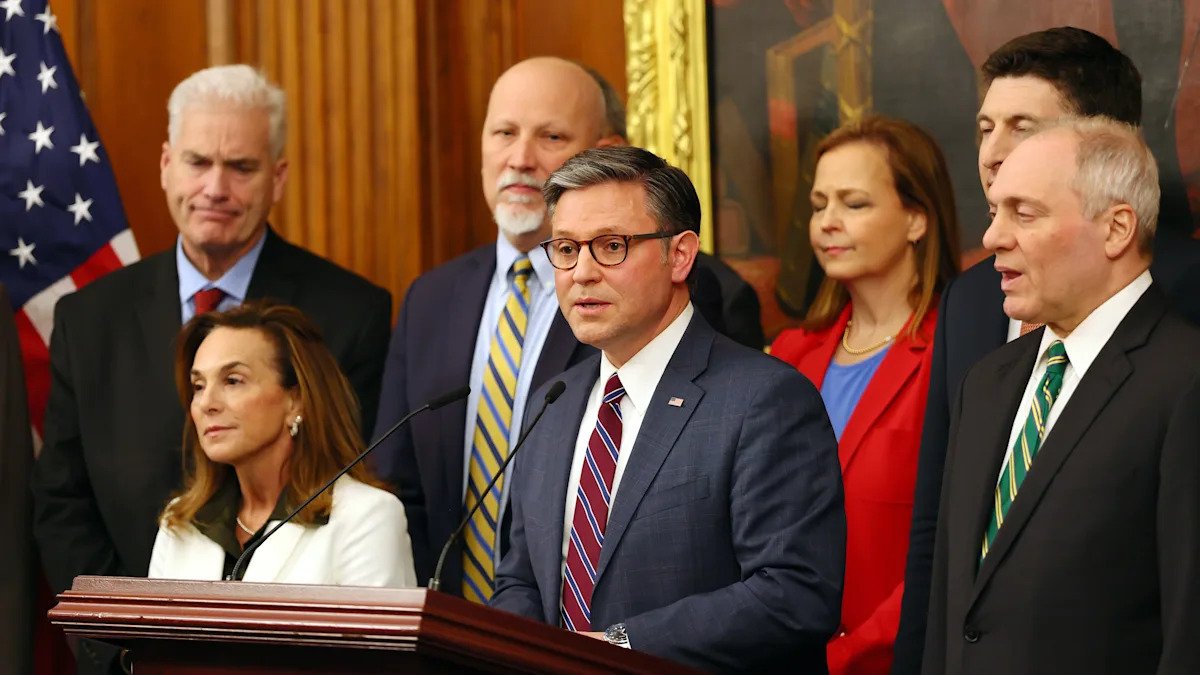
The SAVE Act, a bill that would dramatically overhaul elections nationwide and potentially disenfranchise millions of voters, was approved by the House of Representatives on Wednesday. The legislation, which President Trump has been urging Congress to pass for years, edged through the House in a near party-line vote, with all Republicans voting in favor and all but one Democrat voting against.
The legislation now moves to the Senate, where it faces a difficult path to becoming law. Democrats have vowed to block it from moving forward and Republican leaders in the chamber have so far balked at calls to change the rules to get around a Democratic filibuster.
What would the SAVE Act do?
Right now, rules around voter registration, the types of ID people need to show when they go to the polls and things like mail-in voting vary dramatically from state to state. The SAVE Act, which is officially named the SAVE America Act, comes well short of Trump’s ambition to “nationalize” American elections, but it would impose strict new rules for the whole country. These are some of its most important provisions:
Proof of citizenship for voter registration: The SAVE Act would require anyone registering to vote anywhere in the U.S. to show “documentary proof of United States citizenship.” Under the provisions in the bill, things like a driver’s license, Real ID or Social Security number would not be enough. Prospective voters would need to provide a valid U.S. passport, military ID, tribal ID or a birth certificate.
These requirements would apply to new voters and to anyone who was reregistering, either because they moved to a new state or changed their name. It would create additional hurdles for women who take their partner’s name after getting married, who would need to provide extra documentation to explain why their current name doesn’t match what’s listed on their birth certificate or passport.
Only U.S. citizens are eligible to vote in most U.S. elections. States already require voters to certify, under the threat of legal penalties, that they are citizens when they register. States also audit their voter rolls regularly to purge the names of anyone who shouldn’t be listed. Though Trump and many Republicans have claimed that non-citizen voting is rampant in American elections, researchers have found a “shockingly small number” of actual documented incidents — far too few to impact the outcome of even small local elections.
Only eight states currently require documentary proof of citizenship for voter registration. Expanding these standards nationwide would prevent 21 million eligible voters from being able to vote, according to an estimate by the Brennan Center for Justice. Only half of all Americans have a passport. Millions more either don’t have or can’t readily access their birth certificates.
Nationwide voter ID: The SAVE Act would require all voters to present a valid photo ID when they cast their ballots. Though a majority of states have some sort of voter ID law in place already, most of those laws are far less stringent than the standard the SAVE Act would create. For example, a number of states accept non-photo IDs or have procedures that allow voters without ID to still cast their ballots. Only 10 states currently have the kind of strict voter ID laws in place that the SAVE Act would impose on the whole country.
Though a strong majority of Americans support voter ID laws, many experts say the rules do little to prevent fraud and instead disenfranchise otherwise eligible voters. Like non-citizen voting, cases of voter impersonation are exceedingly rare. There have been just 34 documented cases of someone falsifying their identity at the polls out of the billions of individual votes cast in the U.S. over the past 40+ years, according to a database compiled by the conservative think tank Heritage Foundation.
Research on how many people voter ID laws prevent from voting is mixed, but most studies have found that it does have at least some impact on turnout. Elderly voters and people of color are disproportionately likely to lack the kind of photo ID they’d need to cast their ballots under the standards the SAVE Act would create.
New limits on mail-in voting: The SAVE Act wouldn’t override state mail-in voting rules — or fulfill Trump’s wish to ban the practice altogether. But it would make voting by mail harder. That’s because the new proof of citizenship rules would also apply to voters who register to vote by mail. Anyone registering for an absentee ballot, with some limited exceptions, would still have to go in person to a local elections office to present their passport or birth certificate for their registration to be valid.
Other provisions: The SAVE Act would also impose strict new requirements for how often and how thoroughly states would be required to audit their voter rolls for noncitizens, create criminal penalties for elections officials who allow someone who fails to show proof of citizenship to register, and give regular citizens the power to sue elections officials who they believe violated the provisions of the law.
Will the SAVE Act become law?
At the moment, the prospects of the SAVE Act making it through the Senate seem dim. Republicans would need at least seven Democrats to vote in favor of the bill to overcome the filibuster, but the party is uniformly in opposition to the legislation — which their leader in the Senate, Chuck Schumer, has called “Jim Crow 2.0.”
Some hard-line Republicans in the House tried to create pressure to pass the SAVE Act by attempting to have it added to the crucial funding bill that ended the brief partial government shutdown earlier this month, but that effort came up short. They have also been calling on the top Republican in the Senate, John Thune, to amend filibuster rules to allow the SAVE Act to pass with a simple majority. Thune would need the backing of almost every GOP senator to do that, which he is unlikely to get.
“There aren’t anywhere close to the votes — not even close — to nuking the filibuster,” he said on Tuesday.
There’s no guarantee that the SAVE Act would pass even in a majority vote. Alaska Republican Sen. Lisa Murkowski said on Tuesday that she opposes the bill, which she described as “federal overreach” into states’ power to run their own elections. Some other GOP senators, including Susan Collins of Maine and Mitch McConnell of Kentucky, have also expressed their misgivings about the legislation.