
Breaking News
House passes final government funding bills in milestone, overcoming Democratic DHS opposition

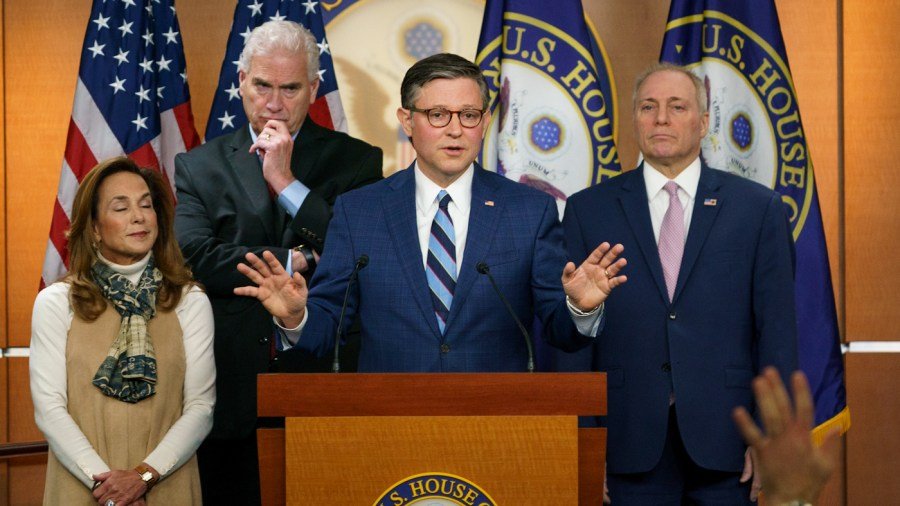
The House on Thursday approved its final slate of 2026 funding bills, overcoming Democratic demands and GOP divisions and marking a significant milestone for Speaker Mike Johnson (R-La.) as he’s sought to rebuild Congress’s “muscle memory” on government funding.
A three-bill minibus appropriations package passed the House by a vote of 341-88. The package funds the departments of Defense, Transportation, Housing and Urban Development, Health and Human Services, Labor, Education and other related agencies.
The most contentious measure, the Department of Homeland Security (DHS) funding bill, passed the House by a separate vote of 220-207. Democratic leaders opposed the bill as tensions flared in the wake of an Immigration and Customs Enforcement (ICE) officer fatally shooting Minneapolis woman Renee Good.
The House will combine the four bills with a two-bill minibus it passed last week and send the full package to the Senate. The upper chamber is expected to take up the bills when it returns from recess next week ahead of a Jan. 30 deadline.
It will mark the first time that new full-year funding levels have been approved for the entire federal government since former President Biden signed an omnibus appropriations bill in March 2024. With Republicans facing limited time to negotiate and design new funding levels after the 2024 election, Congress opted to operate under a full-year continuing resolution (CR) that extended those Biden-era funding levels for the following fiscal year.
Some hard-line conservatives had pitched extending the CR for another year rather than negotiating with Democrats on new funding levels. But Johnson and congressional appropriators succeeded in pushing for new full-year funding bills.
Johnson in a press conference this week called completing the funding “the most significant sign of progress in these halls in years.”
“We’re returning the appropriations process to a committee-led, member-driven approach, as it should be,” Johnson said, touting the lack of an overarching, leadership-negotiated omnibus bill.
While funding the government is a core constitutional responsibility for Congress, the chamber has long struggled to complete that work in a timely manner.
Even House Minority Leader Hakeem Jeffries (D-N.Y.) said that “significant progress has been achieved” in the appropriations process to “fund the government in a way that’s consistent with our values.”
Bringing all 12 appropriations bills across the finish line, though, was no easy feat for lawmakers.
The fiscal year began with the longest government shutdown in history.
The House passed three bills, along with a short-term stopgap measure, in November that brought a 43-day shutdown to an end.
But the holiday season, a contentious health care debate and other issues cut lawmakers’ time short in December. Not wanting to bring another stopgap measure to the floor and prolong the appropriations process during an election year, appropriators in both chambers worked overtime this month to get the remaining nine bills drafted and voted on.
House Appropriations Committee Chair Tom Cole (R-Okla.) acknowledged on the House floor before the vote that “months of hard work” have turned into results.
“We aren’t here for just another stopgap temporary fix. We’re here to finish the job by providing full-year funding,” Cole said.
The DHS bill proved to be the most contentious, as liberals argued it didn’t go far enough in reining in ICE. They had demanded that tougher oversight and conduct standards for ICE officers should be included in the legislation.
The bill had included a few targeted reforms to appease Democrats, including a $115 million reduction in funding for ICE Enforcement and Removal Operations, a decrease of 5,500 ICE detention beds and a $1.8 billion cut in Border Patrol funding. It also strengthens oversight of ICE through the Office of the Inspector General and Office for Civil Rights and Civil Liberties.
House Appropriations Committee ranking member Rosa DeLauro (D-Conn.), who voted no on the bill, said on the House floor that she’s glad those reforms are in the bill, but added that “it’s clear that more must be done.”
“ICE believes it can act with impunity and is behaving accordingly,” DeLauro said.
Only seven Democrats ultimately voted with Republicans to support the bill, which would allow billions of dollars to continue flowing to the agency.
But despite that partisan division, lawmakers were unanimous in making a last-minute addition to jam the Senate, adding an amendment to repeal a law that allowed senators to sue the government for $500,000 if they weren’t notified when law enforcement sought their phone records. Republican senators, who were responding to the revelation that members’ phone records were subpoenaed by former special counsel Jack Smith in his 2020 election probe, had previously blindsided and angered the House by including that provision in a bill to end the historic government shutdown.
There was some discontent from hard-line conservatives, though, about “community funding project” earmarks that they saw as wasteful. They also balked at funding bills continuing government programs they saw as wasteful.
Copyright 2026 Nexstar Media, Inc. All rights reserved. This material may not be published, broadcast, rewritten, or redistributed.
For the latest news, weather, sports, and streaming video, head to The Hill.