
Breaking News
NASA will send your name around the moon for free

You don’t need to be an astronaut or spend a dime to take part in NASA’s next historic journey around the Moon. As anticipation grows for the 2026 Artemis II mission, the space agency is quietly compiling a digital manifest that will fly alongside the crew, carrying names from across the globe. Curious to see yours included? Read on to learn how to claim a free digital boarding pass, reserve a place on the mission roster, and become part of a once-in-a-generation spaceflight already capturing worldwide attention.
How to get your name aboard the Artemis II moon flight
People from anywhere in the world can now submit their names online to join NASA’s Artemis II mission, set to launch no later than April 2026. Each submitted name will be stored on a small SD card aboard the Orion spacecraft as it completes its roughly 10-day journey around the moon and back to Earth.
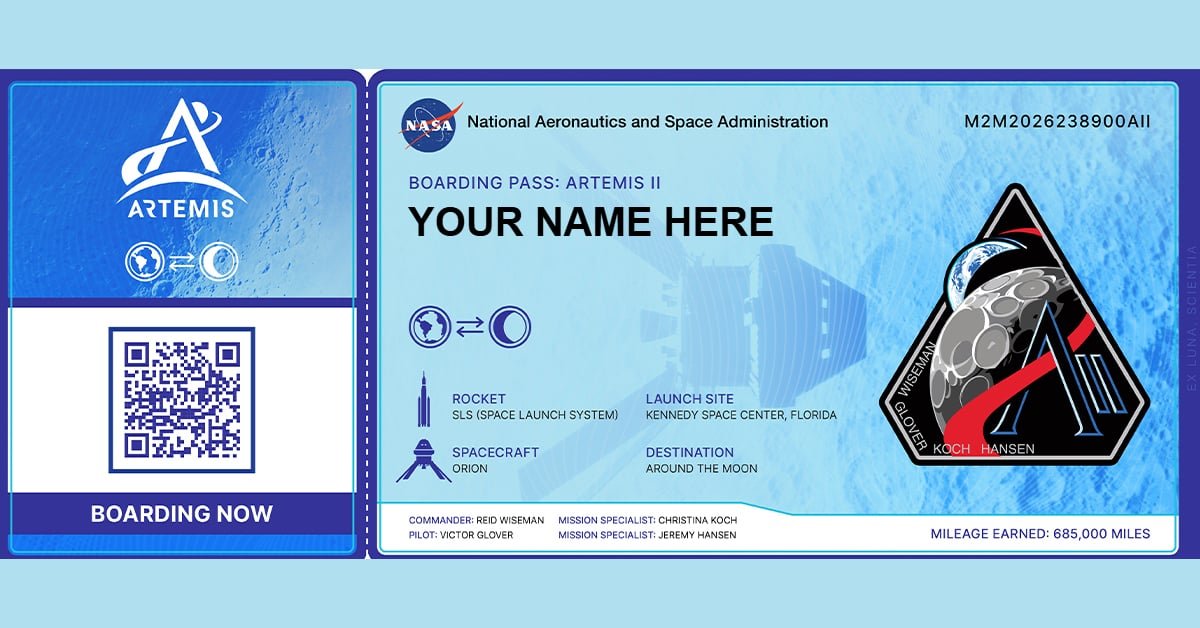
Signing up is simple: participants provide their first and last names here and create a short personal pin code. Once submitted, NASA generates a digital Artemis II “boarding pass”, a printable keepsake that makes it feel like you’re officially part of the mission.
The boarding pass features the mission patch, launch site, spacecraft details, and destination. It highlights the Space Launch System rocket, the Orion spacecraft, and Kennedy Space Center as the launch site. It also lists the four astronauts flying the mission and even calculates the total distance participants’ names will travel — more than 685,000 miles as Orion loops around the moon and returns to Earth.
NASA advises everyone to keep their pin code safe, as it’s required to view or re-download the boarding pass later and cannot be recovered if lost.
The public’s response has already been astronomical, with over 1.8 million digital boarding passes claimed as of Monday, January 19.
Meet the Artemis II crew and their record-breaking flight
NASA’s Artemis II will be the first mission to carry humans aboard the Space Launch System (SLS) rocket and Orion spacecraft, setting the stage for a new era of lunar exploration. Strapped into the cockpit for this historic maiden voyage are four pioneers: Commander Reid Wiseman, Pilot Victor Glover, and Mission Specialists Christina Koch and Jeremy Hansen.
Following liftoff, the crew will spend the first few days orbiting Earth while testing Orion’s systems. Then, the spacecraft’s service module will fire for a translunar injection burn, sending the astronauts on a four-day journey to the moon.
The mission’s trajectory will swing the crew in a figure-eight path around the far side of the moon, carrying them over 230,000 miles from Earth, including roughly 4,600 miles past the moon, farther than any human has ever traveled.
The ultimate stress test
While the crew won’t be kicking up lunar dust just yet, Artemis II is far from a simple flyby. Astronauts will manually operate Orion, check life-support systems, and test hardware critical for future moon landings. Onboard experiments will also collect valuable data on space radiation, human physiology, and deep-space communications.
The mission will conclude with a literal “trial by fire” as Orion hits Earth’s atmosphere at blistering speeds, aiming for a precision splashdown in the Pacific Ocean near San Diego for a full military-assisted recovery.
Source: KTLA.com
Read the original article on GEEKSPIN.
Affiliate links on GEEKSPIN may earn us and our partners a commission.